It’s no coincidence that the Honda CR-V is made in several countries around the world.
Where are Honda CR-Vs made?
You might assume it’s simply about meeting demand, but there’s more to the story involving supply chains, local regulations, and production efficiency.
When you consider how different plants contribute—from engine assembly in Alabama to precision work in Japan—you’ll see why Honda’s global approach matters.
Understanding this will change how you view the CR-V’s availability and pricing.
Key Takeaways
- Honda CR-Vs are manufactured in the United States, Japan, Canada, China, and Thailand.
- Major U.S. plants include Ohio for assembly, Alabama for engines, and Indiana for parts fabrication.
- Asian production occurs mainly in Thailand, Malaysia, and China to meet regional demand and cost efficiency.
- Japanese factories focus on precision manufacturing and advanced automation for high-quality standards.
- Regional manufacturing supports local market needs, reduces shipping costs, and enhances supply chain resilience.
Honda CR-V Manufacturing Locations Worldwide
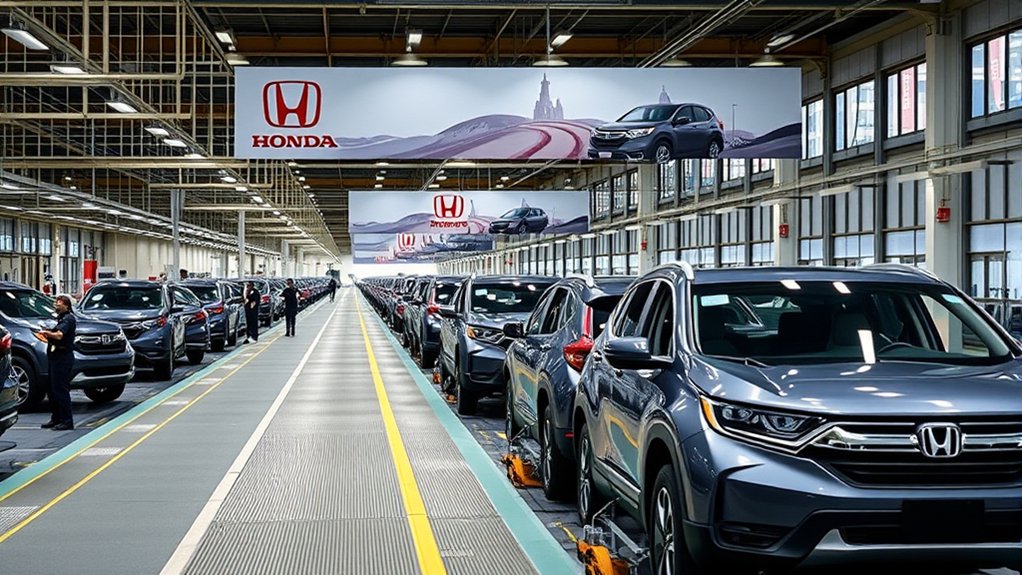
Where does Honda produce the CR-V you see on the road? Honda manufactures the CR-V in several key locations worldwide, including plants in the United States, Japan, Canada, China, and Thailand.
Honda produces the CR-V in key plants across the US, Japan, Canada, China, and Thailand.
Each site plays a critical role in Honda’s production logistics, ensuring efficient assembly and timely delivery. These facilities rely on extensive supplier networks that provide components tailored to regional market demands.
By positioning manufacturing close to major markets, Honda minimizes shipping costs and lead times. You’ll find that these strategically placed plants enable Honda to maintain consistent quality standards while adapting to local regulations and preferences.
Understanding the global footprint of CR-V production helps you appreciate the complexity behind this popular SUV’s worldwide availability.
Why Honda Builds CR-Vs in Multiple Factories
Producing the CR-V across multiple factories allows Honda to respond effectively to regional market demands and logistical challenges. By diversifying production locations, Honda enhances supply chain resilience, minimizing disruptions caused by natural disasters, political issues, or transportation delays.
This approach also supports flexible pricing strategies tailored to local economic conditions, tariffs, and consumer preferences. When you buy a CR-V manufactured closer to your region, Honda can reduce shipping costs and import taxes, which helps keep prices competitive.
Additionally, multiple factories enable Honda to scale production up or down quickly based on demand fluctuations in different markets. Overall, building CR-Vs in various factories worldwide strengthens Honda’s ability to maintain steady supply, optimize costs, and meet customer expectations efficiently.
How Honda CR-V Production Differs by Region
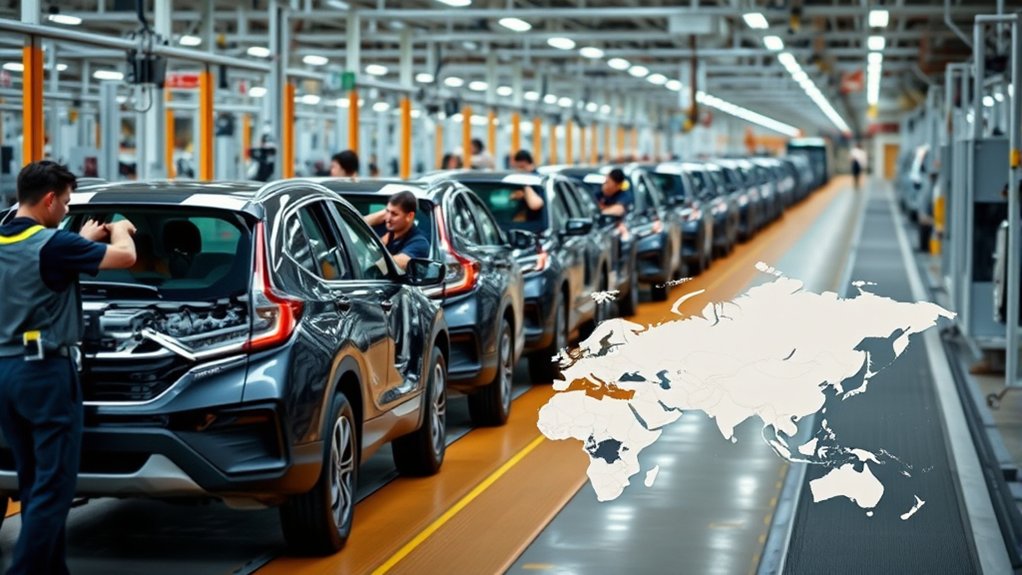
How does Honda tailor CR-V production to different regions? Honda adjusts its manufacturing processes to align with regional labor skills, local regulations, and consumer preferences.
Honda customizes CR-V production to match regional labor skills, regulations, and consumer preferences.
You’ll find that regional labor expertise influences assembly techniques, ensuring quality while optimizing efficiency. Supplier networks also vary by location, affecting component sourcing and logistics.
In Asia, for example, Honda relies on dense, well-established supplier networks to streamline parts delivery, while in North America, it partners with local suppliers to support the regional economy and reduce lead times.
These regional differences mean that while the core design of the CR-V remains consistent, manufacturing adapts to local strengths. This approach not only enhances production efficiency but also allows Honda to meet diverse market demands effectively.
How U.S. Plants Help Build the Honda CR-V
Why do U.S. plants play a crucial role in building the Honda CR-V? US plants streamline production to meet regional demand efficiently. They help reduce shipping costs and adapt models to fit regional pricing strategies, ensuring competitive pricing.
Here’s how U.S. plants contribute:
| Plant Location | Role in Production | Impact on Regional Pricing |
|---|---|---|
| Ohio | Final assembly | Lowers logistics expenses |
| Alabama | Engine manufacturing | Supports local supply chain |
| Indiana | Parts fabrication | Enables quick market response |
Honda CR-V Production in Japan and Asia
You’ll find that Honda produces the CR-V at several key facilities in Japan, where attention to detail is a priority.
In addition, various Asian plants handle regional assembly to meet local market demands efficiently. Understanding these differences helps explain how Honda maintains quality while adapting to diverse customer needs.
Japanese Manufacturing Facilities
Where does Honda manufacture its CR-V models in Asia? Primarily, Honda produces CR-Vs in its Japanese manufacturing facilities, known for advanced engineering and stringent quality control. These plants focus on integrating fuel efficiency technologies to meet both domestic and international demands.
By doing so, Honda supports its global marketing strategy that emphasizes reliability and eco-friendliness. The Japanese facilities employ cutting-edge production methods to optimize performance while reducing emissions, aligning with evolving environmental standards.
If you’re considering a CR-V made in Japan, you benefit from precise craftsmanship and innovations that enhance fuel economy. This approach not only satisfies consumer expectations but also reinforces Honda’s position in competitive markets where efficiency and sustainability are key selling points.
Asian Production Plants
How does Honda manage the production of its CR-V models across Asia? Honda operates several production plants in countries like Thailand, Malaysia, and China, balancing production ethics and labor costs effectively. These plants adhere to strict ethical standards, ensuring worker safety and fair labor practices while maintaining efficient output.
By situating production in Asia, Honda leverages lower labor costs compared to Japan, which helps keep the CR-V competitively priced without compromising quality. Each facility follows Honda’s global manufacturing protocols to maintain consistency.
You’ll find that these Asian plants play a crucial role in meeting regional demand and supporting export markets. Overall, Honda’s approach combines ethical responsibility with cost efficiency, allowing you to trust the quality of CR-Vs produced throughout Asia.
Regional Assembly Differences
What distinguishes the assembly of Honda CR-Vs in Japan from those produced in Asia? The key differences lie in regional labor practices and export logistics.
In Japan, assembly focuses heavily on precision and advanced automation, supported by a highly skilled workforce trained for stringent quality standards. This results from Japan’s strong emphasis on craftsmanship and efficiency. Conversely, Asian plants, including those in Thailand and China, utilize a combination of manual labor and mechanization, balancing cost-efficiency with quality control.
Export logistics also vary; Japanese plants primarily serve domestic and nearby markets with streamlined shipping routes, while Asian factories manage broader export networks to North America and Europe, leveraging proximity and trade agreements. Understanding these distinctions helps you appreciate how Honda adapts production to regional strengths and market demands.
How Global Production Impacts CR-V Availability and Pricing
Why does the location of CR-V manufacturing plants matter to you? It directly influences the vehicle’s availability and pricing in your market. Honda’s globally synchronized production ensures that CR-Vs are assembled close to regional demand centers, reducing shipping delays and costs.
This approach allows for timely delivery and better inventory management, so you can find the model you want without extended wait times. Additionally, regional pricing strategies reflect local production expenses, tariffs, and currency fluctuations.
When a CR-V is made nearby, you often benefit from lower prices compared to imported models. Understanding this global production network helps you grasp why CR-V prices vary by region and how availability aligns with local manufacturing capacity, ultimately affecting your purchasing decisions.
Frequently Asked Questions
What Are the Common Engine Options for the Honda CR-V?
You’ll find common Honda CR-V engine options include the 1.5L turbocharged L15B7 and the 2.4L K24W4. These engines, identified by their engine codes, vary by production location globally for efficiency and emissions standards.
How Fuel-Efficient Is the Honda CR-V Compared to Competitors?
You won’t mistake the Honda CR-V for a gas guzzler; its fuel efficiency actually rivals top competitors.
Thanks to advanced battery tech in hybrids, you’ll enjoy impressive mileage without sacrificing performance or style.
What Safety Features Come Standard in the Latest Honda CR-V?
You’ll get advanced safety features like Honda Sensing®, which includes collision mitigation braking, adaptive cruise control, and lane-keeping assist.
The CR-V’s strong crash testing history supports its smart key capabilities for convenience and security.
How Often Does the Honda CR-V Require Maintenance?
You’ll need to maintain your Honda CR-V every 7,500 miles or six months, keeping subtopic relevance clear by focusing strictly on maintenance schedules without drifting into unrelated topics like manufacturing origins or unrelated vehicle features.
What Is the Warranty Coverage for a New Honda CR-V?
You get a 3-year/36,000-mile basic warranty and a 5-year/60,000-mile powertrain warranty on a new Honda CR-V.
Warranty coverage specifics align with recommended maintenance intervals to keep your coverage valid and your vehicle reliable.
Conclusion
You see, Honda builds CR-Vs across the globe to ensure precision, speed, and affordability. You benefit from U.S. plants that boost local supply and pricing, from Japan’s focus on automation and quality, and from Asia’s role in regional demand and exports.
This global approach provides resilience in supply chains, alignment with regulations, and quicker deliveries. By spreading production, Honda balances efficiency, meets diverse markets, and keeps the CR-V available wherever you are.
Ultimately, this strategic manufacturing footprint highlights where Honda CR-Vs are made, ensuring the vehicle meets high standards worldwide.