You might not realize that the Honda Civic is manufactured in multiple locations around the world. This global production strategy allows Honda to serve diverse markets efficiently.
From North America to Asia and Europe, each plant focuses on different models and technologies tailored to regional demands. This distributed approach helps optimize logistics and maintain high production quality.
Understanding where and why these manufacturing decisions are made reveals a lot about Honda’s overall strategy. It highlights the company’s commitment to innovation and customer satisfaction worldwide.
Key Takeaways
- Honda Civic is manufactured globally in multiple locations to reduce shipping costs and improve delivery times.
- North American production centers include facilities in Ohio and Canada, focusing on high-quality assembly and local demand.
- Asian manufacturing hubs in Japan and Thailand emphasize advanced engine technology and a broader model range.
- European plants in the UK and Turkey produce fuel-efficient, compact models with regionally sourced components.
- Production varies by region, with future trends toward automation, smart factories, and sustainable manufacturing practices.
Global Locations of Honda Civic Manufacturing
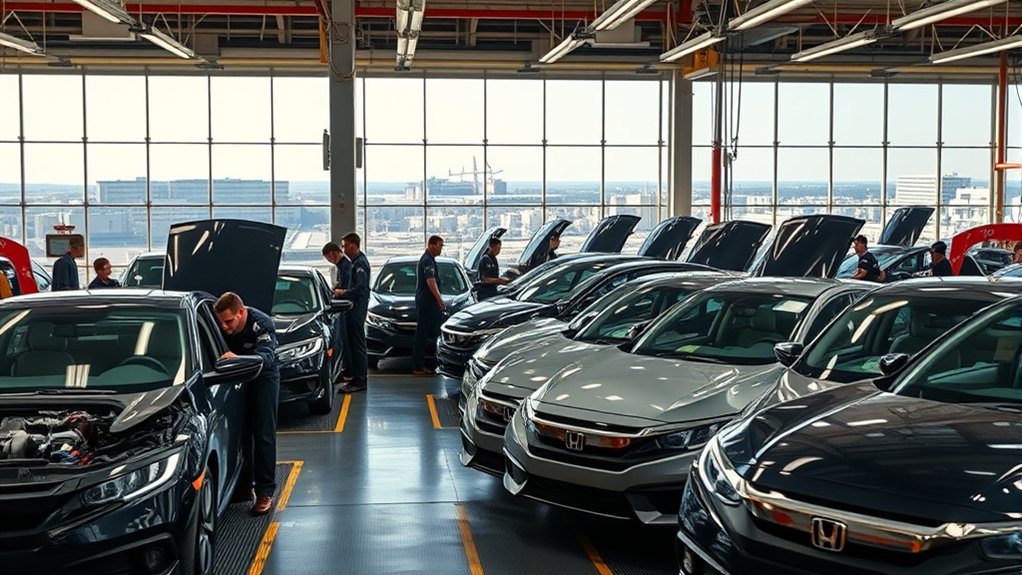
Where does Honda manufacture the Civic you see on the road? The answer lies in its strategic approach to global supply and regional diversification. Honda produces the Civic in multiple locations worldwide to meet demand efficiently while minimizing logistical challenges.
This regional diversification ensures that vehicles are closer to their target markets, reducing shipping costs and delivery times. By distributing manufacturing across various countries, Honda balances production loads and adapts to local market needs and regulations.
This global supply network also enhances resilience, allowing Honda to respond swiftly to disruptions in any single region. Understanding this framework helps you appreciate how Honda maintains consistent quality and availability for the Civic, no matter where you are driving it.
Honda Civic Production Facilities in North America, Asia, and Europe
Honda’s strategy of regional manufacturing extends to key production hubs across North America, Asia, and Europe, each tailored to serve its respective market efficiently. In North America, facilities in Ohio and Canada focus on optimizing labor costs while ensuring high-quality assembly.
Asia’s production centers, particularly in Japan and Thailand, emphasize advanced engine sourcing and incorporate cutting-edge technology to meet regional demands. Meanwhile, Europe’s plants, primarily in the UK and Turkey, balance competitive labor costs with proximity to major markets.
This geographic distribution allows Honda to streamline supply chains and adapt to local regulations. By aligning engine sourcing and labor costs with regional strengths, Honda maintains cost-effectiveness and responsiveness in its global Civic production network, ensuring consistent quality across all facilities.
How Civic Production Varies by Region and Model
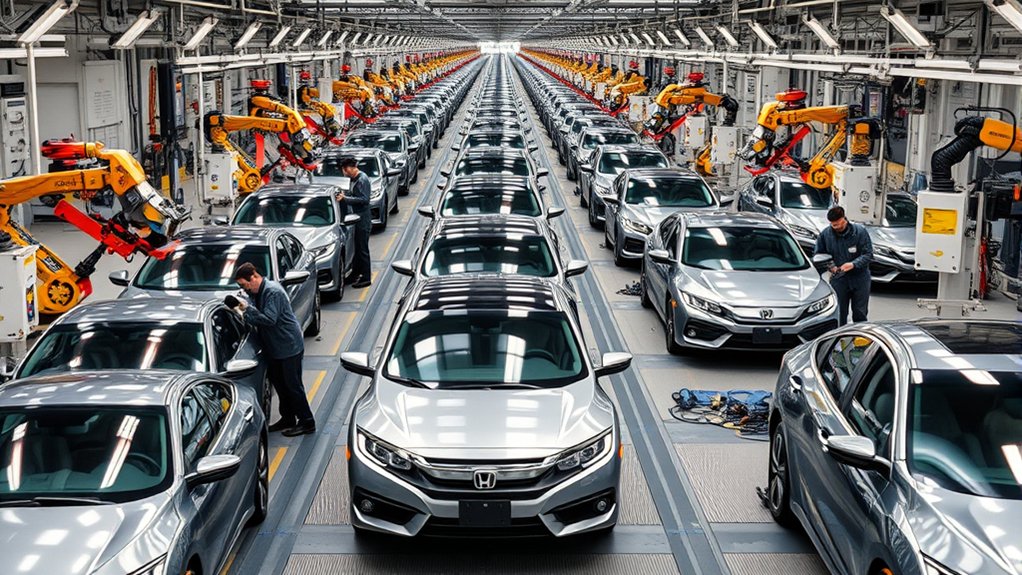
How does Civic production differ across regions and models? You’ll find that Honda tailors manufacturing processes based on regional demand and model specifications.
For instance, in North America, production focuses heavily on the sedan and hatchback variants, utilizing regional sourcing for components to meet local preferences and regulations. Meanwhile, Asian facilities often produce a broader range, including performance-oriented models, leveraging global supply chains for specialized parts.
European plants emphasize models designed for fuel efficiency and compact size, integrating regional sourcing to optimize logistics. This variation ensures that each Civic model aligns with market needs while maintaining consistent quality.
Why Honda Civic Production Uses Multiple Locations
Why does producing the Honda Civic across multiple locations make a significant difference? By spreading production regionally, Honda reduces transportation costs and delivery times, allowing you to receive vehicles tailored to local market demands more efficiently.
This approach also helps the company manage risks like supply chain disruptions and geopolitical uncertainties, ensuring consistent availability. Regional production enables Honda to adapt quickly to regulatory requirements in different areas, enhancing compliance and customer satisfaction.
While future trends will continue to shape manufacturing strategies, this multi-location setup offers flexibility and resilience today. You’ll find that this strategic distribution is key to meeting diverse consumer needs worldwide, optimizing resources, and maintaining competitive advantage in a rapidly evolving automotive industry.
Future Trends in Honda Civic Manufacturing
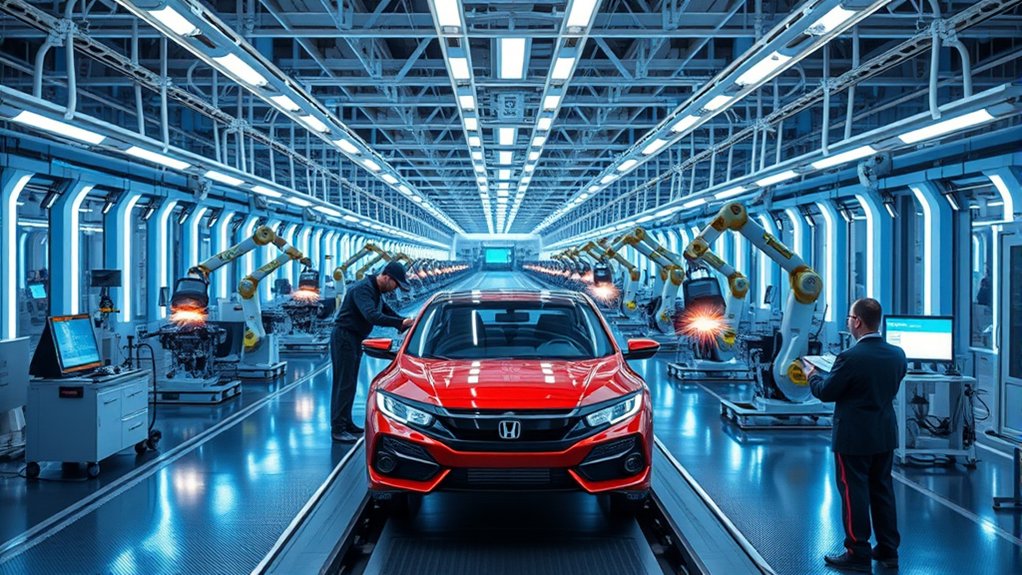
Building on the benefits of regional production, future trends in Honda Civic manufacturing will increasingly focus on integrating advanced technologies and sustainable practices. You’ll notice a stronger emphasis on automation and robotics, which enhance manufacturing efficiency by reducing errors and accelerating assembly lines.
Honda is also investing in smart factory systems that use data analytics and AI to optimize production schedules and minimize downtime. Additionally, you’ll see a shift toward environmentally friendly materials and energy-efficient processes, aligning with global sustainability goals.
These developments not only improve product quality but also reduce the environmental impact of manufacturing. As a result, the Honda Civic’s production will become more adaptable and responsive to market demands, ensuring that you receive a vehicle built with cutting-edge technology and responsible manufacturing practices.
Frequently Asked Questions
What Is the Fuel Efficiency of the Honda Civic?
You’ll find the Honda Civic delivers impressive fuel efficiency, typically around 30-36 MPG. This is thanks to its efficient design aesthetics and engineering influenced by its locational context, optimizing performance and economy for various driving environments.
How Often Should I Service My Honda Civic?
You should service your Honda Civic every 7,500 to 10,000 miles, but don’t buy into maintenance myths. Regular check-ups help avoid issues.
Use discussion ideas from your mechanic to tailor the schedule for your driving habits.
What Safety Features Are Standard in the Honda Civic?
Think of the Honda Civic’s safety features as a fortress; you get advanced airbags, Collision Mitigation Braking, and lane-keeping assist.
Its strong safety ratings reflect meticulous production plants and a transparent vehicle history, often highlighted during factory tours.
Are There Hybrid or Electric Versions of the Honda Civic?
Yes, you’ll find electric and hybrid variants of the Honda Civic, reflecting Honda Civic manufacturing’s shift toward sustainability. These models offer improved fuel efficiency and reduced emissions, aligning with modern eco-friendly automotive trends and consumer demand.
What Is the Warranty Coverage for a New Honda Civic?
Don’t worry about manufacturing locations affecting coverage; your new Honda Civic comes with a 3-year/36,000-mile limited warranty and a 5-year/60,000-mile powertrain warranty, ensuring extensive protection and peace of mind.
Conclusion
You’ll find Honda Civics crafted like a global symphony—each plant playing its part with precision. From Ohio’s efficient assembly lines to Japan’s tech-driven engines, every region adds a unique note to the vehicle’s harmony.
This worldwide network not only balances demand and quality but also drives innovation forward. As automation and smart factories take center stage, you’re witnessing a future where sustainability and technology steer the Civic’s evolution across the globe.
The diverse manufacturing locations highlight the global nature of where Honda Civic is manufactured, ensuring each vehicle meets high standards no matter where it’s built.