You might not realize that Honda Motor Company, invented by the self-taught engineer Soichiro Honda, was born from his ingenuity and vision.
He began his journey long before the brand became a global icon.
His ability to transform limited resources into innovative engines set new standards in automotive engineering.
Understanding how his early challenges shaped his approach reveals why Honda’s impact extends far beyond motorcycles.
His influence continues to shape the entire industry in ways you might not expect.
Key Takeaways
- Soichiro Honda founded Honda Motor Company in 1946, transforming from a mechanic to an automotive innovator.
- His early passion for mechanics and precision metalworking shaped Honda’s engineering excellence.
- Honda’s vision extended beyond motorcycles to global automobile production with a focus on quality and innovation.
- Despite financial hardships, Honda’s perseverance and strategic foresight enabled global market entry and growth.
- Soichiro Honda’s engineering philosophy emphasized continuous improvement, quality control, and creative problem-solving.
Soichiro Honda: His Life and Importance
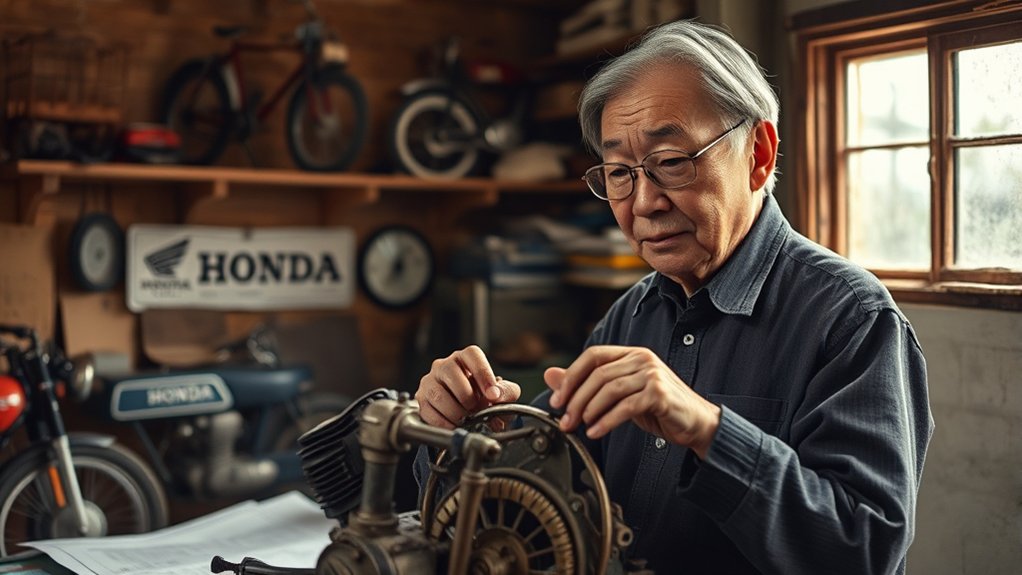
How did Soichiro Honda transform a simple idea into a global automotive powerhouse? You’ll find that his deep understanding of engine physics was crucial. Honda didn’t just tinker with engines; he rigorously applied scientific principles to optimize efficiency and performance.
You’ll appreciate that his commitment to manufacturing ethics set Honda apart. He insisted on quality control and worker welfare, ensuring products were reliable and ethically produced. This dual focus on technical precision and ethical manufacturing cultivated trust and innovation.
Soichiro Honda’s Automotive Beginnings
You’ll see that Soichiro Honda’s passion for mechanics started early, shaping his innovative approach to engineering. His hands-on experience with engines led him to establish the Honda Motor Company in 1946, marking a pivotal moment in automotive history.
Understanding these beginnings reveals how his technical skills and entrepreneurial drive fueled Honda’s rise.
Early Mechanical Interests
Where did Soichiro Honda’s passion for mechanics first take shape? It began in his youth, where his fascination with early design and metalworking fundamentals laid a solid foundation. You’d see him immersed in hands-on tinkering, absorbing essential skills that would define his future.
- Soichiro mastered metalworking fundamentals early, shaping parts with precision and care, fueling his confidence.
- His keen eye for early design allowed him to envision improvements, not just replicate existing machinery.
- Persistent experimentation during his formative years sharpened his problem-solving skills, setting him apart.
Founding Honda Motor Company
The founding of Honda Motor Company marked a pivotal moment in Soichiro Honda’s journey from mechanic to automotive innovator. In 1946, amid post-war scarcity, Honda seized an opportunity to produce motorized bicycles, combining his engineering skill with keen business sense.
You’d recognize his workshop as the “rainbow factory,” a humble space where innovation thrived despite limited resources. Honda’s vision aimed beyond Japan; he anticipated Uncle Sam’s market dominance and tailored his designs for global appeal.
This foresight set Honda apart, laying the foundation for a company that balanced technical precision with mass production. By focusing on reliable, efficient engines, Honda transformed basic mobility into accessible transportation, marking a strategic entry that would redefine automotive engineering worldwide.
Early Challenges Soichiro Honda Faced
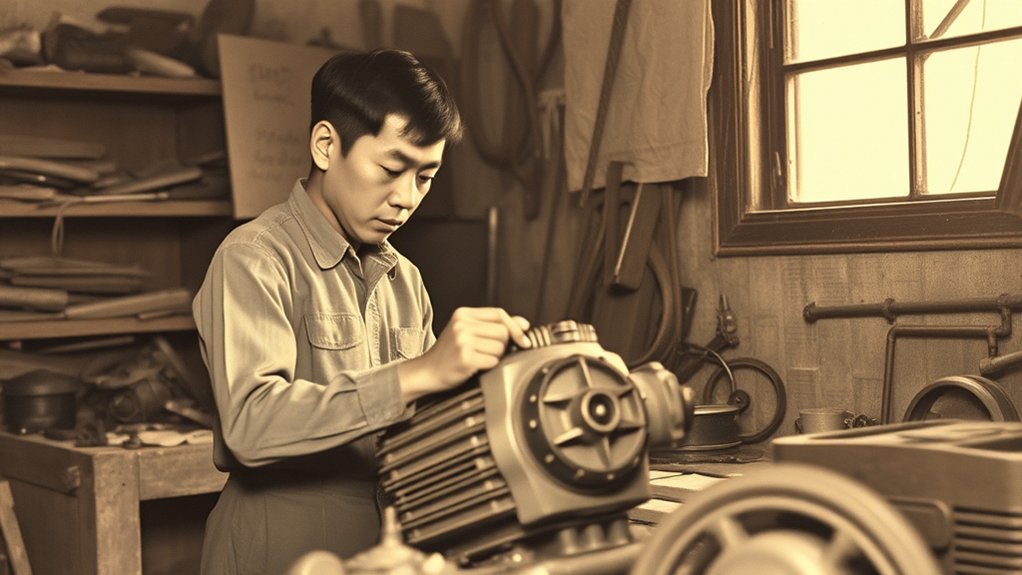
How did Soichiro Honda overcome the numerous obstacles that nearly derailed his early ambitions? His engineer mindset helped him tackle early challenges with relentless problem-solving and innovation.
You see, Honda faced financial struggles, limited resources, and skepticism from the industry. Yet, he stayed focused and adapted quickly.
- Financial Hardships: Honda lacked capital but found creative ways to fund his projects, refusing to give up.
- Technical Setbacks: Early prototypes often failed, but his analytical approach turned failures into learning experiences.
- Industry Doubt: Many doubted a small Japanese company could compete globally, but Honda’s perseverance proved them wrong.
What Innovations Did Soichiro Honda Introduce?
What made Soichiro Honda’s contributions to engineering stand out was his ability to blend innovation with practicality. You’ll notice that his focus wasn’t just on creating advanced engines but making them accessible and reliable for everyday users.
Soichiro Honda excelled by combining innovative engineering with practical, reliable designs for everyday users.
He revolutionized small engine design, improving fuel efficiency and performance, which gave Honda motorcycles and cars a competitive edge. Despite early lackluster branding, he emphasized quality engineering over flashy marketing.
Additionally, Honda pioneered offshore manufacturing, establishing factories outside Japan to optimize costs and expand global reach without sacrificing precision. This strategic move allowed you to see Honda products widely available worldwide, maintaining high standards.
Soichiro’s innovations weren’t just technical; they were strategic decisions that reshaped production and market presence.
How Soichiro Honda’s Engineering Philosophy Shaped Innovation
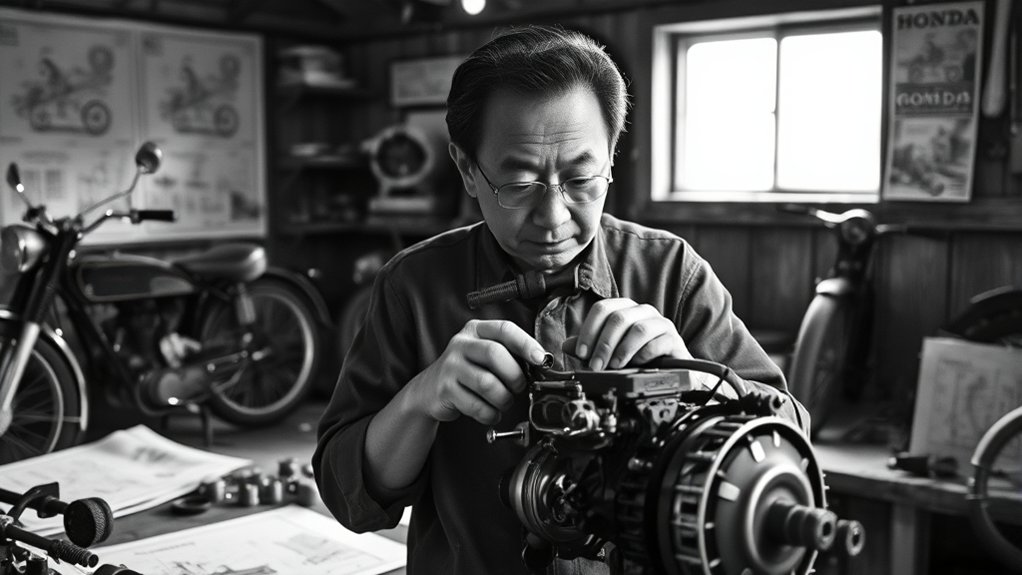
Soichiro Honda’s engineering philosophy centered on relentless experimentation and a deep understanding of mechanics, which directly influenced the innovative spirit that defines Honda today. You can see how his approach fostered breakthroughs by focusing on practical solutions and continuous improvement, driving the company’s commitment to quality and performance.
His influence is evident in:
- Encouraging user comments to refine designs, creating motorcycles that resonate deeply with motor culture enthusiasts.
- Prioritizing lightweight, efficient engines that balance power with reliability, reflecting Honda’s engineering rigor.
- Promoting a hands-on problem-solving mindset that inspires engineers to push boundaries rather than settle for conventional methods.
Honda’s Growth From Workshop to Global Brand
The innovative mindset that fueled Honda’s engineering breakthroughs also laid the foundation for its remarkable expansion from a small workshop into a global powerhouse. You can trace Honda’s growth through strategic improvements in engine design and the optimization of supply chains, which enabled cost-effective production and scalability.
By refining engine components and fostering strong supplier relationships, Honda maintained quality while expanding rapidly.
| Aspect | Impact on Growth |
|---|---|
| Engine Design | Enhanced performance, reliability |
| Supply Chains | Streamlined production, reduced costs |
| Global Expansion | Established manufacturing overseas |
Understanding these elements gives you insight into how Honda evolved beyond engineering, mastering operational efficiency to compete internationally and become a trusted global brand.
Why Did Soichiro Honda’s Engines Change the Automotive World?
How did Honda’s engines revolutionize the automotive industry? You see, Soichiro Honda’s craftsmanship philosophy instilled precision and innovation at every production stage. He didn’t just build engines; he engineered reliable powerhouses that transformed driving experiences worldwide.
His approach reshaped global supply chains, ensuring parts met exacting standards and arrived efficiently, boosting overall quality and scaling production.
- You witness unmatched reliability, as Honda engines consistently outperform in durability and efficiency.
- You appreciate the innovative engineering that prioritizes fuel economy without sacrificing power.
- You recognize how Honda’s supply chain integration allowed rapid global expansion with consistent quality.
How Soichiro Honda Led Honda’s Expansion From Motorcycles to Cars
You’ll see how Soichiro Honda’s clear vision and engineering expertise drove the company’s shift from motorcycle manufacturing to automobile production. His strategic decisions focused on innovation and quality control, enabling Honda to compete in the automotive market.
Understanding this shift reveals how his leadership shaped Honda’s growth into a global car manufacturer.
Soichiro Honda’s Vision
What drove Soichiro Honda to shift from motorcycles to cars was his relentless pursuit of innovation and quality. He refused to view this move as an unrelated topic but as a natural evolution in engineering excellence.
Unlike speculative fiction, his vision was grounded in practical advancements and market needs. You’ll see this clearly in three defining aspects of his leadership:
- He prioritized engineering breakthroughs, pushing boundaries beyond motorcycles.
- He emphasized rigorous quality control, ensuring every vehicle reflected Honda’s standards.
- He fostered a culture of continuous improvement, encouraging teams to solve real-world challenges.
Transition To Automobile Production
Soichiro Honda’s dedication to engineering excellence naturally expanded beyond motorcycles, prompting a strategic move into automobile manufacturing. You’ll see that Honda applied the same precision found in artisanal weaving, careful, deliberate, and innovative, to crafting reliable engines and vehicle components.
Understanding the complexities of coastal navigation, Honda approached car production with a mindset attuned to adapting and steering through challenges, much like navigating unpredictable waters. This transition demanded not just technical skill but also strategic foresight, as Honda recognized market shifts and consumer needs.
The Legacy Soichiro Honda Left Behind
How did one man’s vision transform not only an industry but also the culture of engineering and innovation worldwide? Soichiro Honda’s legacy is more than just motorcycles or cars; it’s an enduring engineering philosophy centered on relentless innovation and quality. You see his influence in every Honda vehicle, reflecting his commitment to pushing boundaries.
Consider these key aspects of his legacy:
- Motorcycle innovation: Soichiro Honda revolutionized lightweight, efficient engines, setting new industry standards.
- Engineering philosophy: He fostered a culture of creativity and persistence, encouraging engineers to challenge norms.
- Global impact: His vision reshaped automotive and motorcycle industries, inspiring worldwide technological advancement.
When you look at Honda today, you witness Soichiro Honda’s lasting imprint on engineering excellence and innovation culture.
Frequently Asked Questions
What Inspired Soichiro Honda to Start His Own Company?
You’ll find Soichiro Honda’s inspiration sources in his early experiments with engines and racing. His passion for mechanics and innovation pushed him to start his own company, driven by a desire to improve technology and performance.
Did Soichiro Honda Have Any Formal Engineering Education?
Picture a river forging its path; you don’t need formal engineering education to innovate. Soichiro Honda lacked traditional schooling but gained hands-on experience and mechanical insight. He blended practical knowledge with creative problem-solving in his engineering journey.
How Did World War II Impact Honda’s Early Business?
You’ll find that World War II caused market disruption, forcing Honda to pivot from aircraft repair to motorcycles.
Late night brainstorming sessions helped Soichiro Honda innovate affordable, efficient bikes, laying the foundation for future success.
What Role Did Soichiro Honda’s Family Play in the Company?
Imagine planting seeds for a garden; Soichiro Honda’s family influence helped nurture Honda’s growth, ensuring succession planning was like steady watering. Their support provided stability, guiding leadership transitions and preserving his innovative spirit throughout the company’s evolution.
Are There Any Museums Dedicated to Soichiro Honda?
Yes, you can visit the Soichiro Honda Museum in Japan, which celebrates the inventor’s origins and achievements. It highlights his innovative spirit and impact as one of the key automotive pioneers shaping modern motor engineering.
Conclusion
So, you might think Honda just popped out of nowhere with flashy cars and bikes, but nope—it was Soichiro Honda’s relentless tinkering and obsession with quality that built the empire. His “rainbow factory” wasn’t some magical startup; it was a grit-fueled, hands-on lab of innovation.
So next time you zoom past a Honda, remember: it’s not just engineering; it’s the stubborn spirit of a self-taught genius who refused to settle. This is the true story of who invented Honda.