You might wonder if Honda and Hyundai are the same given their global presence in the automotive market. Honda and Hyundai are both well-known car manufacturers, but they have different origins and identities.
While both produce reliable vehicles, they come from different origins and follow distinct design and engineering philosophies.
Their approaches to technology, performance, and customer service also vary considerably.
Understanding these differences can help you decide which brand better suits your needs—but first, let’s explore where each company started and how that shapes their identity today.
Key Takeaways
- Honda and Hyundai are two distinct automotive brands with independent origins in Japan and South Korea, respectively.
- Honda was founded in 1946 by Soichiro Honda, while Hyundai was established in 1967 by Chung Ju-Yung.
- Their design philosophies differ: Honda focuses on sporty, driver-centered vehicles; Hyundai emphasizes modern, tech-rich, and spacious interiors.
- Honda prioritizes performance and reliability, whereas Hyundai focuses on comfort, innovation, and competitive pricing.
- Both brands operate separate dealer networks, warranty programs, and customer service approaches, reflecting their unique market positioning.
Where Did Honda and Hyundai Come From?
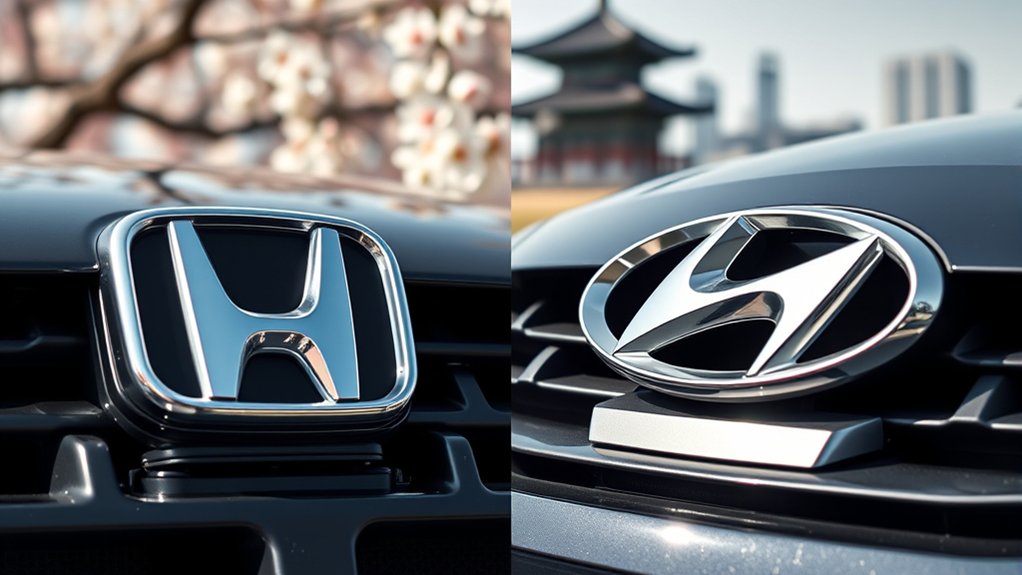
Where did two of the world’s most recognizable car brands, Honda and Hyundai, originate? Honda was founded in Japan in 1946 by Soichiro Honda, initially focusing on motorized bicycles before expanding into automobiles and motorcycles.
Hyundai began in South Korea in 1967, established by Chung Ju-Yung, aiming to boost Korea’s industrial growth through affordable vehicles. Both brands have unique origin stories rooted in their countries’ post-war economic development.
You should note that while Honda and Hyundai started independently, their paths occasionally intersect through cross brand partnerships, especially in technology sharing and joint ventures. Understanding these origins clarifies how their distinct cultural and industrial backgrounds shape their approaches, setting them apart despite occasional collaboration.
This foundational knowledge helps you appreciate the differences and similarities without confusion.
How Do Honda and Hyundai Differ in Design Philosophy?
You’ll notice Honda tends to emphasize sleek, functional exterior styling paired with a driver-focused interior that highlights simplicity and ergonomics.
Hyundai, on the other hand, often incorporates bold, modern design cues and prioritizes spacious, tech-rich cabins to create a more contemporary feel. Both brands use distinct elements to reinforce their unique identities, reflecting different approaches to aesthetics and user experience.
Exterior Styling Approaches
How do Honda and Hyundai approach exterior styling in ways that reflect their distinct brand identities? Honda tends to emphasize sleek, aerodynamic shapes with a subtle use of different materials, aiming for a sporty yet practical look. Their color palettes usually stick to classic, understated tones that align with their design philosophy focused on reliability and understated sophistication.
Hyundai, on the other hand, embraces bold, dynamic lines and a more adventurous use of materials to create a modern, eye-catching presence. Their color choices are often more vibrant and varied, reflecting a design philosophy centered on innovation and youthful appeal. When you compare both, you’ll see how these exterior styling approaches clearly express each brand’s unique character and market positioning.
Interior Design Focus
What sets Honda and Hyundai apart inside their vehicles reveals much about their design philosophies. When you explore their interiors, you’ll notice distinct approaches to internal layout and seating comfort.
Honda often emphasizes functionality and driver-centric ergonomics, ensuring controls are intuitively placed. Hyundai, meanwhile, tends to focus on creating a spacious feel with modern aesthetics and enhanced comfort features.
Key differences include:
- Honda’s internal layout prioritizes straightforward accessibility and minimal distractions.
- Hyundai invests in plush seating comfort and premium materials to elevate the passenger experience.
- Both brands integrate technology differently: Honda opts for practicality, while Hyundai leans toward visually striking interfaces.
Understanding these contrasts helps you appreciate how each brand tailors the interior environment to different driver preferences.
Brand Identity Elements
Beyond interior design, the core of Honda and Hyundai’s appeal lies in their distinct brand identities, shaped by unique design philosophies. You’ll notice Honda emphasizes a sporty, performance-driven look reflecting its strong brand heritage rooted in engineering excellence.
Hyundai, on the other hand, prioritizes sleek, modern aesthetics aimed at enhancing customer interaction through innovative and user-friendly designs. These differing approaches influence how each brand connects with you and their broader audience.
| Aspect | Honda | Hyundai |
|---|---|---|
| Design Philosophy | Sporty, performance-oriented | Sleek, modern, user-friendly |
| Brand Heritage | Engineering excellence | Innovation and accessibility |
| Customer Interaction | Engaged, driver-focused | Comfortable, tech-integrated |
| Visual Appeal | Aggressive, dynamic lines | Smooth, futuristic shapes |
What Tech Makes Honda and Hyundai Different?
You’ll notice that Honda and Hyundai each prioritize different powertrain innovations, shaping their driving performance uniquely. Their infotainment systems also offer distinct user experiences, reflecting varied tech approaches.
Additionally, their safety technologies highlight contrasting strategies to protect drivers and passengers.
Powertrain Innovations
How do Honda and Hyundai set themselves apart when it comes to powertrain technology? Their design philosophy and brand identity heavily influence their innovations.
Honda emphasizes efficiency and reliability through hybrid systems and VTEC engines, reflecting a commitment to performance and fuel economy. Hyundai, meanwhile, focuses on advanced turbocharging and electrification, showcasing its push toward cutting-edge, sustainable mobility.
Consider these key differences:
- Honda’s i-MMD hybrid system prioritizes seamless integration and fuel efficiency.
- Hyundai’s Smartstream engines combine turbocharging with optimized combustion for power and emissions control.
- Hyundai leads in electric vehicle battery tech, aligning with its eco-friendly brand identity.
Understanding these distinctions helps you appreciate how each brand engineers powertrains to match their unique market positioning.
Infotainment Systems
What sets Honda and Hyundai apart in infotainment systems? Both brands offer advanced infotainment features, but their display interfaces and user experience differ notably.
Honda tends to focus on simplicity and ease of use, with intuitive touchscreen layouts that minimize distractions. Hyundai, on the other hand, often incorporates larger, more vibrant displays with customizable options, enhancing visual appeal and interaction flexibility.
Hyundai’s systems frequently support more extensive smartphone integration and advanced voice commands. Meanwhile, Honda prioritizes straightforward connectivity and reliability.
So, if you value a clean, user-friendly interface, Honda might suit you better. If you prefer a feature-rich, visually dynamic infotainment system, Hyundai could be the choice.
Understanding these distinctions helps you pick the infotainment experience that matches your driving style and tech preferences.
Safety Technology
When comparing safety technology, how do Honda and Hyundai differentiate themselves? Both brands emphasize a strong safety culture but approach driver assistance systems with unique features and priorities. Honda integrates its Honda Sensing suite, focusing on intuitive alerts and adaptive cruise control to enhance driver awareness.
Hyundai, on the other hand, offers the SmartSense package, which includes advanced collision avoidance and blind-spot monitoring with a proactive stance.
Consider these key distinctions:
- Honda prioritizes real-time driver feedback through lane-keeping assist and road departure mitigation.
- Hyundai emphasizes comprehensive collision prevention with forward collision-avoidance assist.
- Both brands use driver attention monitoring but with different sensitivity and alert styles.
Understanding these differences helps you choose based on how each brand’s safety culture aligns with your driving needs.
How Do Honda and Hyundai Compare in Vehicle Performance?
Examining vehicle performance between Honda and Hyundai reveals distinct strengths that cater to different driving preferences. When you explore their performance comparison, you’ll notice Honda leans toward sporty handling and engine responsiveness, reflecting a design philosophy focused on driver engagement.
Hyundai, meanwhile, emphasizes smooth rides and refined powertrains, showcasing a design philosophy centered on comfort and value.
| Aspect | Honda | Hyundai |
|---|---|---|
| Engine Power | Responsive, sport-tuned | Smooth, balanced |
| Handling | Agile, driver-focused | Comfortable, stable |
| Suspension | Firm, performance-oriented | Softer, comfort-oriented |
| Transmission | Quick-shifting, manual options | Smooth automatic options |
You can see these differences clearly affect your driving experience depending on what you prioritize.
Which Brand Offers Better Fuel Efficiency and Reliability?
How do Honda and Hyundai stack up in fuel efficiency and reliability? When you compare their fuel economy, both brands offer competitive options, but Honda often leads with more efficient hybrid models. Reliability ratings favor Honda slightly due to its long-standing reputation for durability. However, Hyundai has made significant improvements in recent years, closing the gap.
Consider these points:
- Honda’s fuel economy excels in hybrid and compact models.
- Hyundai offers strong reliability ratings with newer vehicles benefiting from advanced warranties.
- Both brands provide efficient engines, but Honda’s consistent reliability gives it an edge.
If fuel economy and reliability ratings are your priorities, Honda generally offers a slight advantage, though Hyundai’s progress makes it a compelling choice as well.
How Do Honda and Hyundai Price Their Cars Differently?
Where you find the biggest differences between Honda and Hyundai often lies in their pricing strategies. Honda tends to position its vehicles at a slightly higher price point, reflecting its established brand reputation and perceived long-term reliability.
Hyundai, on the other hand, often adopts a more aggressive price strategy, offering competitive base prices and frequent incentives to attract budget-conscious buyers. This approach helps Hyundai gain market share quickly.
Hyundai’s aggressive pricing and frequent incentives attract budget-conscious buyers, boosting its market share rapidly.
Additionally, Honda’s extensive dealership network provides consistent pricing and availability, supporting its premium positioning. Hyundai’s growing dealership network focuses on volume sales, sometimes resulting in more flexible pricing at local dealerships.
When you compare both brands, you’ll notice that these distinct price strategies align with their broader business models, influencing how you might prioritize value versus brand prestige in your purchase decision.
What Warranty and Customer Service Options Do They Provide?
Beyond pricing, warranty coverage and customer service play a significant role in shaping your overall ownership experience with Honda and Hyundai. Both brands offer competitive warranty options, but they differ in length and scope.
Hyundai typically provides a longer basic warranty, which can appeal if you want extended peace of mind. Honda’s warranty options focus on standard coverage with reliable customer service support.
Here’s what you can expect:
- Hyundai offers a 5-year/60,000-mile basic warranty and a 10-year/100,000-mile powertrain warranty.
- Honda provides a 3-year/36,000-mile basic warranty and a 5-year/60,000-mile powertrain warranty.
- Both brands emphasize strong customer service networks, but Hyundai often ranks slightly higher in customer satisfaction.
Understanding these differences helps you choose a brand that fits your warranty and customer service priorities.
Most Popular Models From Honda and Hyundai
Which models stand out the most when you compare Honda and Hyundai? For Honda, the Civic and CR-V are top picks, known for their efficient engine design and reliable performance. The Civic offers a sporty feel with responsive handling, while the CR-V prioritizes ride comfort and spaciousness.
Hyundai’s Elantra and Tucson also capture attention, featuring modern engine design focused on fuel efficiency and smooth acceleration. The Elantra boasts a comfortable cabin with advanced tech, and the Tucson enhances ride comfort with its refined suspension.
When you look at these models, you’ll notice both brands emphasize a balance between performance and comfort. Your choice might depend on whether you prefer Honda’s tried-and-true engineering or Hyundai’s innovative approach to ride comfort and design.
Which Brand Should You Choose: Honda or Hyundai?
Deciding between Honda and Hyundai comes down to your priorities in performance, design, and value. Both brands have earned consumer trust, but their approaches differ, influenced by distinct brand ethics. Consider these factors when choosing:
- Performance and Reliability: Honda emphasizes long-term reliability and fuel efficiency, while Hyundai offers competitive warranties and innovative tech.
- Design and Features: Hyundai tends to push bolder, modern aesthetics and tech inclusions, whereas Honda focuses on practical, user-friendly designs.
- Value and Ownership Costs: Hyundai often provides better initial pricing and warranty coverage. Honda’s resale value and maintenance costs are generally favorable.
Frequently Asked Questions
Do Honda and Hyundai Collaborate on Any Vehicle Projects?
You won’t find any confirmed collaboration projects between Honda and Hyundai despite occasional collaboration rumors. Their brand rivalry keeps them focused on competing independently rather than partnering on vehicle development or technology sharing.
Are Honda and Hyundai Involved in Motorsports?
You’ll find Honda actively competes in motorsports, emphasizing performance, while Hyundai’s motorsports rivalry highlights its rally success. These efforts showcase brand identity differences, with each focusing on unique racing disciplines and technological innovation.
How Do Honda and Hyundai Handle Electric Vehicle Development?
Think of EV strategy like cooking: Honda carefully blends battery partnerships for efficiency,
while Hyundai spices innovation with diverse collaborations.
You’ll see each brand’s distinct recipe shaping their electric vehicle development and future market impact.
What Are the Environmental Initiatives of Honda and Hyundai?
You’ll find Honda and Hyundai both prioritize environmental policy and corporate philanthropy, investing in sustainable practices and community projects to reduce emissions and promote green energy. This reflects their commitment to environmental responsibility and social impact.
Do Honda and Hyundai Offer Hybrid Models in the Same Markets?
You’ll find that 70% of market-specific hybrids from Honda and Hyundai overlap globally. Despite brand collaboration discussions, they mainly develop their hybrid models independently, targeting unique regional demands and preferences for maximum market impact.
Conclusion
Choosing between Honda and Hyundai is like picking between a trusted watch and a cutting-edge smartwatch. Honda offers tried-and-true reliability and efficiency, much like a classic timepiece that never misses a beat.
Hyundai, on the other hand, brings bold designs and tech innovations, similar to a smartwatch packed with new features. Knowing their roots, strengths, and warranties helps you decide which fits your style and needs best.
Whether you want tradition or tech-forward excitement, understanding the differences between Honda and Hyundai will guide you to the perfect choice.