If you’re wondering whether the Honda CR-V 4WD is available, it’s important to know that most models actually feature all-wheel drive (AWD) instead. This system automatically adjusts power between wheels to improve traction, but it’s not the same as traditional 4WD, which is designed for more rugged conditions.
Knowing the difference can help you decide if the CR-V’s setup matches your driving needs or if you require something more specialized. The AWD system in the Honda CR-V is excellent for everyday driving and light off-road use, providing better stability and control.
However, if you need a vehicle for heavy-duty off-roading, a traditional 4WD system might be more suitable. Understanding these distinctions ensures you choose the right drivetrain for your lifestyle.
Key Takeaways
- The Honda CR-V uses all-wheel drive (AWD), not traditional four-wheel drive (4WD).
- CR-V AWD automatically distributes power to all wheels as needed for traction.
- It lacks manual engagement and low-range gearing found in 4WD systems.
- AWD in the CR-V is designed for on-road performance and light off-road use.
- Traditional 4WD is better suited for rugged off-road conditions, unlike CR-V’s AWD.
Does the Honda CR-V Come With 4WD or AWD?
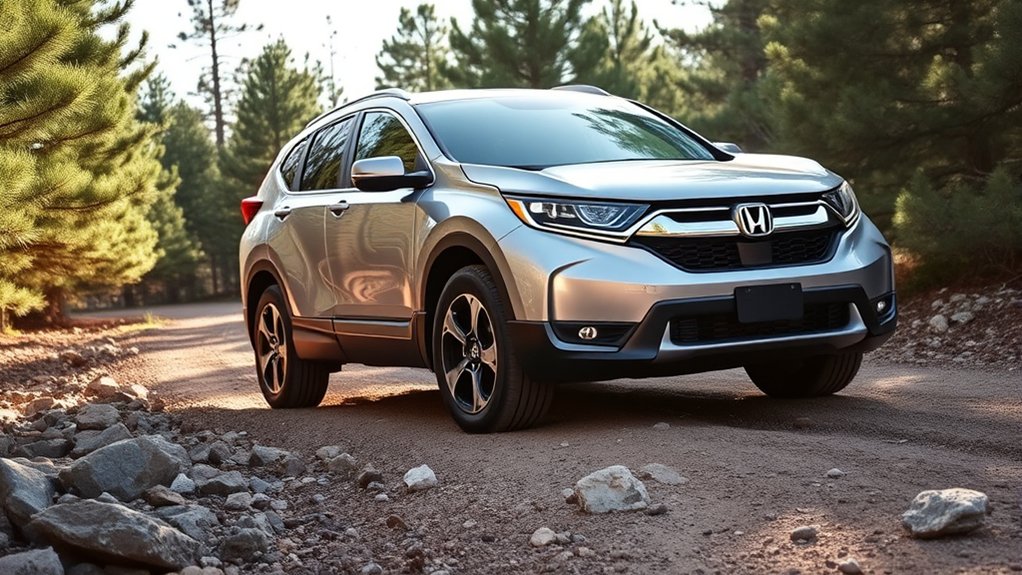
Wondering whether the Honda CR-V offers 4WD or AWD? The CR-V comes equipped with an all-wheel-drive (AWD) system rather than traditional four-wheel drive (4WD).
This AWD setup enhances fuel efficiency compared to 4WD systems, making it a practical choice for everyday driving. You’ll also find that maintenance costs tend to be lower with AWD due to fewer mechanical components involved.
Honda backs the CR-V with solid warranty coverage, providing peace of mind for your investment. Additionally, the combination of Honda’s reliability and the AWD system helps maintain a strong resale value over time.
What’s the Difference Between 4WD and AWD?
While the Honda CR-V features an all-wheel-drive (AWD) system rather than traditional four-wheel drive (4WD), understanding the distinctions between these two drivetrains can help you make a more informed choice when evaluating vehicles.
AWD systems automatically distribute power to all four wheels as needed, offering improved traction on slippery roads without driver intervention. In contrast, 4WD systems usually require manual activation and are designed for rugged off road suitability, providing maximum torque to all wheels in challenging terrains.
Drivetrain nuances include 4WD’s low-range gearing for steep climbs and deep mud, whereas AWD prioritizes seamless on-road performance and occasional light off-road use. Knowing these differences ensures you select a vehicle that matches your driving needs and environment accurately.
How the CR-V’s AWD Boosts Traction and Stability
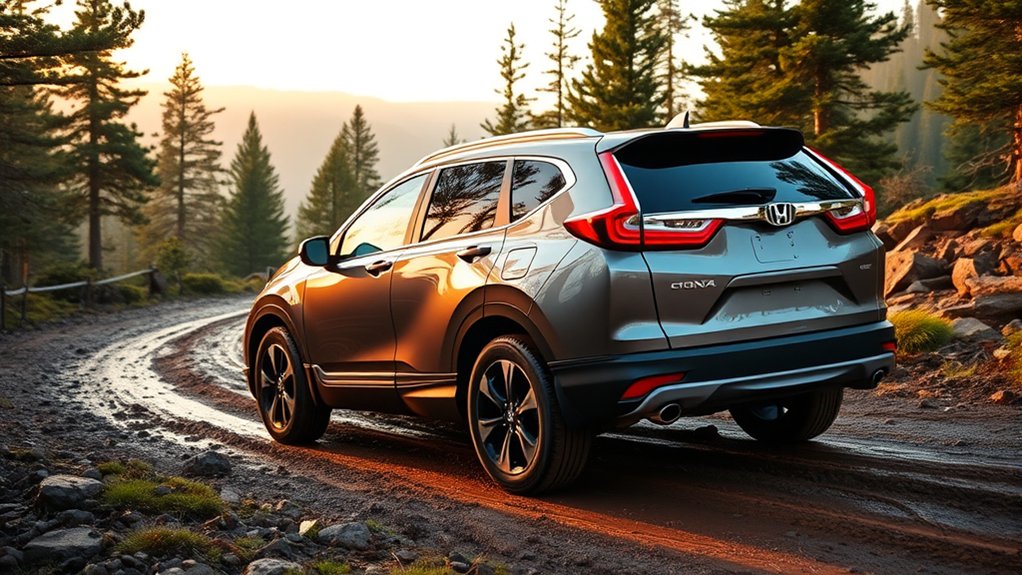
How exactly does the CR-V’s AWD system enhance traction and stability on the road? It continuously monitors wheel speed, throttle input, and steering angle, redistributing power between the front and rear wheels as needed. This dynamic adjustment improves grip on slippery or uneven surfaces, giving you better control during rain, snow, or light off-road conditions.
The system’s design balances off road durability with everyday drivability, ensuring the vehicle handles rough terrain without compromising performance. Additionally, the CR-V’s AWD system optimizes power delivery to maintain fuel efficiency, engaging all-wheel drive only when necessary rather than constantly.
This intelligent approach means you get enhanced stability and traction without a significant fuel economy penalty, making it practical for varied driving conditions.
Which Honda CR-V Models Offer AWD?
You’ll find AWD available on most Honda CR-V trims, especially from recent model years onward. Depending on the year, certain trims offer AWD as standard or as an optional upgrade.
Understanding which models include AWD helps you choose the right CR-V for your driving needs.
AWD Availability By Trim
Which Honda CR-V trims come equipped with AWD? Typically, Honda offers all-wheel drive as an option or standard feature on higher trims such as the EX, EX-L, and Touring.
If you choose an AWD model, you’ll benefit from improved traction in varied road conditions without sacrificing much in fuel economy. Keep in mind that AWD variants might require slightly more involved CR-V maintenance due to their additional drivetrain components.
However, Honda designs these systems for reliability and efficiency, so routine upkeep remains straightforward. When selecting your trim, consider how often you’ll need AWD’s enhanced capability versus potential impacts on fuel economy and maintenance costs.
This approach helps ensure you get the right balance of performance and cost-effectiveness for your driving needs.
Model Years With AWD
Several Honda CR-V model years offer AWD options, providing drivers with enhanced traction and control. Since the early 2000s, Honda has included AWD across multiple trims, allowing you to select models suited for varied driving conditions.
For instance, from the 2007 model year onward, AWD became widely available, improving off road safety and stability on slippery surfaces. Recent models, especially from 2017 to the latest releases, feature advanced AWD systems that automatically distribute power when needed, enhancing your vehicle’s responsiveness.
While AWD improves grip and off road safety, it may slightly impact fuel economy compared to 2WD versions. However, Honda engineers have optimized these systems to minimize fuel consumption penalties. When choosing your CR-V, consider how often you need AWD for better traction versus your priorities on fuel economy.
Honda CR-V AWD vs. Traditional 4WD Systems
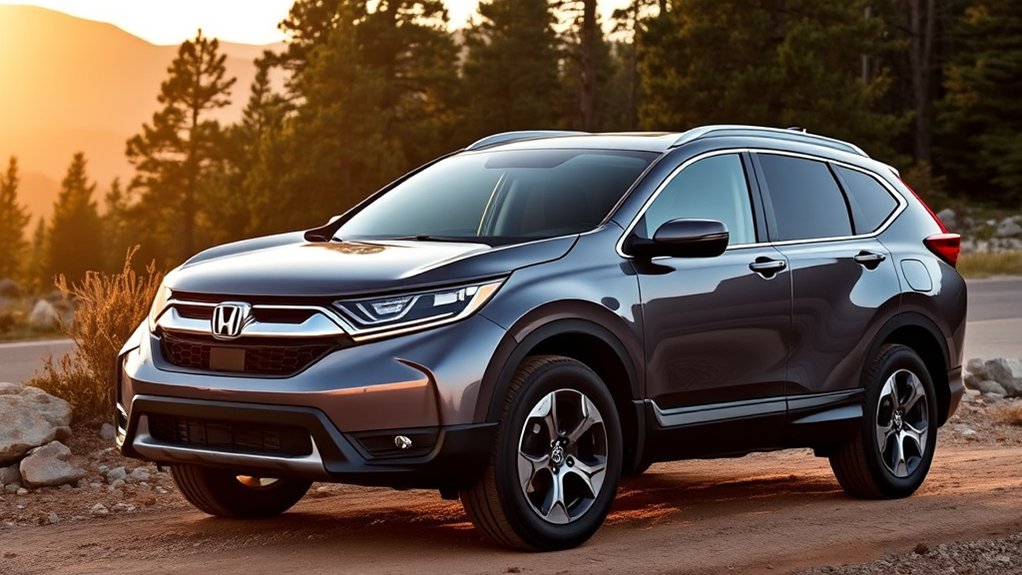
You’ll find that the Honda CR-V’s AWD system automatically adjusts power between the front and rear wheels for improved traction in varying conditions.
Traditional 4WD systems, on the other hand, often require manual engagement and provide enhanced capability for rugged off-road terrain. Understanding how each performs on different surfaces can help you choose the right system for your driving needs.
AWD Functionality Explained
How does the Honda CR-V’s all-wheel-drive (AWD) system differ from traditional four-wheel-drive (4WD) setups? Unlike 4WD, which you manually engage for off-road or challenging conditions, the CR-V’s AWD operates automatically. It continuously monitors drive quality and redistributes power between the front and rear wheels to maintain traction without driver input.
This system enhances fuel economy by engaging the rear wheels only when necessary, unlike 4WD systems that often send power to all wheels constantly.
Key AWD functionality features include:
- Automatic torque distribution based on road conditions
- Improved on-road stability and handling
- Reduced drivetrain wear due to selective power delivery
- Enhanced fuel efficiency compared to traditional 4WD
- Seamless transition between two-wheel and all-wheel drive modes
This design prioritizes everyday driving comfort and efficiency.
4WD System Benefits
Why choose the Honda CR-V’s AWD system over a traditional 4WD setup? The CR-V’s AWD offers a more refined aesthetic design, blending seamlessly with its urban-friendly look, unlike the rugged, bulky appearance common in 4WD vehicles.
From an automobile marketing perspective, Honda emphasizes AWD’s advantage in everyday driving, highlighting superior fuel economy. Unlike traditional 4WD, which often engages all wheels continuously, the CR-V’s system activates only when needed, saving fuel and reducing wear.
Additionally, maintaining your CR-V with quality oil brands ensures optimal performance without the heavier demands typical of a full 4WD drivetrain. So, if you want a balance of style, efficiency, and reliable traction, the CR-V’s AWD system stands out as a practical alternative to traditional 4WD.
Terrain Performance Comparison
While the Honda CR-V’s AWD system offers efficiency and everyday practicality, understanding how it handles different terrains compared to traditional 4WD systems can help you make a more informed choice. The CR-V’s AWD is optimized for on-road traction and light off-road conditions, while traditional 4WD excels in rugged, off-road environments.
- AWD adjusts power automatically for slippery roads, improving fuel efficiency
- Traditional 4WD provides superior torque distribution on uneven terrain
- AWD requires less maintenance, lowering overall maintenance costs
- 4WD systems often include low-range gearing for challenging off-road use
- AWD suits urban and mild off-road driving, while 4WD is ideal for serious off-roading
Benefits of Honda CR-V AWD for Everyday Driving
When you drive a Honda CR-V equipped with AWD, you gain enhanced traction and stability on various road surfaces. This system automatically distributes power to the wheels with the most grip, improving control in rain, light snow, or uneven terrain.
Despite the added capability, the AWD system maintains respectable fuel economy, thanks to its intelligent design that engages only when necessary. You won’t sacrifice efficiency compared to traditional 4WD systems.
Additionally, the CR-V offers generous cargo capacity, allowing you to carry gear or groceries without compromising passenger space. The AWD setup doesn’t intrude on the interior layout, so you still benefit from a roomy, practical cabin.
Limitations of CR-V AWD Compared to 4WD Vehicles
How does the Honda CR-V AWD compare to traditional 4WD systems in challenging off-road situations? While the CR-V’s AWD offers enhanced traction, it lacks the rugged capabilities of 4WD systems designed for severe terrain. You’ll notice limitations in ground clearance, torque distribution, and specialized off-road features. These factors can impact performance when tackling steep, rocky, or deep mud-covered paths.
Consider these key limitations of CR-V AWD versus 4WD:
- Limited low-range gearing for demanding climbs
- Less aggressive traction control in extreme conditions
- Lower ground clearance reduces obstacle clearance
- Lacks locking differentials for maximum wheel grip
- CR-V maintenance favors fuel efficiency, reflected in better cr v mpg but compromises off-road ruggedness
Understanding these limits helps set realistic expectations for your CR-V’s off-road potential.
How the CR-V’s AWD Performs in Different Conditions
Where does the Honda CR-V’s AWD system truly excel across various driving conditions? It performs well in everyday scenarios, offering enhanced stability and traction, especially on wet or slippery roads.
When it comes to winter traction, the AWD system automatically distributes power to the wheels with the most grip, helping you maintain control on snow-covered or icy surfaces. However, its off road readiness is limited compared to dedicated 4WD vehicles; it’s designed more for light trails and uneven terrain rather than rugged off-roading.
The system continuously monitors wheel slippage and adjusts torque accordingly, optimizing grip without driver intervention. Overall, the CR-V’s AWD provides reliable performance in moderate off-road situations and challenging weather, making it a practical choice for drivers seeking improved safety and confidence.
Choosing AWD or 4WD: What Fits Your Driving Needs?
Understanding the capabilities of the Honda CR-V’s AWD system helps clarify whether it suits your driving habits or if a traditional 4WD system is a better fit. When deciding between AWD and 4WD, focus on your specific needs rather than irrelevant topic tangents or two word discussion ideas that don’t apply.
Consider these factors:
- AWD offers seamless traction on varied road surfaces without driver intervention.
- 4WD is ideal for rugged terrain and heavy off-road use, requiring manual control.
- AWD provides better fuel efficiency compared to most 4WD systems.
- 4WD typically adds weight and complexity, impacting daily driving comfort.
- AWD suits urban and mild off-road conditions, while 4WD excels in extreme environments.
Can the Honda CR-V AWD Handle Light Off-Roading?
You can expect the Honda CR-V’s AWD system to provide reliable traction on light off-road trails like dirt or gravel roads. It automatically adjusts power between the front and rear wheels to improve grip on uneven surfaces.
While it handles moderate terrain well, it’s not designed for heavy off-roading or extreme conditions.
AWD System Capabilities
How well can the Honda CR-V’s AWD system handle light off-roading? Its capabilities are designed to provide confident traction on uneven surfaces without compromising fuel economy. The system automatically distributes power to wheels needing grip, helping you maintain control on dirt roads or light trails.
While it’s not built for extreme off-road conditions, it offers reliable performance for casual outdoor adventures.
Key AWD system capabilities include:
- Real-time torque distribution for improved traction
- Stability control integration for safe handling
- Automatic engagement to optimize fuel efficiency
- Responsive to subtle changes in wheel slip
- Supports responsible driving etiquette by preventing excessive wheel spin
This balance ensures you can navigate light off-road terrain efficiently while maintaining good fuel economy and vehicle control.
Terrain Handling Performance
What makes the Honda CR-V’s AWD system effective for light off-roading is its ability to automatically adjust power distribution based on traction needs. When you encounter uneven or slippery terrain, the system reallocates torque to the wheels with the best grip, enhancing stability and control.
This capability allows you to confidently navigate dirt paths, gravel, or shallow mud without getting stuck. Additionally, the CR-V maintains emissions compliance by optimizing engine performance during these conditions, ensuring you meet environmental standards.
The hybrid models complement this with advanced battery efficiency, providing electric assistance that reduces fuel consumption and emissions even on challenging surfaces. While it’s not designed for intense off-roading, the Honda CR-V AWD handles light off-road terrain competently, balancing performance with eco-friendly operation.
Frequently Asked Questions
What Is the Fuel Economy of a Honda CR-V With AWD?
You can expect the fuel economy of a Honda CR-V with AWD to be around 27 MPG city and 32 MPG highway. Its maintenance frequency is moderate, helping you balance efficiency with regular upkeep demands effectively.
How Often Does the AWD System Require Maintenance?
You know what they say, “An ounce of prevention is worth a pound of cure.” Follow the maintenance schedule and run system diagnostics every 30,000 miles to keep the AWD system in ideal condition and avoid costly repairs.
Does AWD Affect the Resale Value of the Honda CR-V?
AWD can slightly boost your Honda CR-V’s resale value due to better traction, but reliability concerns might affect buyers.
To maximize resale timing, keep maintenance up-to-date and disclose AWD system condition honestly for a fair sale.
Can I Switch Between AWD and FWD Manually in the CR-V?
You can’t use a manual switch to toggle AWD and FWD in the Honda CR-V; its system automatically adjusts based on tire traction and road conditions. Tires’ influence on grip directly affects how AWD engages.
Are There Any Additional Insurance Costs for AWD Honda CR-VS?
You might face slightly higher insurance premiums for an AWD Honda CR-V due to increased repair costs, but these differences are usually minimal.
Also, AWD generally doesn’t affect warranty implications, so your coverage remains consistent.
Conclusion
You won’t find traditional 4WD in the Honda CR-V, but its AWD system offers smart traction, balanced stability, and efficient performance. You’ll enjoy confident handling on wet roads, light snow, and moderate trails.
You won’t get rugged off-road capability or low-range gearing, but you will get reliable everyday drivability and enhanced safety. If you want versatility without compromising comfort, the CR-V’s AWD fits your needs better than a traditional 4WD system.
For those specifically seeking a Honda CR-V 4WD, the vehicle’s AWD provides a practical alternative that meets most daily driving demands with ease and confidence.