You might find it notable that recent Honda Accord hybrids achieve around 48 miles per gallon combined, markedly outperforming many conventional sedans.
How many miles per gallon does a Honda Accord get?
The answer varies depending on the specific model and engine type.
Fuel efficiency you experience will vary depending on factors like engine type, model year, and driving conditions.
Understanding these nuances is key to optimizing your Accord’s performance.
There are important distinctions between hybrid and gasoline models that can influence your fuel costs over time.
Key Takeaways
- Honda Accord gasoline models typically achieve around 27-30 MPG combined, depending on engine type and model year.
- Hybrid Accord models offer significantly higher fuel efficiency, averaging about 48 MPG combined per EPA estimates.
- Real-world MPG varies with driving habits, terrain, traffic, and climate, often differing from official EPA ratings.
- The 1.5L turbocharged engine provides better mileage than the 2.0L turbocharged engine, which favors power over efficiency.
- Proper maintenance, smooth driving, and highway cruising can optimize fuel economy for all Accord variants.
Honda Accord MPG by Model Year
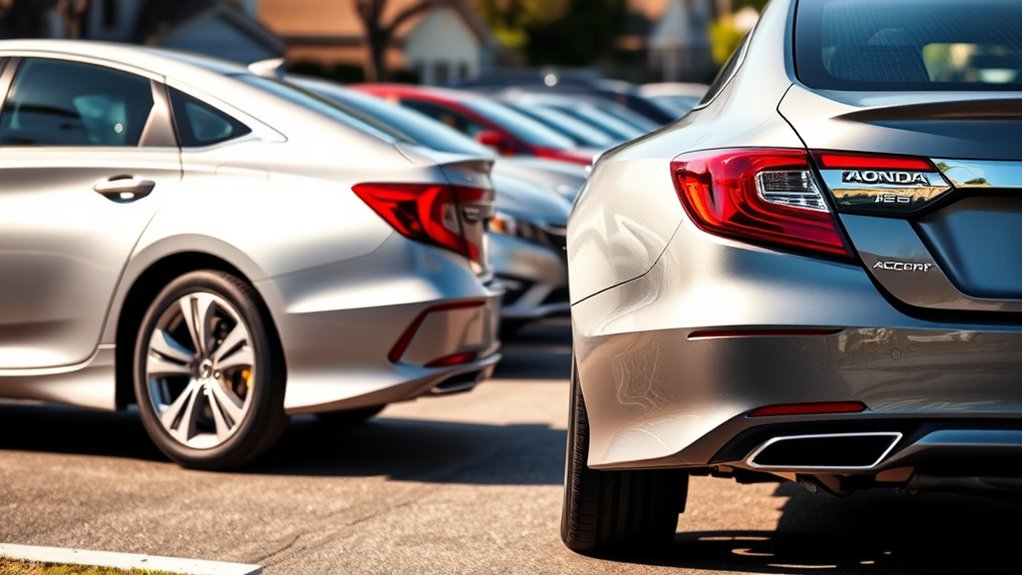
The Honda Accord’s fuel efficiency varies notably across different model years due to advancements in engine technology, aerodynamics, and weight reduction. For instance, earlier models from the 1990s typically deliver around 20-25 MPG combined, reflecting less optimized combustion and heavier structures.
As you examine model year improvements, you’ll notice that the 2010-2015 Accords achieve better fuel economy, often reaching 27-30 MPG, thanks to enhanced CVT transmissions and refined fuel injection systems. More recent models from 2018 onward incorporate turbocharged engines and hybrid variants, pushing fuel economy above 30 MPG in many configurations.
When evaluating fuel economy by model year, consider that each generation integrates incremental technical upgrades, impacting overall efficiency. Tracking these changes helps you understand how Honda balances performance with fuel savings across the Accord lineup.
Comparing Gas Mileage Across Honda Accord Engine Types
How do different engine types influence the Honda Accord’s gas mileage? The Accord offers various engines, ranging from a 1.5L turbocharged inline-4 to a 2.0L turbo inline-4, that directly impact fuel efficiency.
The smaller 1.5L engine typically delivers higher MPG due to lower fuel consumption under standard driving conditions. Conversely, the 2.0L engine provides more power but slightly reduces mileage.
Maintaining essential engine oil viscosity and regularly checking tire pressure are critical regardless of engine type; both factors affect engine load and rolling resistance, influencing overall fuel economy. You’ll notice that balancing these maintenance aspects maximizes each engine’s efficiency.
Understanding these technical differences helps you select the Accord engine that best aligns with your fuel-saving priorities without compromising performance.
Hybrid vs. Gasoline Honda Accord: Which Saves More Fuel?

You’ll notice the Honda Accord Hybrid generally offers superior fuel efficiency compared to its gasoline-only counterpart, directly impacting your fuel costs over time.
Evaluating the total cost of ownership includes considering maintenance, fuel expenses, and potential tax incentives. Additionally, the hybrid model reduces emissions, which benefits the environment by lowering your carbon footprint.
Fuel Efficiency Comparison
Where does the Honda Accord truly shine when it comes to fuel efficiency: the hybrid or gasoline model? The hybrid Accord consistently outperforms its gasoline counterpart, delivering an EPA-estimated 48 mpg combined versus approximately 33 mpg combined for the gasoline version.
This difference stems from the hybrid’s electric motor assisting the gasoline engine, especially in stop-and-go traffic, reducing fuel consumption. The gasoline model relies solely on internal combustion, making it less efficient in urban environments.
When analyzing fuel trivia, the hybrid’s regenerative braking system recovers energy otherwise lost, enhancing mileage. Design quirks such as aerodynamic modifications on hybrids also contribute to improved efficiency.
While both models offer solid fuel economy, if your priority is minimizing fuel use, the hybrid Accord clearly saves more fuel through advanced technology and optimized engineering.
Cost of Ownership
Beyond fuel efficiency figures, understanding the total cost of ownership helps you determine which Honda Accord variant truly saves more money over time. The hybrid Accord typically incurs higher upfront costs but benefits from discounted maintenance due to less frequent brake replacements and engine servicing.
Conversely, the gasoline model has lower initial expenses but may require more regular upkeep. You should also consider the availability and price of rare accessories; hybrids often have limited aftermarket options, potentially increasing customization costs.
Insurance premiums may vary slightly, with hybrids sometimes costing more due to advanced technology. Evaluating depreciation rates, fuel savings, and maintenance expenses collectively will give you a clearer financial picture. Ultimately, your driving habits and local fuel prices will influence which Accord variant is more economical in the long run.
Environmental Impact
How markedly does the choice between a hybrid and a gasoline Honda Accord impact your environmental footprint? The hybrid model noticeably reduces fuel consumption and tailpipe emissions, aligning better with stringent eco policies aimed at lowering greenhouse gases.
By using regenerative braking and an electric motor, the hybrid Honda Accord achieves higher miles per gallon, especially in stop-and-go urban environments shaped by urban planning initiatives that prioritize reduced congestion and cleaner air.
Conversely, the gasoline Accord emits more CO2 and relies solely on internal combustion, increasing your carbon footprint. If your driving involves frequent city stops or heavy traffic, a hybrid’s efficiency gains maximize environmental benefits.
Choosing the hybrid supports broader sustainability goals embedded in eco policies and urban planning, making it the superior option for fuel savings and emissions reduction.
Driving Habits That Improve Your Accord’s MPG
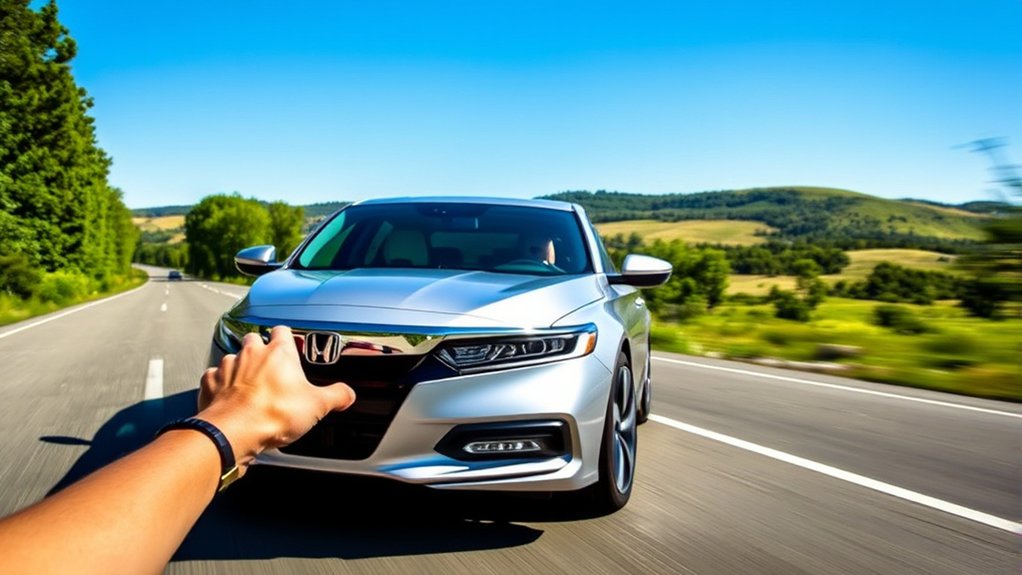
You can improve your Honda Accord’s MPG by focusing on smooth acceleration techniques that reduce fuel consumption during speed changes. Maintaining an optimum, steady speed minimizes engine load and maximizes efficiency.
These driving habits directly influence how effectively your engine uses fuel under varying conditions.
Smooth Acceleration Techniques
Why does smooth acceleration matter for your Honda Accord’s fuel efficiency? Smooth acceleration minimizes rapid fuel injection spikes, optimizing combustion and reducing wasted fuel. When you gradually increase throttle input, you allow the engine control unit (ECU) to manage fuel-air mixture precisely, enhancing efficiency.
Abrupt acceleration forces the ECU to enrich the mixture to prevent stalling, which lowers miles per gallon. Key fuel economy components, such as the throttle body and fuel injectors, respond more efficiently under smooth acceleration, promoting consistent engine load and reducing stress on drivetrain elements.
Optimal Speed Maintenance
When should you maintain a steady speed to maximize your Honda Accord’s fuel efficiency? Maintaining a consistent velocity, especially between 45-65 mph, optimizes engine load and fuel consumption. Sudden speed fluctuations increase fuel usage and reduce MPG.
Your driving ergonomics comfort, including seating position and pedal access, influences how smoothly you control speed. Additionally, consider aftermarket tires designed for low rolling resistance; these can improve fuel economy by reducing drag.
To optimize speed maintenance effectively:
- Use cruise control on highways to sustain steady speeds
- Avoid aggressive lane changes and unnecessary braking
- Select aftermarket tires with fuel-efficient ratings
How Maintenance Affects Your Accord’s MPG
How substantially can proper maintenance impact your Honda Accord’s fuel efficiency? Quite significantly. Regular upkeep ensures your engine operates at peak efficiency, directly influencing miles per gallon.
Contrary to some maintenance myths, skipping timely oil changes or neglecting air filter replacements can reduce MPG by increasing engine friction and limiting airflow. Battery care also plays a role; a weak battery can strain the alternator, indirectly affecting fuel consumption.
Ensuring your battery terminals are clean and connections secure prevents such inefficiencies. Additionally, maintaining correct tire pressure reduces rolling resistance, improving fuel economy.
Real-World Honda Accord MPG Reports
Maintaining your Honda Accord properly sets the stage for achieving its expected fuel efficiency, but real-world driving conditions ultimately determine the miles per gallon you experience daily. Real world MPG often varies due to factors beyond manufacturer estimates, reflecting actual driving efficiency.
Drivers report fluctuations based on variables such as traffic density and stop-and-go frequency, which increase fuel consumption. Terrain and elevation changes impact engine load and efficiency. Climate conditions, where extreme temperatures affect fuel vaporization and engine performance, also play a role.
You’ll notice that highway driving typically yields higher real world MPG than urban commuting. Additionally, individual driving habits, including acceleration patterns and speed consistency, play significant roles in the overall fuel economy you witness. Understanding these influences helps you interpret real-world MPG reports with technical accuracy.
Tips to Maximize Your Honda Accord’s Fuel Economy
Why does your driving style impact fuel economy so crucial? Aggressive acceleration and frequent braking cause your Honda Accord’s engine to work harder, increasing fuel consumption. To maximize fuel economy, accelerate smoothly and maintain steady speeds.
Use cruise control on highways to optimize fuel delivery and reduce unnecessary engine load. Regular maintenance also plays a crucial role; ensure your tires are properly inflated to reduce rolling resistance and keep your engine tuned to preserve engine aesthetics, which helps maintain efficient combustion and lowers fuel use.
Avoid excessive idling, as it wastes fuel without moving the vehicle. By adopting these techniques, you’ll reduce fuel waste and improve your Honda Accord’s overall fuel economy, extending your mileage per gallon and preserving the vehicle’s mechanical integrity.
How Honda Accord’s Fuel Efficiency Compares to Competitors
When comparing fuel efficiency, you’ll find the Honda Accord consistently ranks near the top in its midsize sedan class. Its advanced powertrain and aerodynamic design help it achieve impressive miles per gallon, even when outside pressures like varying terrain and weather conditions come into play. Unlike some competitors, the Accord’s fuel efficiency doesn’t heavily rely on fuel additives, maintaining consistent performance with standard gasoline.
The Honda Accord offers top-tier fuel efficiency with advanced design and reliable performance on standard gasoline.
Consider these points when evaluating competitors:
- The Accord’s hybrid variant often surpasses rivals in combined city/highway MPG.
- Some competitors require premium fuel or specialized additives to match the Accord’s efficiency.
- Outside pressures such as engine tuning and vehicle weight impact fuel economy differently across models.
You can trust the Accord for reliable, efficient driving without extra fuel-related expenses.
Frequently Asked Questions
What Type of Fuel Is Best for a Honda Accord?
You should use regular unleaded gasoline for your Honda Accord, as it balances fuel types and offers optimal mpg improvements. Using higher-octane fuel won’t boost efficiency unless your engine specifically requires it.
Does Using Premium Gasoline Improve Accord’s MPG?
Using premium gasoline in your Honda Accord doesn’t improve mpg; premium comparisons often fuel mpg myths.
Unless specified by the manufacturer, premium fuel won’t enhance efficiency or performance, so stick to regular for optimal, cost-effective driving.
How Does Tire Pressure Affect Honda Accord Fuel Efficiency?
You’ll improve your Honda Accord’s fuel efficiency by maintaining proper tire inflation, as underinflated tires increase rolling resistance. However, overinflation might reduce ride comfort, so balance pressure to optimize both fuel economy and driving smoothness.
Can Adding Fuel Additives Enhance Accord’s Gas Mileage?
You can improve your Accord’s fuel economy slightly with fuel additives, but results vary.
Additives aid engine tuning by cleaning injectors and combustion chambers, optimizing performance, though they won’t drastically boost gas mileage consistently.
What Impact Does Air Conditioning Have on Accord’s MPG?
You might think air conditioning drastically cuts fuel economy, but in your Honda Accord, it reduces mpg by only 5-10%. Using A/C efficiently keeps you cool without severely impacting your fuel economy or driving comfort.
Conclusion
You’ll find that the Honda Accord consistently combines commendable combustion control with clever engineering, creating a car that cuts fuel costs without compromising performance. Whether you choose a hybrid or gasoline model, understanding your driving dynamics and diligent maintenance dramatically drives your miles per gallon.
By balancing behavior and upkeep, you’ll boost your Accord’s efficiency, ensuring each journey is both economical and environmentally efficient. This approach is perfect for precision-minded drivers prioritizing power and practicality.
Ultimately, by focusing on these factors, you can maximize how many miles per gallon a Honda Accord gets, making every trip more cost-effective and eco-friendly.