If you’re curious about how the Honda CR-V Hybrid works, it’s worth understanding the mechanics behind its two-motor system. This system efficiently combines gasoline and electric power to enhance performance and fuel economy.
You’ll see how this setup selectively uses electric-only, gas-only, or combined modes to optimize driving efficiency. But what really sets this hybrid apart is how its advanced controls manage energy flow and battery recharge.
These details reveal why the Honda CR-V Hybrid balances power and practicality better than many SUVs on the market today.
Key Takeaways
- The Honda CR-V Hybrid uses a two-motor system to seamlessly switch between electric, gasoline, or combined power modes for efficiency and performance.
- At low speeds, the electric motor powers the vehicle to reduce fuel consumption and noise, while the gasoline engine assists during acceleration.
- The gasoline engine activates at higher speeds or low battery levels, providing consistent power and recharging the battery via regenerative braking or combustion.
- Regenerative braking converts kinetic energy into electrical energy to recharge the lithium-ion battery, enhancing fuel efficiency and reducing emissions.
- The battery management system monitors battery health and energy flow, ensuring optimal performance and longevity of the hybrid powertrain.
How Honda Combines Gasoline Engine and Electric Motors
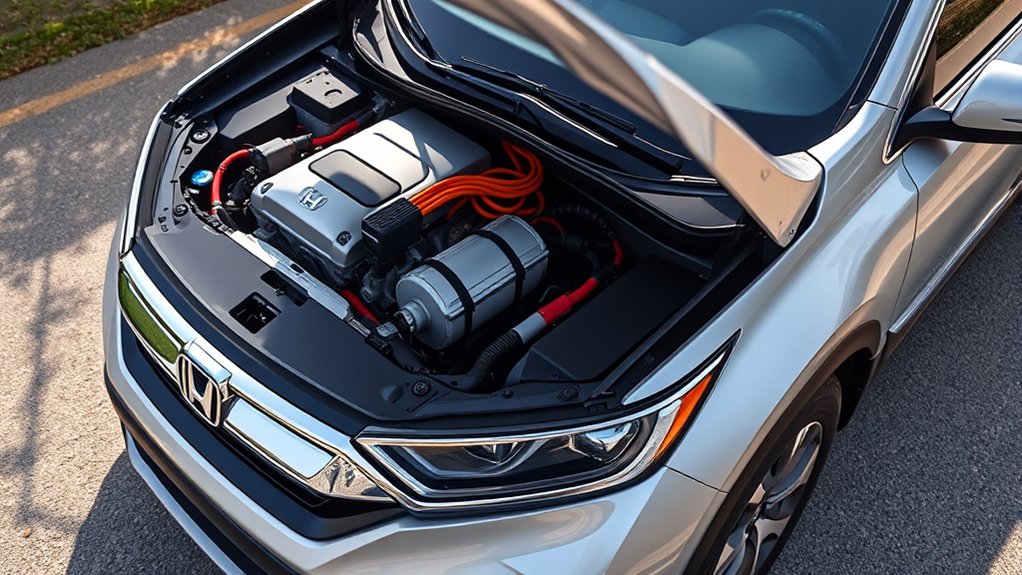
How exactly does Honda integrate its gasoline engine with electric motors in the CR-V Hybrid? Honda employs a sophisticated two-motor hybrid system that seamlessly balances power delivery between the gasoline engine and electric motors.
You’ll find that this integration optimizes fuel economy by automatically switching between electric-only, gasoline-only, or combined power modes based on driving conditions. The electric motors assist during acceleration, reducing fuel consumption while maintaining performance.
This system also minimizes the need for a bulky battery pack, preserving the CR-V Hybrid’s generous cargo space compared to competitors. By intelligently managing energy flow, Honda ensures you get efficient power without sacrificing practicality, making the CR-V Hybrid an ideal choice for drivers seeking both economy and utility in a compact SUV.
The Gasoline Engine’s Role in the CR-V Hybrid
The gasoline engine in the CR-V Hybrid serves as the primary power source during higher-speed driving and when battery charge is low, efficiently delivering consistent combustion energy. You’ll notice Honda’s engineering optimizes fuel injection and combustion timing to maximize efficiency, aligning with current sales trends favoring eco-conscious vehicles without sacrificing performance.
Its integration respects the CR-V’s design aesthetics, maintaining a compact engine bay that supports sleek styling.
Seamlessly designed to preserve the CR-V’s sleek look with a compact, efficient engine bay.
You’ll appreciate these engine contributions:
- Sustains power output during highway acceleration.
- Charges the battery during low electric use.
- Reduces reliance on frequent recharging.
- Enhances overall drivetrain durability.
How Electric Motors Help the CR-V Hybrid Perform Better
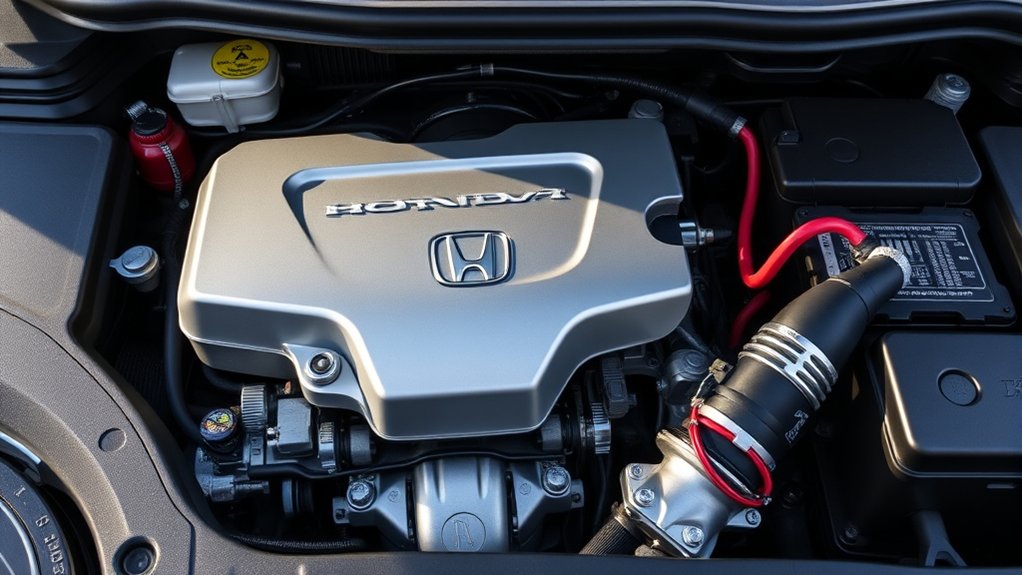
Why do electric motors substantially enhance the CR-V Hybrid’s performance? They provide instant motor torque, which improves acceleration responsiveness and overall drivability. Unlike gasoline engines, electric motors deliver peak torque from zero RPM, allowing you to experience smoother, more efficient power delivery during city driving or quick maneuvers.
Additionally, the CR-V Hybrid utilizes an eco charging system that recovers energy during braking and deceleration, converting kinetic energy into electrical energy. This stored energy powers the electric motors, reducing fuel consumption and emissions.
CR-V Hybrid Battery and Energy Storage Explained
You’ll find the CR-V Hybrid uses a lithium-ion battery designed for high energy density and durability. Its energy storage mechanism efficiently balances charge and discharge cycles to optimize performance.
The battery management system continuously monitors temperature, voltage, and current to guarantee safety and longevity.
Battery Type And Design
The Honda CR-V Hybrid manages its energy storage to optimize efficiency by using a lithium-ion battery specifically crafted for compactness and rapid charge-discharge cycles. This battery type delivers superior energy density versus traditional nickel-metal hydride packs, presenting a pro-Li-ion view for weight and performance. The battery pack’s modular arrangement improves thermal management, essential for longevity and steady output.
Consider these design highlights:
- High energy density for extended electric driving range
- Robust thermal control system to prevent overheating
- Compact architecture enabling better vehicle packaging
- Integration readiness for future innovations like solid-state batteries
This precise engineering ensures you experience both efficiency and reliability, aligning with Honda’s forward-looking hybrid technology ambitions.
Energy Storage Mechanism
Although the lithium-ion battery serves as the core energy reservoir, the CR-V Hybrid employs a sophisticated energy storage mechanism that dynamically balances power flow between the battery and the electric motors. This system optimizes energy use during acceleration, regenerative braking, and steady cruising, reducing tire wear and maximizing efficiency on long road trips.
You benefit from seamless energy transitions that maintain performance and battery longevity.
| Mode | Energy Source | Impact on Components |
|---|---|---|
| Acceleration | Battery + Engine | Reduced tire wear, efficient power delivery |
| Regenerative Braking | Electric Motor | Recharges battery, lowers brake wear |
| Cruising | Engine or Battery | Optimized fuel efficiency and battery use |
| Road Trip | Balanced use | Sustained battery life, minimal tire wear |
Battery Management System
The sophisticated energy storage mechanism in the CR-V Hybrid relies heavily on the Battery Management System (BMS) to maintain optimal/peak performance and safety. When you drive, the BMS constantly monitors the battery’s voltage, temperature, and state of charge, ensuring optimal energy flow without risking damage.
It balances cell voltages meticulously, preventing degradation and prolonging battery life. Unlike an unrelated topic or dummy text, this system’s precision directly impacts your vehicle’s efficiency and reliability. The BMS also safeguards against overheating and electrical faults, activating protective measures when necessary.
Here’s what it manages for you:
- Real-time monitoring of battery health
- Cell voltage balancing to avoid overcharge
- Temperature regulation for safety
- Fault detection and emergency shutoff
This technical oversight keeps your CR-V Hybrid running smoothly.
How Regenerative Braking Recharges the Hybrid Battery
When you apply the brakes in the Honda CR-V Hybrid, the system converts kinetic energy into electrical energy through regenerative braking. This energy is then directed to recharge the hybrid battery, optimizing efficiency during deceleration.
Understanding this energy conversion and battery charging mechanism is key to grasping how the hybrid system maintains its power supply.
Energy Conversion Process
How exactly does regenerative braking convert kinetic energy into electrical energy to recharge the hybrid battery? When you apply the brakes in a Honda CR-V Hybrid, the system shifts from traditional friction braking to energy recovery.
Here’s how you experience this precise energy conversion:
- The wheels’ kinetic energy, instead of being wasted as heat, powers the electric motor as a generator.
- This generator converts mechanical energy into electrical energy efficiently.
- The electrical energy flows directly into the hybrid battery, replenishing its charge.
- The system seamlessly balances braking force, ensuring safety without treating the unrelated topic of friction-only braking as an irrelevant concept.
This process maximizes energy use, reducing waste and enhancing overall efficiency in your drive.
Battery Charging Mechanism
Where does the electrical energy generated during regenerative braking go? It redirects to the hybrid battery pack, efficiently converting kinetic energy into electrical energy. When you brake, the motor acts as a generator, producing electricity that flows through the power control unit to recharge the battery.
This process optimizes recharge cycles, enhancing battery longevity and performance. You’ll notice that the system continuously monitors battery state-of-charge to prevent overcharging. Additionally, precise battery calibration ensures accurate energy management and optimal recharge efficiency.
When and Why the CR-V Hybrid Switches Power Sources

Why does the CR-V Hybrid alternate between its electric motor and gasoline engine? It intelligently switches power sources to optimize efficiency, performance, and emissions. You’ll notice these shifts occur based on specific driving conditions:
- Low-speed cruising relies on the electric motor to minimize fuel consumption and noise.
- Acceleration prompts the gasoline engine to engage, delivering additional power.
- Battery charge levels dictate when the engine activates to recharge via regenerative braking or direct combustion.
- High-speed driving or steep inclines require combined power from both sources for sustained performance.
This seamless power management complements the CR-V Hybrid’s refined interior design and harmonious color options, reflecting Honda’s commitment to technical excellence and driver experience. You benefit from a system that balances energy use precisely, enhancing your drive while reducing environmental impact.
What Makes the CR-V Hybrid System Different
What sets the CR-V Hybrid system apart is its integration of advanced powertrain components that optimize energy flow and responsiveness. Unlike typical hybrid setups, Honda employs a two-motor hybrid system that seamlessly balances electric and gasoline power without a traditional transmission.
This design trend emphasizes mechanical simplicity paired with electronic sophistication, improving efficiency and reducing weight. You’ll notice that many marketing claims highlight the CR-V Hybrid’s smooth acceleration and instant torque delivery, both results of precise energy management between the motors and battery.
Additionally, Honda’s system prioritizes regenerative braking to maximize energy recapture, enhancing overall efficiency. By focusing on hardware integration and control algorithms rather than just hybrid branding, the CR-V Hybrid delivers a technically refined experience that stands out amid current hybrid design trends.
Balancing Fuel Economy and SUV Utility in the CR-V Hybrid
The CR-V Hybrid’s advanced powertrain not only refines energy management but also addresses the challenge of combining fuel efficiency with the practical demands of an SUV. When you drive the CR-V Hybrid, you experience a seamless integration of drivetrain ergonomics that optimizes power delivery and reduces energy loss.
You’ll also appreciate cargo practicality, as Honda maintains ample storage without compromising hybrid components. This balance is achieved through:
- Efficient electric motor assist reducing gasoline consumption
- Intelligent AWD system adapting to terrain without excess fuel use
- Compact battery placement preserving interior and cargo space
- Regenerative braking recovering energy while maintaining driving dynamics
Frequently Asked Questions
How Much Does It Cost to Maintain a Honda CR-V Hybrid?
You’ll spend about $400 to $600 annually on hybrid maintenance for your Honda CR-V Hybrid. Regular check-ups optimize battery longevity, minimizing costly replacements while ensuring efficient system performance through precise diagnostics and fluid exchanges.
What Is the Warranty Coverage for the CR-V Hybrid Battery?
Like a trusty sidekick, Honda’s warranty coverage for the CR-V Hybrid battery protects you for 8 years or 100,000 miles, ensuring optimal battery life with precise diagnostics and replacements if capacity dips below 70%.
Are There Any Tax Incentives for Purchasing a CR-V Hybrid?
You might qualify for hybrid tax incentives when purchasing a CR-V Hybrid, but current eligibility depends on federal and state regulations. Check updated local guidelines to confirm if you meet specific criteria for these financial benefits.
How Does the CR-V Hybrid Perform in Cold Weather Conditions?
You’ll find the CR-V Hybrid’s cold weather performance reliable, thanks to its battery heating system that maintains optimal temperature. This ensures consistent power delivery and efficiency, minimizing performance drops in low temperatures during your drives.
What Are the Differences Between the CR-V Hybrid and the Non-Hybrid Model?
You’ll notice the CR-V Hybrid uses hybrid technology combining electric motors with a gasoline engine, boosting engine efficiency and reducing emissions.
The non-hybrid relies solely on a traditional gasoline engine, offering less fuel economy and fewer eco benefits.
Conclusion
You’ll find the Honda CR-V Hybrid dances smoothly between gas and electric power, optimizing efficiency like a skilled conductor leading an orchestra. Its intelligent system switches seamlessly, balancing performance and fuel economy without sacrificing SUV practicality.
By harnessing regenerative braking and smart energy management, it keeps you moving efficiently while reducing emissions. This precise harmony between components ensures you get the best of both worlds—powerful yet eco-friendly driving tailored to your needs.
In conclusion, the Honda CR-V Hybrid works by combining advanced technology and smart design to deliver a driving experience that is both dynamic and environmentally responsible.