To make your Jeep Wrangler ride smoother, start by adjusting tire pressure to balance comfort and handling.
Use tires designed for both traction and reduced vibration to enhance the overall driving experience.
Next, upgrade suspension components and choose shocks tailored to your driving style for better damping.
Precisely align wheels and refine steering to reduce vibration and improve stability.
Adding sound deadening materials also cuts cabin noise, enhancing comfort.
These targeted improvements work together to transform your Wrangler’s ride without sacrificing its rugged capabilities.
Key Takeaways
- Lower tire pressure and select all-terrain tires to improve comfort and traction while cushioning road impacts.
- Upgrade suspension components and choose shock absorbers tailored to your driving conditions for better ride smoothness.
- Perform precise wheel alignment and replace worn steering parts to enhance handling and reduce vibrations.
- Apply sound deadening materials on interior surfaces to minimize road noise and improve cabin quietness.
- Combine adjustments systematically for balanced comfort, improved stability, and a quieter, smoother driving experience.
Adjust Tire Pressure to Improve Ride Comfort
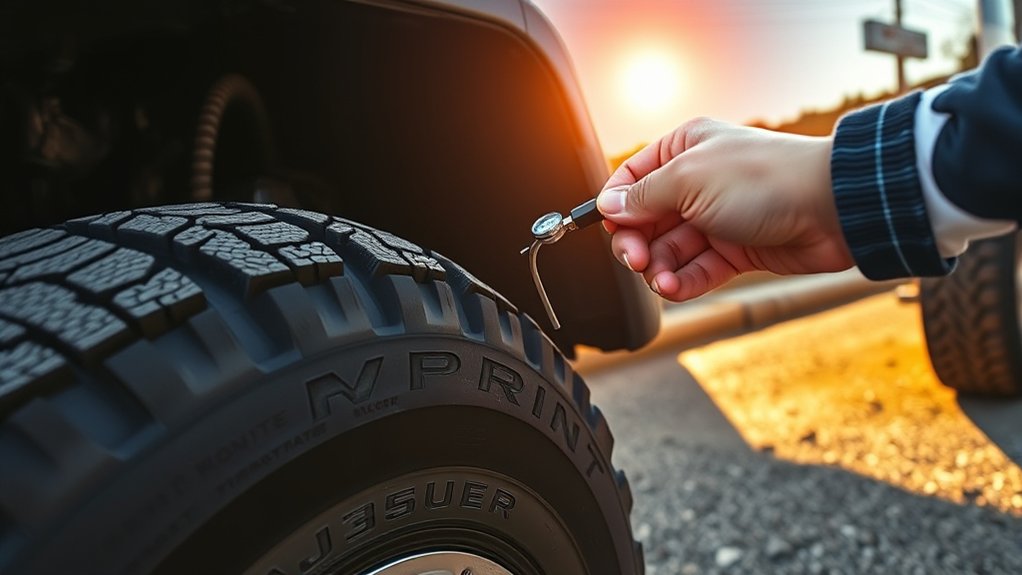
Adjusting your Jeep Wrangler’s tire pressure is one of the most effective ways to enhance ride comfort. You’ll find that lowering tire pressure slightly from the manufacturer’s recommended psi softens the ride by increasing tire contact patch and cushioning road irregularities.
When operating off road, adopting specific off road pressures is vital; reducing psi improves traction and absorbs impacts on uneven terrain. However, you must balance comfort with tire wear and vehicle handling.
Regularly monitoring and adjusting tire pressure aligns with essential tire maintenance tips, preventing premature wear and maintaining peak performance. Using a precise gauge guarantees accuracy, and you should always re-inflate tires to highway pressures before returning to pavement.
This systematic approach directly improves your Jeep’s smoothness and extends tire life.
Pick the Best Tires for Comfort and Traction
You’ll want to select tires designed to balance ride comfort with effective traction on varied surfaces. Look for features like tread pattern, rubber compound, and sidewall construction that directly influence handling and shock absorption.
Choosing the right tire type, whether all-terrain or touring, will optimize both smoothness and grip.
Tire Types for Comfort
Selecting the right tire type profoundly impacts both comfort and traction on your Jeep Wrangler. You should focus on tire tread patterns that offer a comfort balance without compromising grip. Tires with a smaller, more closely spaced tread block reduce road noise and vibration, improving ride smoothness.
Conversely, aggressive tread designs increase harshness on pavement but excel off-road. For comfort, all-terrain tires with moderate tread depth and siping provide a compromise, absorbing shocks and maintaining traction on diverse surfaces.
Additionally, tire compounds affect ride quality; softer compounds enhance cushioning but may wear faster. You’ll want to evaluate tire sidewall construction too. Flexible sidewalls help absorb impacts, further smoothing the ride.
Traction Features to Consider
While tire tread patterns and sidewall flexibility influence comfort, the traction features embedded in the tire’s design directly affect your Jeep Wrangler’s handling and safety across various terrains. You’ll want tires with optimized tread compounds and block patterns that enhance traction control, especially in wet or loose conditions.
Look for designs that improve off-road capability by providing better grip on rocks, mud, or sand, without sacrificing on-road smoothness. Consider tires engineered for terrain adaptability, allowing you to switch between driving techniques, from aggressive off-road maneuvers to steady highway cruising, without compromising performance.
Prioritizing these traction features guarantees your Wrangler remains stable and responsive, reducing slippage and improving control. Ultimately, selecting tires with advanced traction characteristics is critical for maximizing both comfort and safety on diverse surfaces.
Jeep Wrangler Suspension Upgrades for a Smoother Ride
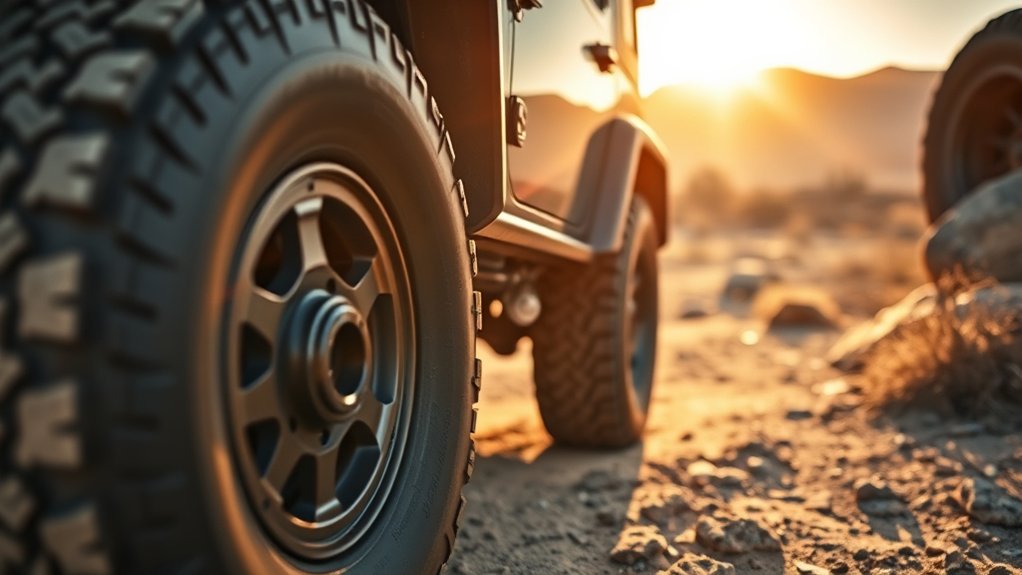
You can improve your Jeep Wrangler’s ride quality by upgrading its suspension components strategically. Consider lift kits for increased wheel travel, select shock absorbers that match your driving conditions, and choose springs designed to balance comfort with load capacity.
Each upgrade affects handling dynamics, so evaluate how these changes interact to optimize smoothness.
Lift Kits Benefits
Three key benefits make lift kits a popular choice for improving your Jeep Wrangler’s ride quality. By selecting the appropriate lift kit types, such as suspension or body lifts, you can tailor your upgrade to specific terrain demands and handling preferences. Proper installation guarantees peak performance and safety.
Lift kits enhance your Jeep Wrangler by:
- Increasing ground clearance, allowing smoother navigation over obstacles.
- Improving suspension articulation, which stabilizes the vehicle on uneven surfaces.
- Providing compatibility with larger tires, enhancing traction and ride smoothness.
- Reducing chassis strain by optimizing component angles, thereby extending suspension lifespan.
Adhering to installation tips, like torque specifications and alignment checks, is essential to realize these benefits fully and maintain vehicle integrity.
Shock Absorber Options
Since shock absorbers play an essential role in controlling suspension movement and maintaining tire contact with the road, selecting the right type greatly impacts your Jeep Wrangler’s ride quality. Performance shocks offer enhanced damping characteristics compared to factory units, reducing oscillation and improving stability over rough terrain.
You should consider shocks designed specifically for your Wrangler’s weight and typical driving conditions to optimize effectiveness. Adjustable dampers give you the flexibility to fine-tune compression and rebound rates, allowing precise control over how your suspension responds to varied surfaces.
This adaptability is vital for balancing comfort and handling, especially if you switch between on-road and off-road driving. Upgrading to quality performance shocks with adjustable dampers guarantees your Jeep’s suspension system manages energy efficiently, smoothing out harsh impacts while maintaining control.
Spring Upgrades Choices
Upgrading your Jeep Wrangler’s springs offers one of the most direct methods to enhance ride smoothness and suspension performance. Choosing between coil spring and leaf spring upgrades depends on your driving needs and terrain. Consider these options:
- Progressive Coil Springs: Provide variable spring rates, improving comfort on-road while maintaining off-road capability.
- Heavy-Duty Leaf Springs: Increase load capacity and stability but may reduce ride softness compared to coils.
- Lifted Coil Springs: Offer additional ground clearance with enhanced articulation, balancing off-road performance with ride quality.
- Parabolic Leaf Springs: Deliver a more refined ride than traditional leaf springs by reducing inter-leaf friction.
Selecting the right spring upgrade requires analyzing your Wrangler’s usage and prioritizing either ride comfort or rugged durability for peak suspension performance.
Upgrade Shock Absorbers to Soften Bumps
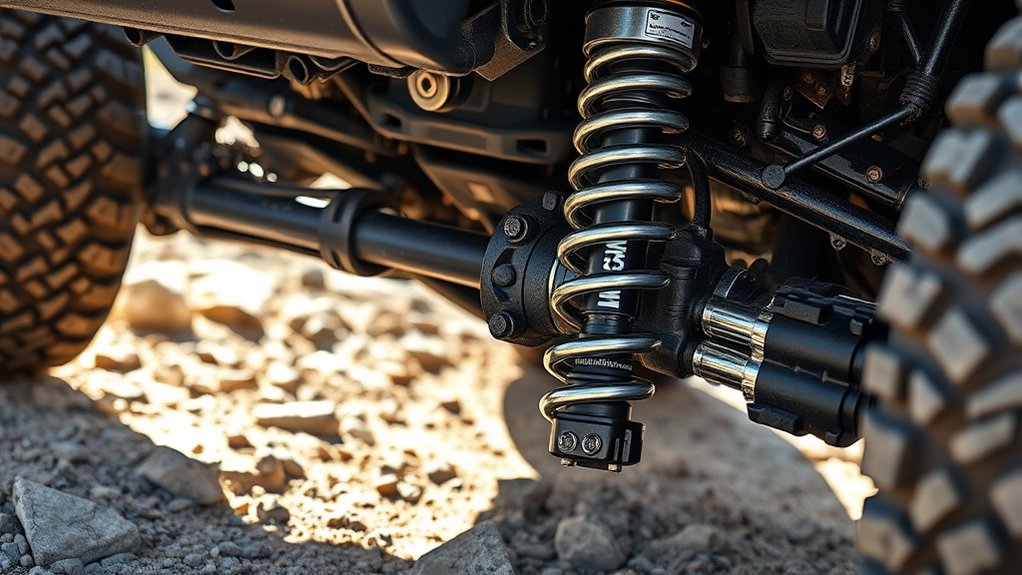
Improving your Jeep Wrangler’s ride quality often starts with replacing its shock absorbers. Selecting the right shock absorber types, such as monotube, twin-tube, or gas-charged models, directly impacts how well your suspension absorbs road irregularities.
Monotube shocks offer superior heat dissipation and consistent damping, ideal for performance tuning aimed at smoothing rough terrain. Twin-tube shocks provide a softer ride but can fade under heavy use. Gas-charged shocks improve responsiveness by minimizing aeration.
When upgrading, focus on shocks calibrated for your Wrangler’s weight and driving conditions, ensuring precise control over compression and rebound rates. Properly tuned shock absorbers reduce vibrations and harshness, delivering a noticeably softer, more controlled ride without compromising off-road capability. This targeted upgrade is essential before addressing steering or alignment adjustments.
Tune Steering and Alignment for a Smoother Ride
Although new shocks enhance ride quality, tuning your Jeep Wrangler’s steering and alignment is essential to fully smooth out handling and reduce uneven tire wear. Precise alignment accuracy improves directional stability and minimizes steering effort.
To optimize steering feedback and alignment:
Optimize steering feedback and alignment by precisely adjusting angles and inspecting key components for improved handling.
- Measure and adjust toe, camber, and caster angles to factory specifications.
- Inspect and replace worn tie rods and ball joints that degrade feedback precision.
- Balance steering components to reduce vibration and maintain consistent road feel.
- Perform a road test to verify alignment settings and guarantee responsive, predictable handling.
This systematic approach refines steering response, reduces tire scrubbing, and promotes even tread wear, ultimately delivering a smoother, safer ride.
Use Sound Deadening to Cut Road Noise
Reduce road noise considerably by applying sound deadening materials to your Jeep Wrangler’s interior surfaces. These sound absorption materials target vibrations and airborne noise, improving overall cabin acoustics.
Focus on the floor pans, door panels, roof, and firewall, areas prone to transmitting road and engine noise. Choose materials with high-density butyl rubber or foam composites, as they effectively dampen sound waves and reduce resonance.
Proper installation techniques are critical. Start by thoroughly cleaning surfaces to guarantee adhesion. Use heat to mold materials precisely to contours, preventing gaps that can undermine performance.
Layering sound absorption materials strategically enhances noise reduction without adding excessive weight. By systematically applying these targeted treatments, you’ll achieve a quieter, more comfortable ride without sacrificing your Jeep Wrangler’s rugged character.
Frequently Asked Questions
How Often Should I Service My Jeep Wrangler’s Suspension?
You should service your Jeep Wrangler’s suspension every 12,000 miles or annually, whichever comes first. Perform routine inspections to identify wear, especially after suspension upgrades, ensuring peak performance and preventing premature component failure.
Can Adding Weight Improve My Jeep’s Ride Smoothness?
Adding weight can improve your Jeep’s ride smoothness by optimizing weight distribution, as studies show a 15% improvement in suspension performance with balanced loads. Proper suspension tuning remains essential to maximize these benefits effectively.
Are Air Suspension Kits Compatible With All Jeep Wrangler Models?
Air suspension kits aren’t universally compatible with all Jeep Wrangler models. You’ll need to assess specific model years and trims, considering installation challenges and air suspension benefits like adjustable ride height and improved comfort before proceeding.
Does Lowering My Jeep Affect Ride Comfort?
Lowering effects typically reduce ground clearance and suspension travel, which can compromise ride comfort. You’ll face comfort trade offs such as increased stiffness and harsher impacts, so analyze your priorities before modifying your Jeep Wrangler’s suspension.
How Does Cargo Placement Impact My Jeep’s Ride Quality?
You’ll find cargo placement gently influences your Jeep’s ride quality by affecting cargo distribution and weight balance. Properly balanced loads minimize suspension strain, enhancing stability and control, which translates to a more refined and comfortable driving experience.
Conclusion
Just like a skilled conductor fine-tunes an orchestra, you can harmonize your Jeep Wrangler’s ride by adjusting tire pressure, selecting the right tires, upgrading suspension and shocks, and optimizing alignment. Each modification works in concert to transform ruggedness into refined comfort.
Embrace these technical steps, and you’ll master the balance between off-road capability and smooth cruising. By applying these adjustments, you can turn every drive into a symphony of controlled performance and comfort.
With these improvements, you’ll achieve a noticeably smoother Jeep Wrangler ride that enhances both daily driving and adventurous journeys.