The Jeep Wrangler’s width ranges from about 73.7 inches on two-door Sport models to 74.4 inches on four-door Rubicon trims.
Width varies slightly with trim-specific features like fender flares and mirrors. Accessories like roof racks or larger tires can add width, affecting garage fit and off-road maneuverability.
This width influences stability on uneven terrain and clearance in tight spaces.
Understanding these dimensions helps optimize parking and trail performance. You can explore how specific trims and conditions impact your Wrangler’s handling.
Key Takeaways
- The standard two-door Jeep Wrangler is approximately 73.7 inches wide without mirrors.
- The four-door Wrangler Unlimited measures around 74.4 inches wide, slightly wider than the two-door model.
- Trim levels like Sport and Sahara maintain about 73.8 inches width, while Rubicon extends to 74.4 inches due to off-road features.
- Fender flares and mirrors affect overall width, so exact measurements vary by model year and accessories.
- Including mirrors, width can increase, impacting garage clearance and off-road maneuverability on narrow trails.
How Wide Is a Jeep Wrangler Across Different Models?
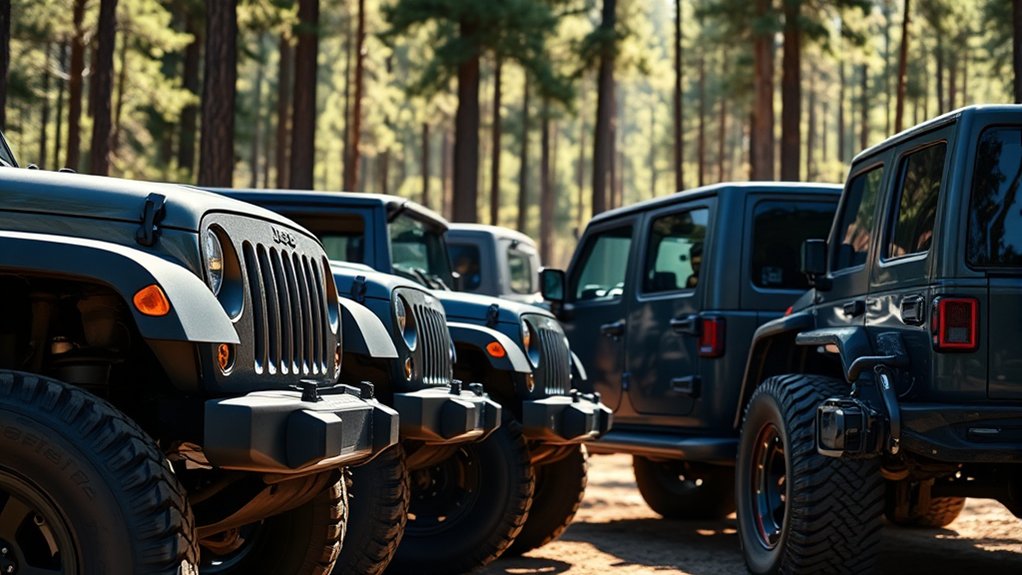
While the exact width of a Jeep Wrangler varies by model and year, you’ll find that most fall within a specific range tailored for off-road capability and road stability. When analyzing Jeep models, the standard two-door Wrangler typically measures about 73.7 inches wide without mirrors, whereas the four-door Unlimited version extends slightly wider, around 74.4 inches.
These dimensions reflect design choices balancing maneuverability on rugged terrain with highway safety. Wrangler comparisons reveal that despite trim variations, width remains fairly consistent, ensuring compatibility with existing aftermarket accessories and trail obstacles.
Understanding these width parameters helps you select the right model for your needs, especially when considering garage space or off-road trail width restrictions. Always check specific model year data for precise measurements.
What Are the Width Differences Between Jeep Wrangler Trims?
Building on the general width measurements for Jeep Wranglers, examining the differences between specific trims reveals subtle variations that can impact fitment and handling. When you analyze Jeep Wrangler width comparisons, you’ll find that Sport and Sahara trims typically measure around 73.8 inches without mirrors.
The Rubicon trim often extends slightly wider due to its off-road enhancements, reaching about 74.4 inches. Trim specific dimensions also reflect changes in fender flares and mirror sizes, contributing to these differences.
Understanding these precise width variations helps you anticipate how each trim fits in tighter spaces or handles off-road conditions. This technical approach to Jeep Wrangler width comparisons guarantees you select the trim that best aligns with your spatial and performance requirements.
Why Jeep Wrangler Width Matters for Garage and Parking
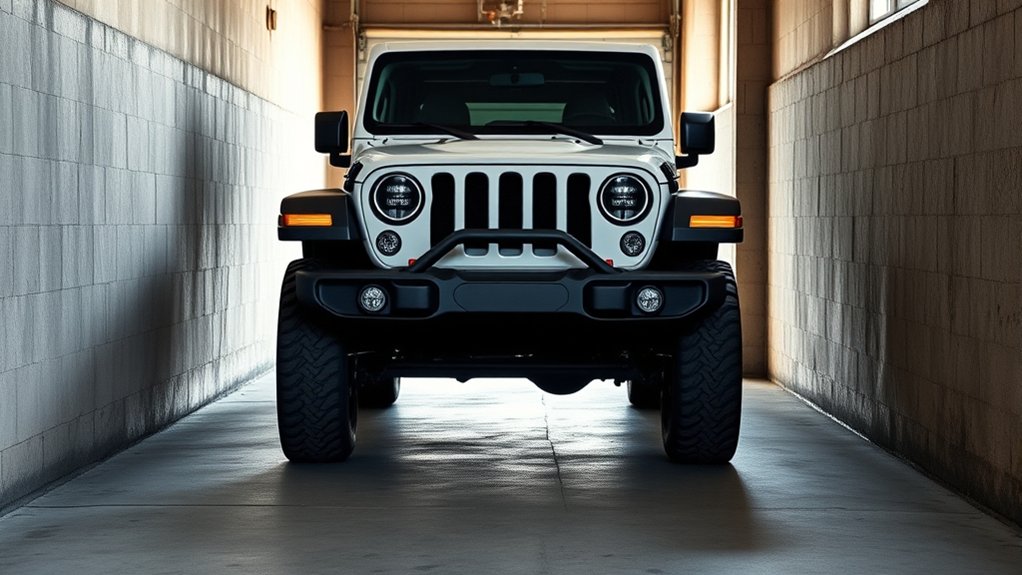
You need to take into account your garage’s width to guarantee the Jeep Wrangler fits comfortably without risking damage. The Wrangler’s size can complicate parking maneuvers, especially in tight spaces or narrow spots.
Additionally, its width affects how easily you can access the vehicle once parked.
Garage Space Requirements
One critical factor to evaluate when accommodating a Jeep Wrangler in your garage is its width, which directly impacts maneuverability and available clearance. The Wrangler’s width, typically around 73 to 75 inches depending on the model, requires you to take into account your garage dimensions carefully.
Standard residential garages, often 8 to 9 feet wide, may provide limited space for vehicle clearance. You’ll need at least 6 to 12 inches of clearance on each side to open doors comfortably and avoid scraping walls. Additionally, any storage or shelving along the garage walls further reduces usable width.
Evaluating your garage’s internal width and factoring in the Wrangler’s dimensions helps guarantee safe entry and exit, protects both the vehicle and structure, and maintains convenient access to your Jeep without constraining the space.
Parking Maneuverability Challenges
Although the Jeep Wrangler’s rugged width enhances stability and off-road capability, it presents distinct challenges when parking in tight garages or crowded spaces. You’ll need precise parking techniques and effective space management to avoid scrapes and guarantee smooth entry and exit. Its wider stance limits maneuvering room, requiring careful angle adjustments and awareness of clearance.
| Challenge | Impact | Recommended Technique |
|---|---|---|
| Narrow Garage Doors | Limited entry space | Use slow, incremental turns |
| Tight Parking Spots | Reduced lateral clearance | Utilize side mirrors actively |
| Adjacent Vehicles | Risk of door dings | Park centrally within spot |
| Obstructed Visibility | Difficult spatial judgment | Employ backup cameras |
| Limited Turning Radius | Complex positioning | Practice multi-point turns |
Mastering these tactics helps you manage space effectively despite the Wrangler’s width.
Width Impact on Accessibility
The Jeep Wrangler’s width, typically ranging between 73 to 75 inches depending on the model year and trim, directly affects its accessibility in garages and parking structures. This dimension plays a critical role in determining whether the vehicle fits comfortably within standard garage spaces and parking spots, which often have width constraints between 72 and 78 inches.
You’ll notice that limited clearance can hinder door opening and restrict movement around the vehicle. Accessibility features like wider door openings and adjustable mirrors can improve user adaptability, but the core width remains a limiting factor.
When planning for garage modifications or parking arrangements, you must consider the Wrangler’s width to guarantee safe, convenient access without risking damage to the vehicle or surrounding structures.
How Does Jeep Wrangler Width Affect Off-Road Performance?
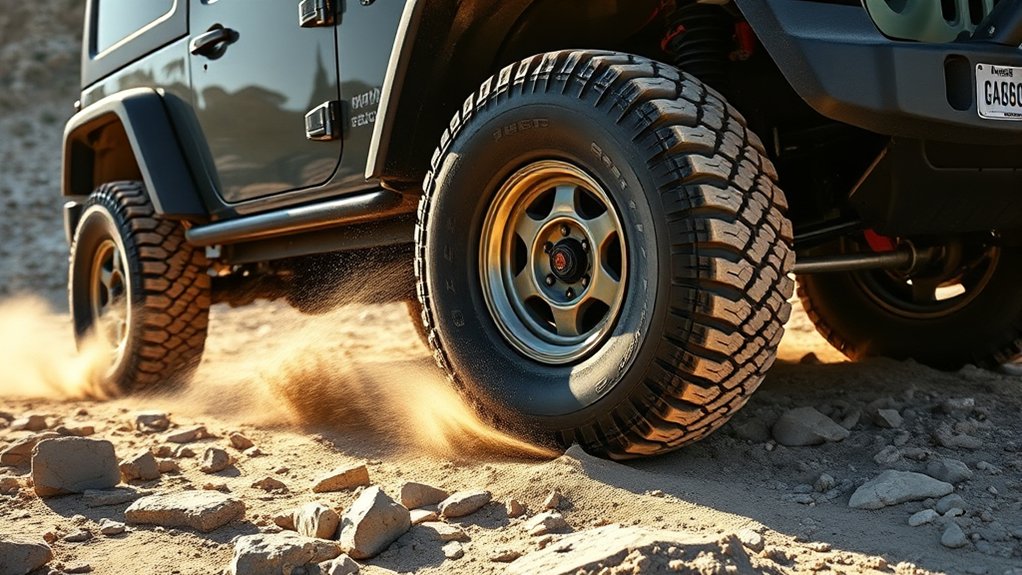
When you tackle uneven terrain, the Jeep Wrangler’s width directly influences its stability by affecting its center of gravity and track width. A wider stance improves balance on slopes but can limit your ability to navigate tight, narrow trails.
Understanding this trade-off helps you optimize your off-road performance based on the specific environment.
Stability On Uneven Terrain
Since uneven terrain challenges a vehicle’s balance, the Jeep Wrangler’s width plays an essential role in its off-road stability. The Wrangler’s track width directly influences stability factors such as lateral stability and rollover resistance.
A wider stance lowers the center of gravity relative to the wheelbase, enhancing the vehicle’s ability to resist tipping when maneuvering through rocky, sloped, or uneven terrain types. Additionally, the width distributes weight more evenly across the tires, improving traction on loose or irregular surfaces.
However, excessive width can increase the risk of contact with obstacles, so the Wrangler balances width to optimize stability without compromising clearance. Understanding these stability factors helps you appreciate how the Wrangler’s dimensions contribute to confident handling and safety on challenging off-road landscapes.
Maneuverability Through Narrow Trails
While the Jeep Wrangler’s width enhances stability on uneven terrain, it also impacts your ability to navigate tight, narrow trails. The vehicle’s trail navigation capabilities depend heavily on its width, which can limit passage through confined spaces. However, the width advantages contribute to improved control and traction, reducing the risk of tipping on uneven ground.
Understanding this balance helps you optimize off-road performance.
Consider these aspects when maneuvering through narrow trails:
- Precise control needed to avoid obstacles close to wide fenders
- Awareness of vehicle width to prevent side scrapes or damage
- Use of advanced suspension to maintain traction despite limited lateral space
- Importance of spotters or cameras in tight trail navigation
- Width advantages offering confidence on challenging terrain without sacrificing safety
You’ll find that mastering the Wrangler’s width is key to effective off-road maneuverability.
Jeep Wrangler Width Compared to Other Off-Road Vehicles
Among popular off-road vehicles, the Jeep Wrangler’s width ranges from approximately 73.8 to 75.8 inches, depending on the model and configuration. When you conduct a Jeep comparison with other off-road vehicles like the Toyota 4Runner or Ford Bronco, you’ll notice the Wrangler typically falls within a moderate width range.
This balance in vehicle dimensions supports both stability on rugged terrain and maneuverability in tight trails. The Wrangler’s width advantages become apparent as it offers a wider stance than many compact SUVs, enhancing off-road capabilities by improving traction and control.
However, it remains narrower than some full-size trucks, allowing you to navigate narrower passages more easily. Understanding these width parameters helps you assess how the Jeep Wrangler fits your off-road driving needs.
How Adding Accessories Changes Your Jeep Wrangler’s Width
When you add accessories like fender flares, roof racks, or aftermarket bumpers to your Jeep Wrangler, its overall width can increase considerably. These modifications cause noticeable accessory impact on width variations, often pushing the vehicle beyond factory measurements. You need to account for each addition’s dimensions to understand your Jeep’s new footprint precisely.
Adding accessories like fender flares and roof racks can significantly widen your Jeep Wrangler beyond factory specs.
Common accessories influencing width include:
- Fender flares extending beyond the wheel wells
- Roof racks adding lateral projections
- Side steps or rock sliders widening the stance
- Aftermarket bumpers with integrated winches or lights
- Larger off-road tires that increase track width
Each accessory alters clearance requirements, affecting maneuverability and parking. By measuring before and after installation, you can accurately assess width variations and guarantee your Jeep Wrangler remains compatible with your intended driving environment.
Trail Conditions That Favor Wider vs. Narrower Jeep Wranglers
Because trail conditions vary widely, understanding how your Jeep Wrangler’s width impacts performance is essential for selecting the right setup. On narrow, technical trails with tight turns and dense obstacles, a narrower Wrangler offers clear width advantages by enhancing maneuverability and reducing the risk of body strikes.
Conversely, wider Wranglers excel on trails with deep ruts, loose sand, or rocky ledges, where increased track width improves stability and distributes weight more effectively. These width advantages help you maintain control during lateral shifts and prevent tipping on uneven terrain.
Evaluating the specific trail challenges you face, whether tight clearance or stability-demanding conditions, allows you to choose a Wrangler width that maximizes off-road capability and safety for your intended use.
Tips for Maneuvering a Wide Jeep Wrangler on Narrow Trails
Steering narrow trails with a wide Jeep Wrangler demands careful planning and precise control to avoid obstacles and minimize body damage. Your trail navigation skills must emphasize width awareness, as even slight misjudgments can lead to scrapes or stuck wheels.
To maneuver effectively, keep these tips in mind:
- Constantly assess the trail width and anticipate tight spots.
- Use spotters or cameras to monitor clearance on both sides.
- Engage low-range gearing for controlled, slow-speed handling.
- Adjust tire pressure for better traction without sacrificing stability.
- Practice smooth steering inputs to prevent overcorrection.
How to Accurately Measure Your Jeep Wrangler’s Width
To accurately measure your Jeep Wrangler’s width, start by identifying the widest points, which typically include the side mirrors and the body panels. Use precise measurement tools such as a tape measure or laser distance measurer to guarantee accuracy.
Measure from the outer edge of the left side mirror to the outer edge of the right side mirror for the maximum width. For body width, measure between the widest points of the fenders or door panels.
Record these measurements carefully and compare them to the official width specifications provided by Jeep for your specific Wrangler model and year. This method guarantees you capture both the overall and body-only widths, essential for clearance assessments and modifications.
Accurate measurements help prevent miscalculations in trail navigation and garage fitting.
Frequently Asked Questions
What Is the Fuel Efficiency of Different Jeep Wrangler Models?
You’ll find Jeep Wrangler fuel efficiency varies by model, averaging 17-25 MPG. With a fuel tank capacity around 21 gallons, your driving range typically spans 350-525 miles, depending on engine type and driving conditions.
How Much Does a Jeep Wrangler Typically Cost?
Jeep Wrangler pricing starts around $30,000 and climbs like a mountain with higher Jeep Wrangler trims, reaching over $50,000 for fully loaded models.
You’ll find specific features and tech vary considerably between trims.
What Are the Engine Options Available for Jeep Wranglers?
You’ll find Jeep Wrangler engine specifications include a 2.0L turbocharged inline-4 producing 270 horsepower and a 3.6L V6 delivering 285 horsepower, both offering robust power output for versatile off-road performance.
How Does the Jeep Wrangler Perform in Snow and Ice Conditions?
You’ll appreciate that the Jeep Wrangler’s four-wheel drive boosts snow traction by over 30%, enhancing ice handling. Its locking differentials and rugged tires actively maintain grip, ensuring stable control during slippery, icy road conditions.
What Are Common Maintenance Tips for Jeep Wrangler Owners?
You should prioritize tire rotation every 6,000 miles, perform regular fluid checks, and maintain battery health. Inspect brakes meticulously and consider suspension upgrades. Prepare off-road gear to guarantee your Jeep Wrangler’s peak performance and longevity.
Conclusion
Understanding your Jeep Wrangler’s width is like knowing the width of a river before you build a bridge—it’s essential for safe passage. Whether you’re traversing tight garages, narrow trails, or comparing trims, precise measurements help you optimize space and performance.
Keep in mind how accessories can add inches, impacting maneuverability. By mastering these width details, you guarantee your Wrangler’s capability matches your adventure, making every drive both efficient and exhilarating.
In conclusion, knowing exactly how wide your Jeep Wrangler is ensures you can confidently tackle any terrain or parking challenge that comes your way.