You design and optimize methods for safe, efficient petroleum extraction as an oil engineer by analyzing geological data and monitoring drilling operations.
You tackle technical challenges with sharp problem-solving skills, guarantee regulatory compliance, and enhance reservoir performance through data-driven strategies.
Managing complex logistics in harsh environments and applying advanced drilling techniques are essential to your role.
Your work safeguards continuous energy supply and boosts economic stability.
Explore further to understand the sophisticated processes and innovations shaping your impact in oil engineering.
Key Takeaways
- Oil engineers design and implement efficient methods for petroleum extraction and reservoir management.
- They analyze geological data to identify drilling sites and optimize oil recovery.
- They monitor drilling operations, troubleshoot technical issues, and ensure safety compliance.
- Oil engineers develop risk assessments, emergency response plans, and promote environmental sustainability.
- They coordinate logistics and maintenance to maintain continuous, safe, and efficient oil production.
Roles and Responsibilities of Oil Engineers
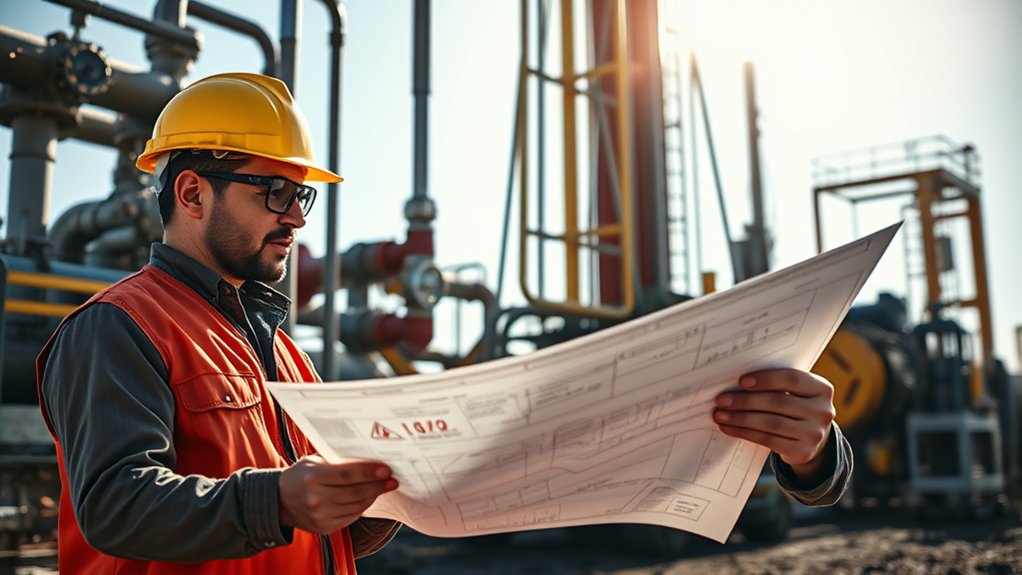
Oil engineers design and implement methods to extract petroleum from underground reservoirs efficiently and safely. You’ll develop exploration strategies that analyze geological data to identify viable drilling sites, ensuring maximum resource recovery with minimal environmental impact.
Your role demands precise project management skills to coordinate multidisciplinary teams, control budgets, and adhere to strict timelines. You’ll monitor drilling operations, troubleshoot technical challenges, and optimize production processes using advanced modeling tools.
Safety protocols and regulatory compliance are integral to your responsibilities, requiring you to conduct risk assessments and implement mitigation measures. By integrating engineering principles with real-time data analysis, you’ll enhance reservoir performance and extend field life.
Ultimately, your analytical approach and strategic oversight are essential to maximizing yield while minimizing operational risks in complex oil extraction projects.
Key Skills Every Oil Engineer Needs
You’ll need strong technical expertise to understand complex drilling and reservoir systems. Your problem-solving skills must be sharp to address unexpected challenges in the field efficiently.
Together, these abilities form the foundation for successful performance as an oil engineer.
Technical Expertise Requirements
Although the field demands a broad knowledge base, mastering specific technical skills is vital for success as an oil engineer. You need strong geological knowledge to interpret subsurface formations accurately.
Expertise in reservoir engineering allows you to assess hydrocarbon reserves and optimize extraction methods. Drilling optimization skills help you design efficient drilling programs, minimizing risks and costs.
Accurate production forecasting is critical for planning output and meeting market demands. You must guarantee regulatory compliance to adhere to safety and environmental standards.
Project management capabilities enable you to coordinate multidisciplinary teams and timelines effectively. Proficiency in data analysis supports informed decision-making through interpreting complex datasets.
Finally, cost estimation skills allow you to budget operations realistically, balancing performance with financial constraints. These competencies form the technical foundation for your role.
Problem-Solving Abilities
Since unexpected challenges frequently arise during exploration and production, your ability to solve complex problems quickly and effectively is essential. You must apply analytical thinking to assess multifaceted issues, such as reservoir inconsistencies or equipment malfunctions, and identify root causes with precision.
By leveraging innovative solutions, you optimize extraction processes and minimize downtime, ensuring operational efficiency. Your problem-solving approach integrates data analysis, engineering principles, and real-time feedback to adapt strategies dynamically.
This skill set enables you to anticipate potential risks and implement corrective actions proactively. Ultimately, your capacity to navigate technical uncertainties and devise practical, evidence-based interventions defines your effectiveness as an oil engineer and drives project success in an unpredictable environment.
Finding and Evaluating Oil Reserves
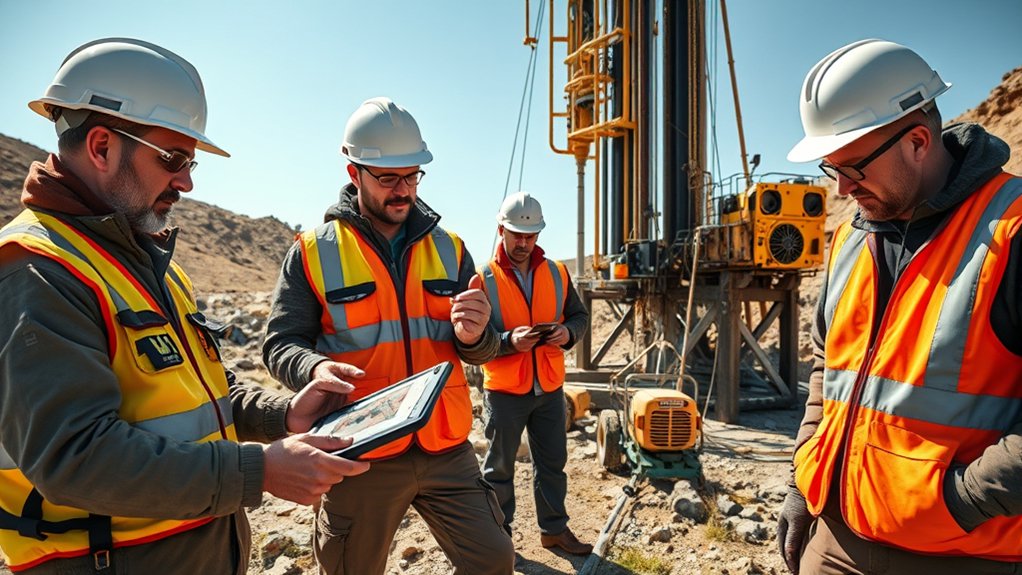
Before drilling begins, engineers must locate and assess potential oil reserves using geological surveys, seismic data, and reservoir modeling. You analyze seismic reflections to interpret subsurface structures, aiding reserve estimation and guiding exploration strategies.
Data interpretation integrates geological surveys with seismic analysis to refine resource management plans and predict reservoir behavior. Economic assessments evaluate extraction methods’ feasibility, balancing costs with potential yield.
This rigorous approach guarantees efficient, cost-effective resource development.
| Task | Purpose |
|---|---|
| Geological Surveys | Identify rock formations and traps |
| Seismic Analysis | Map subsurface structures |
| Reserve Estimation | Quantify recoverable oil volumes |
Drilling Techniques Used by Oil Engineers
Oil engineers employ a range of drilling techniques to access subsurface reservoirs efficiently and safely. You’ll start with seismic surveying to map the geological structures and identify ideal drilling locations.
Among drilling methods, rotary drilling is fundamental, using a rotating drill bit to penetrate rock formations. When reservoirs lie off vertical paths, directional drilling lets you precisely steer the drill to reach target zones.
Rotary drilling forms the core technique, with directional drilling enabling precise navigation to challenging reservoirs.
Offshore drilling demands specialized rigs and techniques to manage deepwater pressures and environmental constraints. You also apply hydraulic fracturing to enhance well productivity by creating fractures in impermeable rock.
Throughout drilling, you control drilling fluids to lubricate the bit, stabilize the wellbore, and remove cuttings. Finally, well completion guarantees the well is prepared for safe extraction, involving casing, cementing, and installing production equipment.
Technologies in Oil Engineering That Boost Efficiency

When you integrate advanced technologies into oil engineering, you greatly enhance operational efficiency and reduce costs. Automation advancements streamline repetitive tasks, allowing you to monitor and control drilling operations remotely with precision.
These systems minimize human error and optimize resource allocation, accelerating project timelines. Data analytics plays a critical role by processing vast datasets from sensors and equipment, enabling you to identify patterns, predict equipment failures, and optimize production rates.
By leveraging real-time data, you can make informed decisions quickly, improving reservoir management and reducing downtime. Together, automation advancements and data analytics transform traditional workflows into dynamic, responsive processes.
This technological synergy not only boosts efficiency but also maximizes asset utilization, ensuring your operations remain competitive and economically viable in a demanding industry.
Ensuring Safety and Environmental Protection
Although advancing efficiency remains a priority, you must prioritize safety and environmental protection to sustain operations and comply with regulations. Your role demands rigorous risk assessment and hazard identification to preempt incidents.
You enforce safety protocols that align with regulatory compliance, minimizing environmental impact and promoting sustainability practices. Effective emergency response plans are essential to mitigate potential damages swiftly.
Additionally, community engagement is critical; you communicate transparently with local stakeholders to address concerns and foster trust.
Key actions include:
- Conducting thorough risk assessments and hazard identification to prevent accidents.
- Implementing robust safety protocols ensuring adherence to regulatory compliance.
- Developing emergency response strategies and maintaining active community engagement to support environmental stewardship.
Challenges Oil Engineers Face in the Field
You’ll encounter extreme weather conditions that can disrupt operations and threaten safety.
Equipment malfunctions require quick diagnosis and repair to minimize downtime.
Managing logistics in remote locations demands meticulous planning and coordination to guarantee resources and personnel arrive on time.
Extreme Weather Conditions
Because oil extraction often occurs in remote and harsh environments, engineers must adapt to extreme weather conditions that can disrupt operations and compromise safety. You face persistent challenges from climate impact, requiring precise adjustments to protocols and equipment to maintain efficiency under stress.
Here are three critical aspects you manage:
- Temperature Extremes: You monitor and mitigate effects of freezing cold or intense heat, which affect machinery performance and personnel safety.
- Severe Storms: You implement contingency plans for hurricanes, blizzards, or sandstorms, ensuring structural integrity and operational continuity.
- Variable Terrain Conditions: You navigate unpredictable ice, mud, or flooding, adjusting drilling techniques and transportation logistics accordingly.
Successfully handling these factors demands analytical assessment and proactive adaptation to maintain safe, effective oil production in extreme conditions.
Equipment Malfunctions
When equipment malfunctions occur, they can halt operations and jeopardize safety, requiring immediate diagnosis and resolution. You rely on advanced diagnostic tools to perform precise equipment diagnostics, identifying root causes quickly.
Implementing effective maintenance strategies reduces unexpected failures and optimizes operational efficiency. Your troubleshooting techniques focus on systematic failure analysis, enabling targeted repair protocols that restore functionality with minimal downtime.
Continuous performance monitoring helps detect anomalies early, preventing escalation. You must balance rapid response with thorough investigation to maintain safety and productivity.
Remote Location Logistics
Although remote locations present unique operational challenges, mastering logistics is essential to maintaining continuous oil extraction. You’ll need to excel in logistical planning to facilitate efficient transportation coordination and supply chain reliability.
Site accessibility issues demand innovative solutions for moving heavy equipment and personnel safely. Resource management is critical, balancing material availability against environmental considerations to minimize impact.
Key areas to focus on include:
- Transportation Coordination: Organize timely delivery through rugged terrain while maintaining safety standards.
- Remote Communication: Establish robust channels to monitor operations and implement emergency protocols swiftly.
- Environmental Considerations: Integrate sustainable practices to comply with regulations and protect fragile ecosystems.
Your ability to manage these factors directly impacts operational efficiency and safety in remote oil extraction environments.
Why Oil Engineers Matter to Our Daily Lives
Since energy underpins nearly every aspect of modern life, oil engineers play a critical role in maintaining the infrastructure that powers transportation, manufacturing, and heating systems. You rely on their expertise to guarantee the continuous extraction and refinement of oil, which sustains your daily activities.
Given society’s oil dependency, oil engineers optimize production processes to meet demand efficiently, minimizing disruptions. Their work directly impacts energy security by securing stable supplies and mitigating risks associated with geopolitical instability or resource depletion.
Without their precise technical skills and problem-solving abilities, the reliability of energy delivery would falter, affecting everything from your commute to industrial output. Fundamentally, oil engineers enable the seamless operation of systems you depend on, reinforcing both economic stability and everyday convenience.
Frequently Asked Questions
What Educational Background Is Required to Become an Oil Engineer?
You’ll need a bachelor’s degree in petroleum engineering or a related field, focusing on geological surveys and drilling techniques.
Advanced knowledge helps you analyze subsurface data precisely and optimize extraction efficiently.
How Do Oil Engineers Collaborate With Other Professionals?
You might think oil engineers work solo, but you’ll actively engage in team dynamics and project management, coordinating with geologists, technicians, and managers to optimize processes. This ensures precise, efficient outcomes through collaborative problem-solving and shared expertise.
What Is the Typical Career Progression for an Oil Engineer?
You’ll start as a junior engineer handling basic job responsibilities, then hit career milestones like project lead or field supervisor.
With experience, you’ll progress to senior roles, managing complex operations and strategic decision-making.
How Do Oil Engineers Stay Updated With Industry Regulations?
Like a radar scanning the horizon, you track regulatory updates and industry standards through professional journals, webinars, and conferences. You analyze changes precisely to guarantee compliance, integrating new protocols efficiently into your engineering processes.
What Are the Common Tools Used by Oil Engineers in the Office?
You’ll use software tools like MATLAB, Petrel, and AutoCAD for data analysis, modeling, and simulation. These precise tools help you interpret geological data, optimize drilling plans, and guarantee efficient reservoir management in your office work.
Conclusion
As an oil engineer, you’re at the forefront of extracting essential resources, balancing cutting-edge technology with rigorous safety standards. But what truly sets you apart is your ability to navigate complex challenges—environmental, technical, and operational—while optimizing every drop of oil.
Your expertise doesn’t just fuel engines; it powers industries and economies. So, next time you think about oil engineering, remember: the real impact lies beneath the surface, waiting for your next breakthrough in oil engineering.