You might not realize that the Honda CR-V and HR-V are designed for distinctly different needs despite their similar names. When comparing the Honda CR-V and HR-V, it’s important to note that each model serves a unique purpose.
The CR-V offers more space and power, making it suited for families or longer trips, while the HR-V focuses on compact size and efficiency, ideal for city driving. Understanding these differences can help you decide which model fits your lifestyle better.
But there’s more to consider beyond just size and engine options. Features, pricing, and technology also play a role in choosing between the two.
Key Takeaways
- The CR-V is larger with more interior space and cargo capacity, while the HR-V is more compact and suited for urban driving.
- CR-V offers turbocharged and hybrid engine options for stronger performance; HR-V uses a simpler, naturally aspirated 2.0L engine focusing on efficiency.
- CR-V includes more advanced technology and comfort features, whereas HR-V emphasizes essential features and straightforward functionality.
- The HR-V has a lower starting price and better city fuel efficiency, making it ideal for urban commuters.
- Both models offer Honda Sensing® safety suites, but the CR-V includes enhanced collision mitigation and slightly better off-road capability.
How To Choose Between the Honda CR-V and HR-V
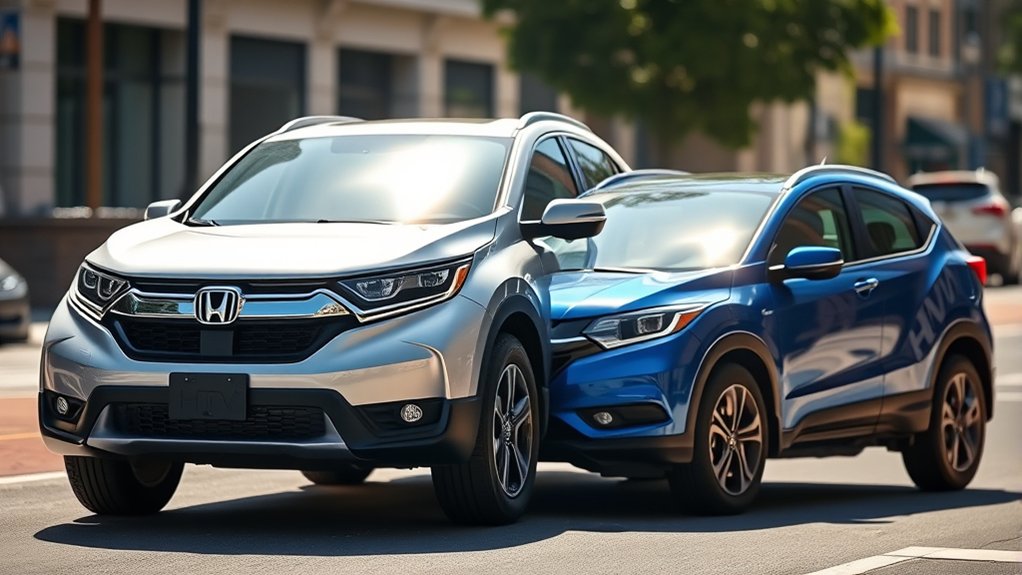
How do you decide between the Honda CR-V and HR-V? Start by considering your priorities. Both models embrace eco friendly materials in their interiors, reducing environmental impact without sacrificing comfort. If you want a vehicle that reflects your commitment to sustainability, either choice fits well.
Next, think about customization. The CR-V offers a wider range of aftermarket accessories, letting you tailor features like roof racks or cargo organizers to your needs. The HR-V, while versatile, has fewer options in this area.
Your decision hinges on whether you value extensive personalization and slightly more upscale materials or prefer a compact, efficient ride with eco conscious design. By weighing these factors, you can confidently pick the model that suits your lifestyle best.
CR-V vs HR-V: Size and Space Differences
Where will you find more room to stretch and store your gear, the Honda CR-V or the HR-V? The CR-V clearly offers more interior space, with greater passenger legroom and a larger cargo area, making it better suited for families or those needing extra storage.
The HR-V, being more compact, fits well in urban settings but limits cargo capacity. Both models have performed well in crash test results, ensuring safety despite their size differences.
Regarding off-road capability, neither is designed for serious rugged terrain, but the CR-V’s larger size and available all-wheel drive provide a slight edge on rougher surfaces. Ultimately, if space and versatility matter most, the CR-V stands out, while the HR-V suits those prioritizing maneuverability over volume.
Comparing Engine Options and Performance
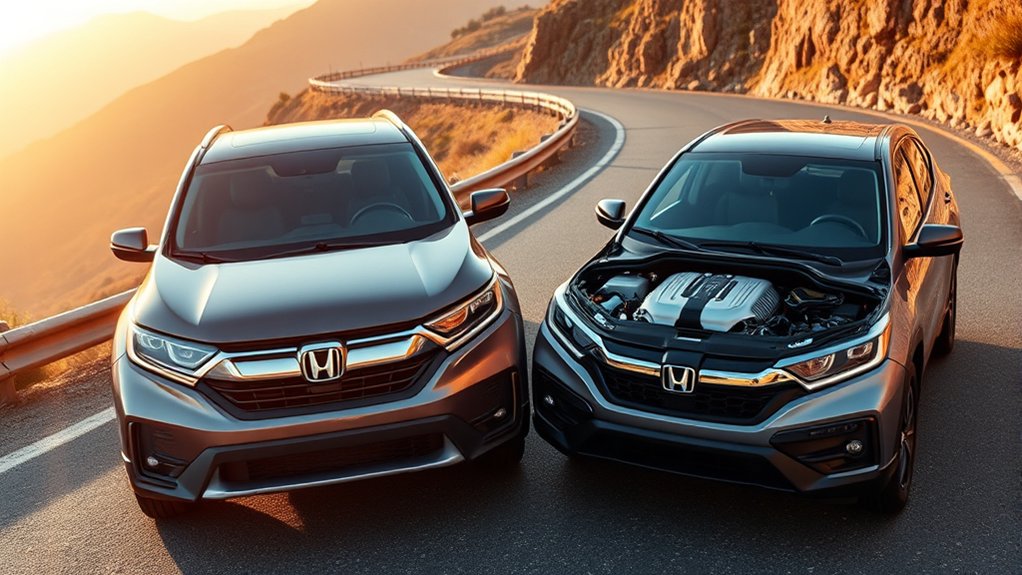
What sets the Honda CR-V and HR-V apart under the hood? The CR-V offers a more powerful engine lineup, including a turbocharged 1.5L four-cylinder, while the HR-V sticks to a naturally aspirated 2.0L four-cylinder.
Transmission choices differ too: the CR-V uses a continuously variable transmission (CVT) optimized for efficiency and performance, whereas the HR-V pairs its engine with a CVT designed for simplicity and economy.
| Model | Engine Options | Transmission Choices |
|---|---|---|
| CR-V | 1.5L Turbo I4 | CVT |
| HR-V | 2.0L Naturally Aspirated I4 | CVT |
| CR-V Hybrid | 2.0L I4 + Electric Motors | E-CVT |
These differences impact acceleration, fuel efficiency, and overall driving dynamics.
Features and Technology in the CR-V and HR-V
When it comes to features and technology, both the Honda CR-V and HR-V offer user-friendly interfaces and modern conveniences, but they cater to slightly different needs. The CR-V tends to include more advanced tech aimed at drivers seeking a higher level of comfort and connectivity, reflecting generational differences in preferences for in-car entertainment and driver assistance.
Meanwhile, the HR-V focuses on essential features, appealing to those who prioritize simplicity and efficiency. While some might argue discussing unrelated topics like infotainment system differences in other brands could be distracting, here it’s clear that Honda tailors each model’s technology suite to its target audience.
You’ll find adaptive cruise control, touchscreen displays, and smartphone integration in both, but the CR-V’s offerings generally edge ahead in sophistication.
Pricing and Fuel Efficiency Compared
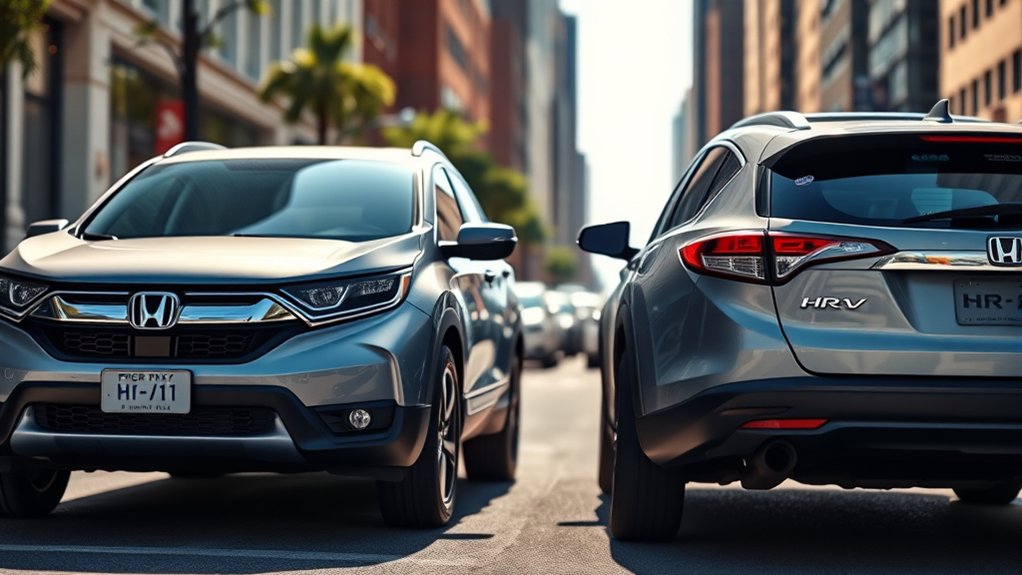
Beyond features and technology, understanding the pricing and fuel efficiency of the Honda CR-V and HR-V will help you determine which model fits your budget and driving habits better. The HR-V generally comes with a lower starting price, making it appealing if upfront cost is a priority.
Meanwhile, the CR-V offers more powerful engine options and performance, which can justify its higher price point.
Consider these key points:
- HR-V’s smaller engine delivers excellent fuel efficiency, ideal for city driving and commuting.
- CR-V’s turbocharged engines provide stronger acceleration but slightly lower fuel economy.
- Pricing and fuel efficiency vary across trims, so balance your need for power against running costs.
Knowing these factors, you can choose the model that aligns with your financial and driving priorities.
Which Honda SUV Is Best for Families or City Drivers?
When choosing between the Honda CR-V and HR-V, consider how much space and seating you need, especially if you have a family. You’ll also want to weigh fuel efficiency and performance based on whether you’re driving mostly in the city or on longer trips.
Finally, compare the technology and safety features to find the best fit for your lifestyle.
Space And Seating Capacity
How much space do you really need in an SUV? When choosing between the Honda CR-V and HR-V, consider your lifestyle and cargo needs. The CR-V offers more overall room, ideal if you regularly haul camping gear or manage pet care essentials.
The HR-V, while more compact, suits city drivers who prioritize maneuverability without sacrificing comfort.
Key points to consider:
- Seating: CR-V comfortably seats five adults with generous legroom; HR-V’s rear seats are cozier but still accommodate five.
- Cargo Space: CR-V provides up to 75.8 cubic feet with seats folded, perfect for bulkier items.
- Versatility: HR-V features a Magic Seat for flexible storage, great for smaller loads.
Ultimately, pick the CR-V for extra space or the HR-V for urban convenience.
Fuel Efficiency And Performance
What kind of driving experience do you need from your Honda SUV? If you prioritize fuel efficiency, the HR-V’s compact design and available hybrid powertrains make it ideal for city driving.
On the other hand, the CR-V offers more powerful engine options and better off road capability, making it suitable for families who enjoy weekend adventures.
| Feature | Honda CR-V | Honda HR-V |
|---|---|---|
| Fuel Efficiency | Moderate, hybrid available | Excellent, hybrid available |
| Performance | Stronger engine choices | Smaller engine, agile |
| Off Road Capability | Enhanced with AWD option | Basic AWD, less rugged |
Choose the CR-V for versatility and power, or the HR-V for efficient urban commuting.
Technology And Safety Features
Why should technology and safety features influence your choice between the Honda CR-V and HR-V? Both SUVs offer impressive technology innovations, but your needs might tilt the balance. The CR-V generally includes more advanced driver-assist systems and infotainment upgrades, making it ideal for families requiring comprehensive protection and connectivity.
Meanwhile, the HR-V’s safety ratings remain strong, appealing to city drivers who prioritize maneuverability with essential tech.
Consider these key differences:
- Adaptive cruise control and lane-keeping assist are more refined in the CR-V.
- The HR-V offers a user-friendly infotainment system suited for urban use.
- Both models feature Honda Sensing® suite, but the CR-V adds enhanced collision mitigation.
Ultimately, your choice depends on whether you value extensive safety tech or streamlined city-friendly features.
Frequently Asked Questions
What Colors Are Available for the Honda CR-V and HR-V?
You’ll find diverse color options exploration in both the Honda CR-V and HR-V, with shades like Lunar Silver and Crystal Black. Interior material contrasts add style, letting you choose fabric or leather to match your preferences.
How Do the CR-V and HR-V Compare in Resale Value?
Think of resale value factors as a tide. CR-V holds steadier, with slower depreciation rates than HR-V.
You’ll find CR-V retains more value over time, making it a smarter choice if you plan to resell.
Are There Hybrid Versions of Both the CR-V and HR-V?
Yes, you’ll find hybridization questions answered by noting the CR-V offers a hybrid model, while the HR-V recently introduced one. When comparing accessory comparisons, CR-V hybrids tend to have more advanced options than HR-V hybrids.
What Safety Ratings Do the CR-V and HR-V Have?
You’ll find both the CR-V and HR-V have strong safety ratings, excelling in crash tests. Focus on two-word discussion ideas like “crashworthiness” and “driver assistance” to compare their safety features effectively.
Can the CR-V and HR-V Tow Trailers or Boats?
You’ll find the CR-V’s towing capacity up to 1,500 pounds, while the HR-V can’t tow.
With stronger engine performance and hybrid options, the CR-V suits light trailers or boats better than the HR-V.
Conclusion
Choosing between the Honda CR-V and HR-V is like picking the right shoes for your journey. If you crave spacious comfort and powerful performance, the CR-V steps up like a reliable hiking boot.
But if city agility and fuel savings matter more, the HR-V fits like a sleek sneaker. Both offer solid features, so consider your daily drive—whether you need room to roam or nimble efficiency in tight urban streets.
In the end, understanding the difference between a Honda CR-V and HR-V will help you select the perfect vehicle that matches your lifestyle and driving needs.