If you’re curious about what is VTEC Honda and how it balances efficiency with performance, understanding this system is essential.
VTEC intelligently switches cam profiles using hydraulic control to optimize valve timing and lift, enhancing both low-end torque and high-end power.
It’s a precise blend of mechanical design and electronic control that improves combustion stability and reduces pumping losses.
But how exactly does this technology adapt to different driving conditions so seamlessly?
Key Takeaways
- VTEC stands for Variable Valve Timing and Lift Electronic Control, a Honda technology optimizing valve timing and lift for efficiency and power.
- It switches between two camshaft profiles using a hydraulically actuated pin based on engine RPM for low-end torque and high-end power.
- VTEC improves volumetric efficiency, fuel economy, and combustion without forced induction by balancing low-RPM efficiency and high-RPM performance.
- Honda uses VTEC primarily in performance-oriented models like the Civic Si, Accord, and Integra to optimize power across the RPM range.
- The system enhances driving experience by providing smooth transitions between cam profiles, delivering both fuel economy and spirited driving power.
What Is VTEC and How Does It Work in Honda Engines
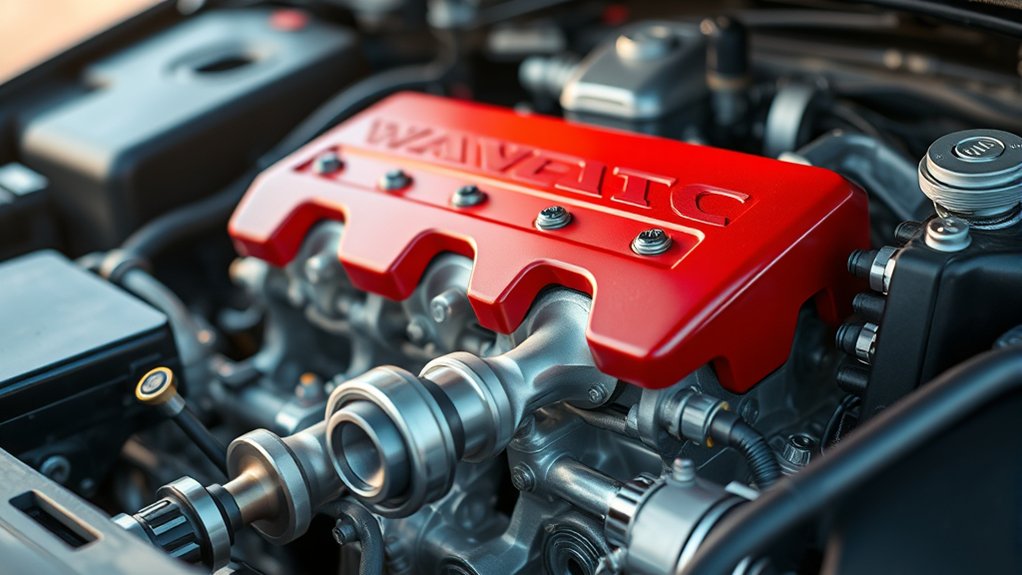
How does VTEC enhance the performance of Honda engines? VTEC, or Variable Valve Timing and Lift Electronic Control, optimizes valve timing and lift to balance low-end torque with high-end power.
When you drive, VTEC switches between two camshaft profiles depending on engine speed, ensuring efficient airflow at varying RPMs. This technology debunks common Vtec myths that suggest it simply boosts power without trade-offs; instead, it precisely adapts valve operation for performance and efficiency.
Similarly, racing myths often exaggerate VTEC’s capabilities, overlooking its core function of improving volumetric efficiency rather than just increasing horsepower.
Why Honda Created VTEC Technology
Why did Honda develop VTEC technology in the first place? Honda production aimed to create an engine system that balanced fuel efficiency with high performance, addressing a core challenge for engine tuners. They needed a solution that allowed engines to optimize valve timing and lift across varying RPM ranges without sacrificing reliability or fuel economy.
VTEC’s variable valve timing achieves this by switching between cam profiles, enabling low-RPM efficiency and high-RPM power in one compact design. This innovation gave Honda a competitive edge, allowing you to enjoy both spirited driving and daily practicality.
Types of VTEC Systems Explained
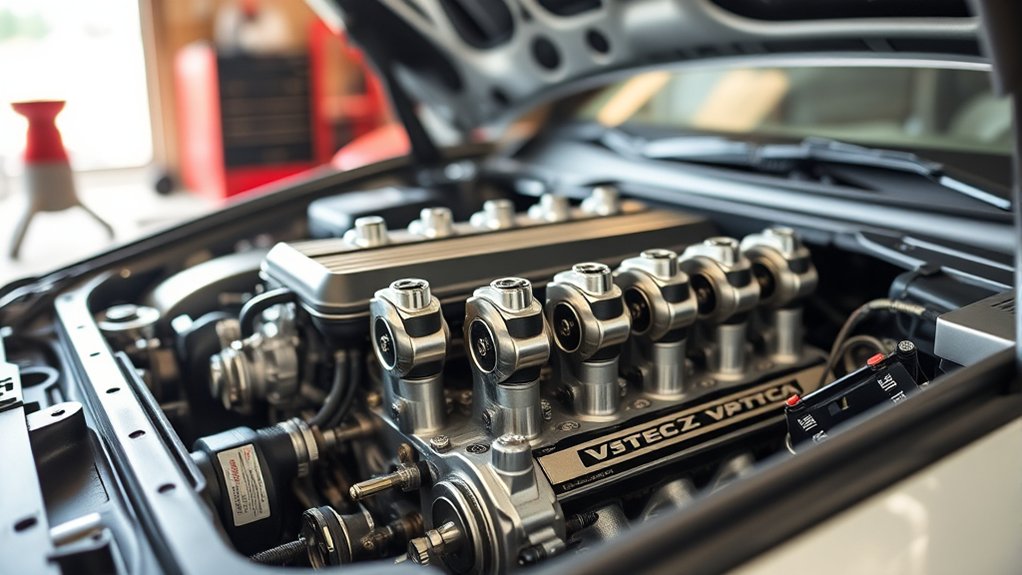
You’ll first need to understand the basic VTEC mechanism, which optimizes valve timing for efficiency and power. Then, you can analyze the main VTEC variants and how they differ in design and application.
Finally, evaluating their performance differences will clarify which system suits specific driving demands.
Basic VTEC Mechanism
What sets VTEC apart from conventional valve timing systems is its ability to switch between camshaft profiles based on engine speed and load. You’ll find that the basic VTEC mechanism uses a hydraulically actuated pin to lock rocker arms to a high-lift cam lobe when certain RPM thresholds are met.
This switch optimizes valve timing for both low-end torque and high-end power. When you analyze the mechanism, it’s clear how precise control over valve lift and duration enhances engine efficiency.
While discussing this, avoid unrelated topics like fuel injection or ignition timing, which belong elsewhere. Staying focused on the camshaft profile switching helps you understand VTEC’s core advantage.
This clarity ensures your discussion ideas remain targeted and technical without wandering into tangential areas.
VTEC Variants Overview
Although the core VTEC mechanism remains consistent, Honda has developed several distinct variants tailored to different performance and efficiency goals. You’ll encounter these variations depending on engine design and intended use, so understanding their differences is crucial.
Avoid confusing this with unrelated topic discussions about general engine tech, as VTEC’s variants are specific. Here’s a precise overview:
| VTEC Variant | Primary Purpose |
|---|---|
| SOHC VTEC | Balances efficiency and power |
| DOHC VTEC | Maximizes high-RPM performance |
| VTEC-E | Focuses on fuel economy |
Each variant activates cam profiles differently, influencing valve timing and lift. This targeted design optimization lets you enjoy tailored engine behavior without random discussion diversions that don’t apply here.
Performance Differences Explained
How do different VTEC systems impact engine performance? Each type, such as SOHC VTEC, DOHC VTEC, and VTEC-E, optimizes valve timing and lift differently. This directly influences power output, fuel efficiency, and emissions.
For instance, DOHC VTEC employs multiple cam profiles that engage at higher RPMs to boost horsepower. VTEC-E prioritizes fuel economy by activating at lower RPMs with a single intake valve.
This precise valve control enhances volumetric efficiency and combustion stability. Avoid confusing this with a random topic or unrelated discussion 2, as understanding these distinctions clarifies why certain Honda engines perform better under specific conditions.
How VTEC Boosts Fuel Efficiency and Performance
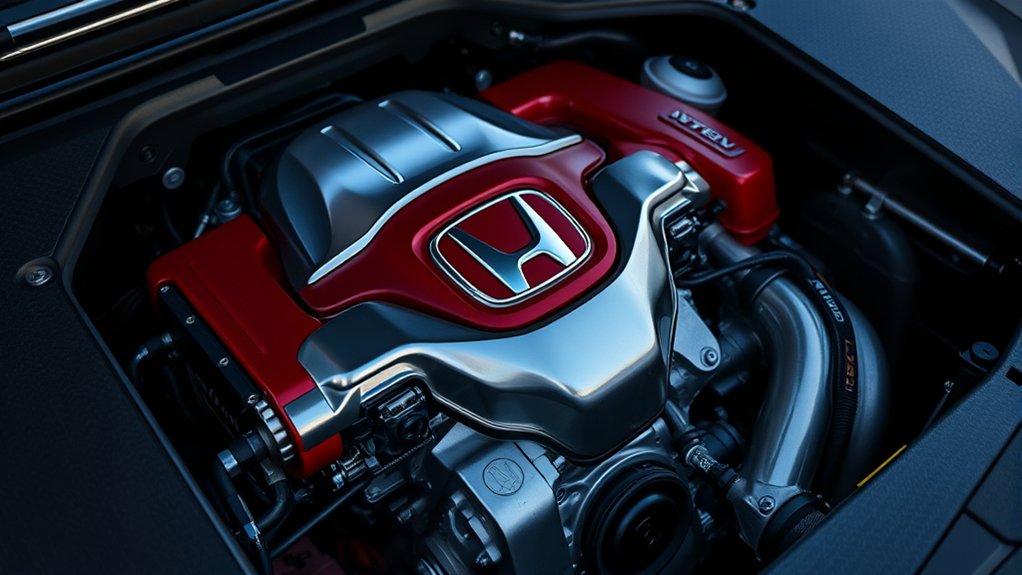
You’ll notice VTEC adjusts valve timing to match engine load and speed, enhancing combustion efficiency. This variable valve timing improves fuel economy by optimizing airflow and fuel mixture.
At the same time, it boosts performance by enabling higher power output when you need it.
Variable Valve Timing Benefits
Efficiency lies at the core of VTEC’s variable valve timing system, which dynamically adjusts valve operation to optimize engine performance across different RPM ranges. By altering valve timing and lift, VTEC reduces engine misfire risk at low RPMs and enhances combustion efficiency.
This modulation also adapts to changing oil viscosity, ensuring smooth hydraulic actuation under varying temperatures. As a result, fuel efficiency improves without compromising power output.
| Benefit | Explanation |
|---|---|
| Reduced Engine Misfire | Precise valve timing prevents incomplete combustion |
| Adaptation to Oil Viscosity | Maintains valve timing accuracy despite oil thickness |
| Fuel Efficiency | Optimizes air-fuel mixture for cleaner burning |
Understanding these benefits helps you appreciate VTEC’s role in balancing efficiency and reliability through advanced valve control.
Optimized Engine Performance
Building on VTEC’s ability to fine-tune valve timing for improved combustion, the system actively enhances engine output and fuel economy by switching between cam profiles optimized for low and high RPM conditions. You’ll notice increased torque at lower speeds and maximum horsepower at higher revs without sacrificing fuel efficiency.
This dynamic adjustment reduces pumping losses and optimizes air-fuel mixture flow, enabling your engine to adapt instantly to driving demands. For Honda, leveraging this technical edge through creative marketing and social media strategy has effectively communicated VTEC’s dual benefits to enthusiasts and everyday drivers alike.
What Makes VTEC Work: Key Components Explained
How does VTEC achieve its remarkable balance between power and efficiency? It hinges on several key components working in unison. First, VTEC uses a multi-profile camshaft system with two sets of cam lobes, one optimized for low RPM efficiency, the other for high RPM power.
VTEC balances power and efficiency using dual cam lobes tailored for low and high RPM performance.
A hydraulic actuator, controlled by engine oil pressure, switches between these cam profiles based on RPM thresholds. This precise mechanism ensures valve timing adapts dynamically, maximizing performance.
Quick trivia: unlike unrelated tech such as variable valve timing in other brands, Honda’s VTEC uniquely combines cam profile switching with valve timing. You’ll also find rocker arms designed to engage selectively with different cam lobes, ensuring seamless transitions.
Understanding these elements clarifies why VTEC is a sophisticated, mechanically elegant system.
How VTEC Changes Your Driving Experience
What changes can you expect behind the wheel when a VTEC system engages? You’ll notice a distinct shift in power delivery and engine responsiveness. VTEC optimizes valve timing, allowing for increased airflow at higher RPMs, which translates to sharper acceleration and improved efficiency.
This dual-mode operation provides a balanced driving experience, smooth and economical at low speeds, aggressive and high-performing when pushed. For enthusiasts and marketers alike, Honda’s creative branding of VTEC enhances social media engagement by highlighting this technical innovation.
Honda Models With VTEC Engines
Although VTEC technology is a hallmark of Honda’s engineering, not every model features it; you’ll primarily find VTEC engines in performance-oriented and mid-range vehicles like the Civic Si, Accord, and Integra. These models utilize variable valve timing to optimize power and efficiency across RPM ranges.
When working with these engines, precise engine diagnostics are crucial to monitor valve timing mechanisms and ensure optimal function. If you’re considering aftermarket tuning, VTEC engines respond well to modifications that enhance both low-end torque and high-RPM power.
However, tuning requires accurate calibration to avoid compromising engine reliability. Understanding which Honda models employ VTEC helps you focus on vehicles with adaptable performance characteristics, allowing you to leverage the technology’s full potential through informed diagnostics and thoughtful tuning strategies.
Maintaining Your VTEC Engine and Fixing Common Issues
When should you perform maintenance on your VTEC engine to guarantee peak performance and longevity? Regular intervals defined by Honda, typically every 5,000 to 7,500 miles, are critical.
Pay close attention to symptoms like a disengaged idle, which often signals VTEC solenoid issues or low oil pressure. Addressing this early prevents valve timing malfunctions.
Routine oil changes with manufacturer-specified viscosity ensure proper hydraulic actuation of VTEC components. Additionally, inspect and replace oil seals proactively to avoid leaks that compromise oil pressure and engine integrity.
When replacing seals, prioritize OEM parts to maintain system tolerances. Monitoring these factors through precise diagnostic checks helps you avoid common VTEC failures, maintaining engine efficiency and durability under varying operating conditions.
Why Enthusiasts Love Honda’s VTEC Technology
Because VTEC technology optimizes valve timing for different engine speeds, it delivers a unique balance of fuel efficiency and high-performance power that enthusiasts appreciate. When you drive a VTEC-equipped Honda, you experience seamless transitions between low-RPM economy and high-RPM power, achieved by switching between cam profiles.
This mechanical precision maximizes volumetric efficiency and combustion, allowing you to extract more power without sacrificing everyday drivability. Enthusiasts value this innovation because it enhances engine responsiveness and performance without resorting to forced induction or complex electronics.
While unrelated topic discussions or random thoughts might distract, focusing on VTEC reveals Honda’s engineering prowess in harmonizing efficiency and sportiness. You get a system that’s not just about power, but about intelligent valve control that elevates your driving experience.
Frequently Asked Questions
When Was VTEC First Introduced by Honda?
You’ll find VTEC origins trace back to 1989 on the Honda timeline, marking its first introduction. Honda designed this system to optimize valve timing, enhancing both performance and efficiency in their engines through advanced mechanical engineering.
Can VTEC Technology Be Added to Non-Honda Engines?
You can’t easily perform a VTEC retrofit on non-Honda engines due to non-Honda compatibility issues. The system relies on Honda-specific hardware and ECU calibration, making precise integration technically complex and generally impractical.
How Does VTEC Affect Insurance Premiums?
VTEC’s engine performance impacts can raise insurance premiums since insurers assess risk based on performance upgrades.
Understanding how insurance works, you’ll find higher power outputs often translate to increased rates due to potential accident likelihood.
Are There Any VTEC Engines Used in Motorcycles?
Yes, some motorcycles use VTEC engines, especially in Honda’s lineup. You’ll find engine swaps and aftermarket tuning popular for enhancing performance, but integrating VTEC requires precise calibration to optimize variable valve timing benefits effectively.
What Is the Environmental Impact of VTEC Engines?
You’ll notice VTEC engines enhance environmental efficiency by optimizing valve timing, which improves combustion. This leads to emission improvements, reducing pollutants while maintaining performance.
Conclusion
Now that you’ve explored VTEC, you can appreciate how this clever system quietly orchestrates your engine’s performance, balancing efficiency with spirited power. It’s like having a finely tuned conductor guiding every valve’s movement, ensuring smooth transitions between low-end torque and high-rev exhilaration.
By understanding VTEC’s nuanced mechanics, you’re better equipped to maintain your Honda’s heart, keeping it humming with precision and reliability for miles of confident driving ahead. This knowledge ultimately enhances your appreciation and care of the VTEC Honda system.