If you’re curious about where Honda Accords are made, you’ll find their production spans several continents, with major assembly plants in the U.S. and advanced manufacturing hubs in Asia. The Honda Accord is a globally produced vehicle, reflecting the brand’s commitment to quality and innovation.
While the company once had European production, that has shifted in recent years. Understanding how Honda’s global strategy and regional demands influence where your Accord is built reveals a complex network designed for quality and efficiency.
But what does this mean for you as a buyer? Knowing the origin of your Accord can give you insight into the craftsmanship and standards upheld in its production.
Key Takeaways
- Honda Accords are manufactured in production centers across the United States, Japan, China, and Thailand.
- Major U.S. assembly plants include Marysville, Ohio, and Lincoln, Alabama, serving domestic demand.
- Japan and other Asian facilities focus on advanced production with robotics and precision assembly.
- Europe no longer produces Accords locally, with demand met primarily through imports since the Swindon plant closure.
- Global manufacturing ensures consistent quality, supported by standardized processes and regional supply chain integration.
Where Are Honda Accords Made Worldwide?
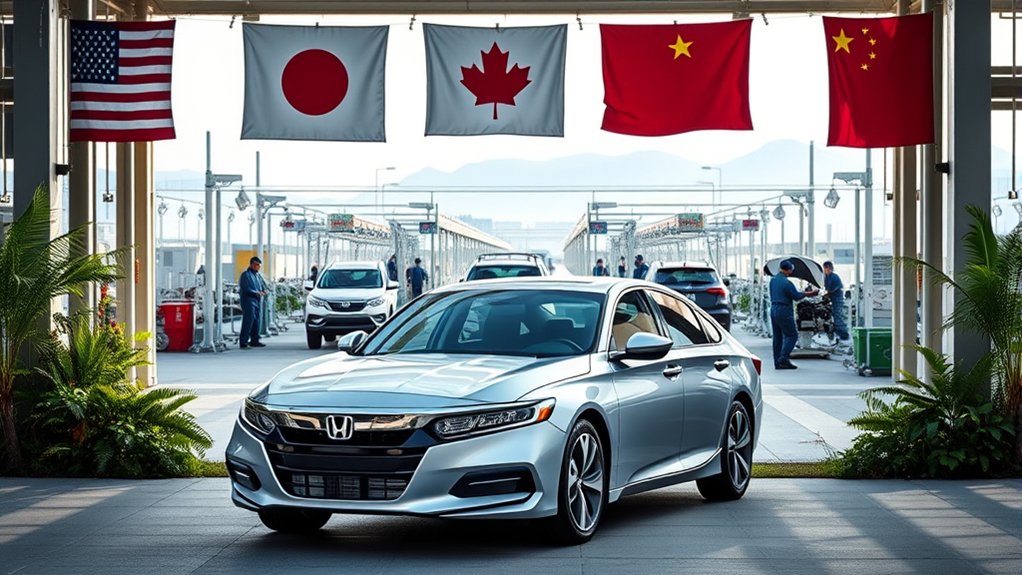
Where exactly are Honda Accords made worldwide? You’ll find production mainly in the United States, Japan, China, and Thailand. These locations aren’t random; they reflect careful decisions driven by production economics.
Honda balances costs like labor, materials, and logistics to maximize efficiency. In the U.S., for example, plants in Ohio and Alabama produce the Accord to meet high domestic demand and reduce shipping expenses.
Labor unions play a significant role in shaping workforce conditions, especially in American factories, affecting wages and productivity. Meanwhile, Japanese and Asian plants benefit from advanced automation and skilled labor, cutting costs further.
How Honda’s Global Strategy Shapes Accord Production
You’ll see that Honda’s global manufacturing footprint allows the Accord to be produced efficiently across multiple continents. The company adapts production to regional market needs while maintaining tight supply chain integration.
These strategies ensure consistent quality and timely delivery worldwide.
Global Manufacturing Footprint
How does Honda manage to supply Accord models to markets worldwide efficiently? The answer lies in its well-coordinated global manufacturing footprint. Honda strategically locates production facilities across multiple continents, balancing proximity to key markets with cost-effective operations.
This approach optimizes global logistics by reducing shipping times and costs, ensuring timely delivery. You’ll find Honda carefully navigating varied labor regulations in each region, which influences facility locations and production methods.
Regional Production Adaptations
Why does Honda tailor its Accord production processes differently across regions? You’ll find that Honda adjusts its manufacturing based on factors like global incentives and regional labor costs.
For example, in countries offering tax breaks or subsidies, Honda leverages these global incentives to lower production expenses. At the same time, labor costs heavily influence where and how specific components are assembled.
You’ll notice that Honda often shifts labor-intensive tasks to regions with competitive wages while reserving advanced manufacturing for areas with higher-skilled workforces. This regional adaptation helps Honda optimize cost-efficiency and maintain quality, ensuring the Accord meets local market demands without compromising global standards.
Supply Chain Integration
Building on Honda’s regional production strategies, the company integrates a complex global supply chain to streamline Accord manufacturing. Honda carefully manages production timing to meet market demands efficiently while maintaining quality.
Their approach balances components sourced worldwide with assembly plants in strategic regions, ensuring flexibility and responsiveness. Labor relations play a crucial role in this integration, as Honda collaborates with local workforces to sustain productivity and minimize disruptions.
Key elements of Honda’s supply chain integration include:
- Coordinated production timing across multiple factories
- Synchronization of parts delivery with assembly schedules
- Strong labor relations fostering stable operations
- Use of advanced logistics technology for inventory management
- Continuous communication between global and regional teams
This integration supports consistent Accord quality and timely delivery worldwide.
How Regional Demand Determines Honda Accord Plant Locations
You’ll find that Honda places Accord plants strategically based on where demand is strongest, ensuring efficient supply chains and quicker delivery. Regional sales trends directly influence production capacity, so factories are located close to major markets.
This approach helps Honda meet customer needs while optimizing manufacturing costs.
Market Influence On Production
How does regional demand shape where Honda decides to produce the Accord? You’ll find that Honda closely monitors market needs, adjusting production accordingly to meet demand efficiently. This approach helps minimize production delays by locating plants where demand supports steady output.
Labor unions also influence production locations, as Honda evaluates workforce stability and labor costs to avoid disruptions.
Key factors you should consider include:
- Proximity to major markets for quicker delivery
- Availability of skilled labor influenced by unions
- Regional incentives impacting production costs
- Infrastructure supporting efficient supply chains
- Risk of production delays due to local labor disputes
Strategic Plant Placement
Why does Honda choose specific locations for its Accord plants? It’s all part of a well-planned production strategy that prioritizes regional diversification. By placing plants near key markets, Honda reduces shipping costs and responds quickly to local demand fluctuations.
You’ll find Accord manufacturing sites in North America and Asia, reflecting where demand is strong and logistics efficient. This approach helps Honda balance production capacity with market needs, ensuring timely delivery and minimizing supply chain disruptions.
When you consider strategic plant placement, it’s clear Honda looks at factors like regional infrastructure, labor availability, and proximity to suppliers. This method supports not just cost control but also adaptability, allowing Honda to scale production up or down based on regional preferences and economic conditions.
Regional Sales Impact
Where does Honda decide to position its Accord plants within various regions? The answer lies largely in regional sales impact, where demand shapes production locations. You’ll find Honda carefully analyzing regional logistics to minimize shipping costs and delivery times.
Currency impact also plays a role. Manufacturing in regions with favorable exchange rates helps control costs and price competitiveness. This strategic alignment ensures Honda meets local demand efficiently.
Consider these factors influencing plant location decisions:
- Proximity to high-demand markets
- Access to skilled labor pools
- Regional logistics infrastructure
- Currency impact and exchange rate stability
- Trade agreements and tariff considerations
Honda Accord Assembly Plants in the United States
Which locations in the United States are responsible for assembling the Honda Accord? Primarily, Honda produces the Accord at the Marysville Auto Plant in Ohio and the Lincoln, Alabama facility. These plants maintain strict assembly timelines to meet demand and minimize disruptions.
While rare, labor disputes have occasionally impacted production schedules, but Honda’s proactive management helps mitigate prolonged delays.
| Plant Location | Key Details |
|---|---|
| Marysville, Ohio | Established 1982, high capacity |
| Lincoln, Alabama | Operational since 2001 |
| Assembly Timelines | Efficient, with minimal delays |
| Labor Disputes | Rare, swiftly managed |
| Production Output | Millions of Accords produced |
You can see these plants play a crucial role in delivering quality Accords across the U.S.
Production Facilities for Honda Accords in Japan and Asia
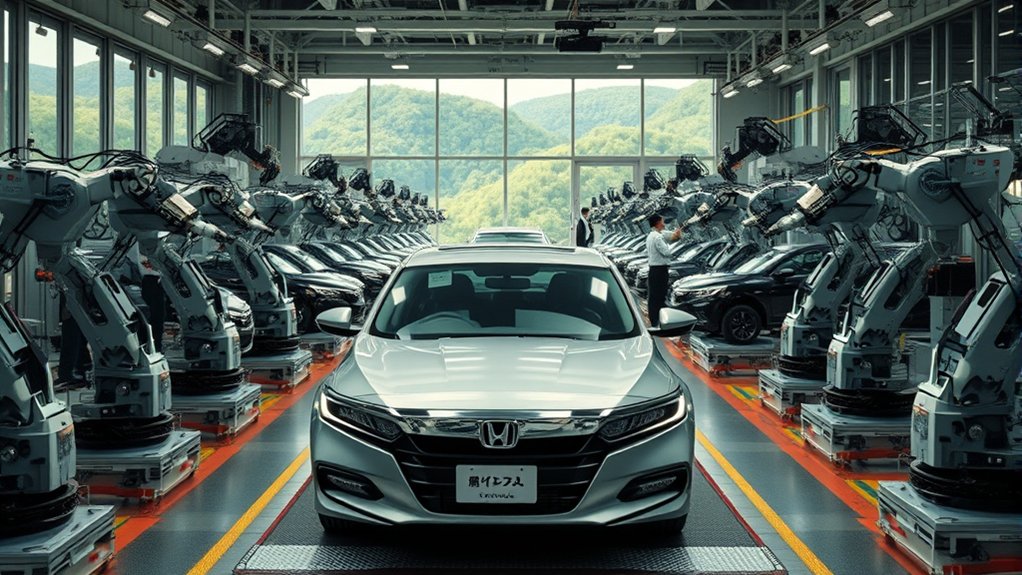
How does Honda maintain its global reputation for quality and reliability in the Accord lineup? By operating advanced production facilities in Japan and Asia, Honda ensures stringent quality control and efficient manufacturing processes. These plants play a vital role in the global supply chain, balancing production volume and cost-effectiveness while addressing regional pricing differences.
In these facilities, you’ll find:
- State-of-the-art robotics and automation
- Skilled workforce trained in precision assembly
- Strict adherence to quality standards
- Flexible production lines adapting to market demand
- Integration with global supply chain logistics
These factors enable Honda to produce Accords that meet diverse market expectations while maintaining consistent quality across regions. The Asian plants, especially in Japan, focus on innovation and refinement, supporting Honda’s commitment to excellence worldwide.
Honda Accord Manufacturing Locations in Europe
Wondering about the European production sites for the Honda Accord? While Europe plays a smaller role compared to Asia or North America, the Accord has been assembled in the UK at Honda’s Swindon plant until its closure in 2021. This facility handled not only the Accord but also other models, contributing to local manufacturing expertise.
Currently, European demand for the Accord is largely met through imports rather than local production. Although unrelated topicA and unrelated topicB don’t influence this manufacturing footprint, understanding irrelevant themeA and irrelevant themeB can help you appreciate the broader context of automotive industry shifts in Europe.
Key Differences Between Honda Accords Made in Different Countries
Although European production of the Honda Accord has largely ceased, the model continues to be manufactured in various countries, each with distinct characteristics. When you compare Accords made in different locations, global logistics and labor dynamics heavily influence design, assembly quality, and component sourcing.
You’ll notice these key differences:
- Variations in materials and parts based on regional supplier networks
- Differences in labor skill sets affecting assembly precision
- Adaptations to meet local regulations and market preferences
- Distinct quality control processes shaped by manufacturing culture
- Supply chain efficiencies influenced by global logistics infrastructure
Understanding these factors helps you appreciate why an Accord made in one country might slightly differ in features or finish from another, reflecting Honda’s approach to optimizing production worldwide.
How Where Your Honda Accord Is Made Affects You
Where your Honda Accord is manufactured can substantially influence your ownership experience. The sourcing components used in different plants may vary slightly, affecting aspects like part availability and repair costs. You might notice differences in how readily replacement parts are obtained depending on the plant’s supply chain efficiency.
The manufacturing location of your Honda Accord affects part availability, repair costs, and supply chain efficiency.
Additionally, labor practices at the manufacturing location can impact build consistency and vehicle durability. Plants with rigorous labor standards often ensure more attentive assembly, potentially reducing defects.
Furthermore, regional manufacturing can influence your car’s compliance with local regulations, which affects warranty and service options. Understanding where your Accord is made helps you anticipate maintenance needs and assess the vehicle’s long-term reliability based on the production environment.
This knowledge empowers you to make informed decisions throughout your ownership.
How Honda Ensures Quality Across Global Accord Plants
Because Honda operates manufacturing plants worldwide, the company implements standardized quality control measures to maintain consistent vehicle performance and safety across all locations. You can expect the same high standards whether your Accord is built in the U.S., Japan, or elsewhere.
Honda enforces strict global labor policies to ensure ethical working conditions, which directly impact product quality. They also prioritize environmental compliance, minimizing emissions and waste during production.
Key quality assurance practices include:
- Uniform training programs for all plant employees
- Regular audits to enforce global labor policies
- Use of advanced robotics and precision tools
- Real-time data monitoring for defect detection
- Environmental compliance checks integrated into manufacturing processes
Frequently Asked Questions
What Is the Average Fuel Efficiency of a Honda Accord?
You can expect the Honda Accord’s average fuel efficiency to range from 30 to 38 mpg, thanks to its advanced drivetrain efficiency, global sourcing of components, and production focused on optimizing fuel economy across models.
How Often Should I Service My Honda Accord?
You should service your Honda Accord every 7,500 miles or six months, whichever comes first.
Staying on top of maintenance scheduling keeps your car humming smoothly, preventing costly repairs and ensuring peak performance.
What Are the Common Safety Features in Honda Accords?
You’ll find Honda Accords packed with safety features like Honda Sensing, adaptive cruise control, collision mitigation, and lane-keeping assist. These highlights reflect Honda’s commitment, no matter the manufacturing location, to keeping you secure on the road.
Does Honda Offer Hybrid Versions of the Accord?
You might think of the Accord’s hybrid availability as a futuristic time machine, blending classic reliability with electric efficiency. Honda produces these hybrids in plants across Ohio and Japan, ensuring quality and innovation worldwide.
What Warranty Coverage Comes With a New Honda Accord?
You get a 3-year/36,000-mile limited warranty and a 5-year/60,000-mile powertrain warranty on a new Honda Accord.
Pricing structures don’t affect this, and options for unrelated topics won’t change your coverage.
Conclusion
You might be surprised to learn that over 60% of Honda Accords sold in the U.S. are assembled right here in Ohio’s Marysville plant, highlighting Honda’s commitment to local production. Understanding where your Accord is made helps you appreciate the blend of global expertise and regional adaptation behind its quality.
No matter the location, Honda’s standardized processes ensure you get the same reliable vehicle, tailored to meet your market’s specific needs. Knowing where Honda Accords are made adds to the appreciation of the craftsmanship and consistency in every car.