To gap your iridium spark plug, first check the manufacturer’s recommended gap size. This step ensures you set the correct distance for optimal performance.
Use a calibrated feeler gauge or spark plug gap tool to measure the distance between the center and ground electrodes precisely.
Adjust the gap carefully by bending the ground electrode, avoiding excessive force to prevent damage. Work on a clean surface and verify the gap frequently to maintain accuracy.
Proper gapping guarantees maximum spark and combustion efficiency.
Understanding these steps helps you maintain peak engine performance and longevity. Taking the time to gap your iridium spark plug correctly can improve fuel efficiency and reduce engine misfires.
Key Takeaways
- Use a feeler gauge or spark plug gap tool to measure the gap precisely according to manufacturer specifications.
- Adjust the gap incrementally by gently bending the ground electrode with a dedicated gap adjuster.
- Avoid excessive force to prevent damaging the iridium tip or electrode structure.
- Work on a clean surface, wear safety glasses, and regularly calibrate your measuring tools.
- Verify the final gap size matches engine requirements to ensure optimal spark performance and avoid misfires.
Why Proper Iridium Spark Plug Gapping Matters
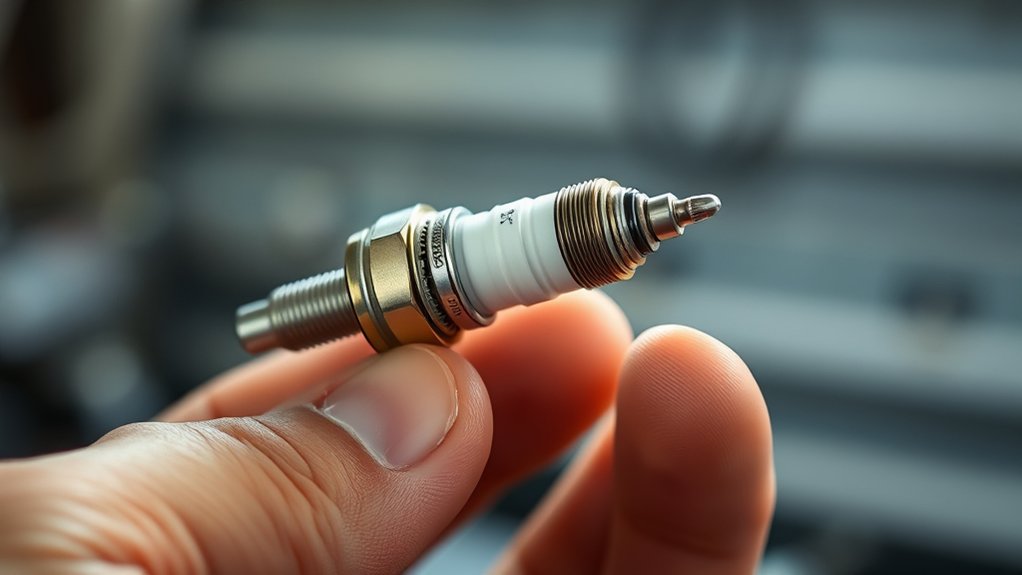
Properly gapping your iridium spark plug guarantees excellent electrical performance and efficient combustion. When you set the correct gap, you enhance spark plug performance by ensuring a consistent and strong spark.
This precise gap influences ignition efficiency, directly affecting fuel combustion and engine power. If the gap is too wide, the spark may weaken or fail to jump, causing misfires and poor fuel economy.
Conversely, a gap too narrow reduces spark intensity, leading to incomplete combustion and increased emissions. By maintaining the manufacturer-recommended gap, you support optimal ignition timing and energy transfer.
A gap too narrow weakens spark intensity, causing incomplete combustion and higher emissions—maintain the recommended gap for best results.
This balance enhances engine responsiveness, reduces wear, and maximizes fuel efficiency. As a result, you must prioritize accurate gapping to maintain peak spark plug performance and overall engine reliability.
Essential Tools for Gapping Iridium Spark Plugs
You’ll need the right tools to gap your iridium spark plug accurately, such as a feeler gauge or a specialized spark plug gap tool. Make certain to calibrate your tools regularly to maintain precise measurements.
Proper calibration guarantees you set the gap within manufacturer specifications for peak performance.
Recommended Gapping Tools
Three essential tools will make gapping your iridium spark plugs accurate and efficient: a spark plug gap gauge, a feeler gauge, and a gap adjuster. The spark plug gap gauge lets you quickly measure the gap size, while the feeler gauge provides precise verification of the clearance to the thousandth of an inch.
Use the gap adjuster to carefully bend the ground electrode without damaging the iridium tip. Employing proper gapping techniques guarantees consistent ignition performance and prevents misfires.
Regular tool maintenance, such as cleaning and inspecting for wear, keeps your instruments reliable and accurate. Avoid using worn or damaged tools, as they can lead to incorrect gap measurements and reduce spark plug effectiveness.
Choosing the right tools and maintaining them correctly streamlines the gapping process and maximizes your engine’s efficiency.
Tool Calibration Tips
Accurate calibration of your gapping tools guarantees reliable measurements when adjusting iridium spark plugs. Start by verifying the tool against a known standard gauge to confirm precision.
Regular tool maintenance, including cleaning and inspecting for wear or damage, prevents measurement errors. Dirt and debris can affect the tool’s accuracy, so keep it clean and lubricated as recommended.
Establish a calibration frequency based on usage intensity. Heavy use demands more frequent checks, ideally monthly, while occasional use might require quarterly calibration. Always recalibrate after any impact or drop.
Document calibration dates and results to track tool performance over time. By adhering to these tool calibration tips, you’ll maintain consistent gap settings, protecting your spark plugs and optimizing engine performance.
Finding the Right Gap for Your Iridium Spark Plug
You need to set the gap according to your spark plug manufacturer’s specifications and your vehicle’s engine requirements. Using the wrong gap can lead to misfires, poor fuel economy, or engine damage.
Let’s review how to identify the correct gap and understand its impact on performance.
Manufacturer Gap Specifications
Although it might be tempting to set a standard gap for all iridium spark plugs, each manufacturer specifies a precise gap size tailored to enhance performance and longevity. You need to adhere strictly to these manufacturer guidelines to avoid damaging the plug or impairing engine efficiency.
Gap variations exist due to differences in combustion chamber design and ignition system requirements. When adjusting your iridium spark plug gap, consider:
- Verify the recommended gap size on the packaging or official documentation.
- Use a precise feeler gauge to measure and adjust the gap.
- Avoid exceeding the maximum gap to prevent misfires.
- Account for heat range and electrode wear as per manufacturer notes.
- Confirm gap size after installation for consistent ignition.
Following these steps guarantees the best spark plug function and engine reliability.
Vehicle Engine Requirements
Manufacturer gap specifications provide a baseline, but the ideal spark plug gap depends heavily on your vehicle’s engine design and operational parameters. You need to consult your engine specifications to determine the correct gap that enhances combustion efficiency.
High-compression or turbocharged engines, for instance, may require a narrower gap to prevent misfires under increased cylinder pressure. Conversely, naturally aspirated engines might benefit from a slightly wider gap to guarantee a strong spark.
Adjusting the gap within the recommended range helps maintain peak ignition timing and flame propagation. Ignoring your engine’s unique requirements can reduce fuel efficiency and power output.
Effects of Incorrect Gap
When the spark plug gap is set incorrectly, ignition efficiency suffers, leading to misfires, poor fuel economy, and reduced engine power. You’ll notice that improper gap settings directly impair spark performance and combustion efficiency, which are critical for peak engine function.
Too wide a gap demands higher voltage to generate a spark, causing inconsistent ignition and increased wear. Conversely, too narrow a gap weakens the spark, resulting in incomplete combustion.
Key effects include:
- Increased misfire frequency due to inconsistent ignition
- Reduced fuel economy from inefficient combustion
- Lower engine power output caused by poor spark intensity
- Accelerated electrode wear impacting spark plug lifespan
- Elevated emissions due to incomplete fuel burn
Maintaining the correct gap guarantees reliable spark performance and maximizes combustion efficiency.
How to Measure Your Spark Plug Gap
Before adjusting the gap, you need to measure it accurately using a feeler gauge or a gap tool. Different spark plug types require precise gap measurement to guarantee peak performance and prevent misfires.
Insert the feeler gauge between the center and ground electrodes gently. The gauge should slide in with slight resistance; if not, the gap is incorrect.
| Spark Plug Type | Recommended Gap (inches) | Tool Used |
|---|---|---|
| Iridium | 0.028 – 0.032 | Feeler Gauge |
| Platinum | 0.030 – 0.035 | Gap Tool |
| Copper | 0.035 – 0.045 | Feeler Gauge |
Accurate gap measurement guarantees your engine runs efficiently and extends spark plug life.
Adjusting Your Iridium Spark Plug Gap Safely
Although iridium spark plugs are delicate, you can safely adjust their gap with the right tools and careful technique. Proper gapping techniques guarantee peak engine performance without damaging the fine iridium tip. Follow these safety precautions to avoid costly mistakes:
Use a dedicated spark plug gap tool designed for iridium plugs to prevent electrode damage. Avoid excessive force when bending the ground electrode to maintain structural integrity.
Work on a clean, non-abrasive surface to prevent contamination or scratching of the electrode. Wear safety glasses to protect your eyes from small metal particles or debris.
Adjust the gap incrementally, checking measurements frequently to prevent over-gapping.
Double-Checking Your Spark Plug Gap for Accuracy
Since even a slight deviation in the gap can impact engine performance, you’ll want to double-check your spark plug gap for accuracy before installation. Start by using a reliable gap measurement tool, such as a feeler gauge or a digital gap tool, to verify the distance between the center and ground electrodes.
Keep in mind that iridium spark plugs have a unique spark plug design, often with a fine-wire center electrode, making precise measurement critical. Carefully measure the gap at multiple points around the electrode to guarantee uniformity.
If the gap isn’t within the manufacturer’s specified range, adjust it accordingly, but avoid excessive force that could damage the iridium tip. Confirm the final gap matches specifications exactly to verify ideal combustion and engine efficiency.
Common Mistakes When Gapping Iridium Spark Plugs
When gapping iridium spark plugs, you’ll often encounter specific pitfalls that can compromise performance and damage the delicate electrodes. Avoid common mistakes by applying proper gapping techniques and dispelling spark plug myths that lead to errors.
- Using excessive force that bends or breaks the fine iridium tip
- Relying on incorrect gap measurements or uncalibrated tools
- Assuming all spark plugs require the same gap, ignoring manufacturer specs
- Repeatedly adjusting the gap, which weakens the electrode’s structure
- Overlooking the need to clean the electrode before measuring the gap
These errors reduce ignition efficiency and plug lifespan. Stay precise and follow OEM gap recommendations to maintain peak engine performance and avoid costly mistakes.
Maintaining Your Iridium Spark Plugs for Longer Life
To extend the lifespan of your iridium spark plugs, you need to perform regular inspections and maintenance tailored to their delicate construction. Check for deposits, electrode wear, and proper gap settings to guarantee peak ignition performance.
Clean the spark plugs gently using a non-abrasive method to avoid damaging the iridium tip. Avoid over-tightening when reinstalling, as it can cause electrode distortion and reduce spark plug longevity.
Monitor engine conditions that affect spark plug health, such as fuel quality and combustion chamber cleanliness. Maintaining correct gap measurements prevents misfires and promotes efficient combustion.
When to Replace Your Iridium Spark Plugs Instead of Re-Gapping
Although properly gapping your iridium spark plugs can restore perfect ignition, you should replace them if you notice significant electrode wear, persistent misfires, or visible damage. Relying solely on gapping techniques won’t extend the spark plug lifespan indefinitely.
Properly gapping iridium spark plugs restores ignition, but replacement is necessary if wear or damage persists.
Replace plugs when:
- Electrode erosion exceeds manufacturer specifications
- Insulator cracks or chips appear
- Carbon or oil fouling resists cleaning
- Consistent engine misfires persist after re-gapping
- Mileage surpasses recommended replacement intervals (usually 60,000 to 100,000 miles)
Ignoring these signs risks poor combustion, reduced fuel efficiency, and engine damage. While gapping adjusts the electrode gap for peak spark, it cannot fix physical deterioration or contamination.
Monitor your plugs regularly and replace them promptly to maintain top engine performance and prevent costly repairs.
Frequently Asked Questions
Can Gapping Iridium Spark Plugs Improve Fuel Efficiency?
Yes, properly gapping iridium spark plugs can improve fuel efficiency by optimizing ignition performance. You’ll maintain spark plug longevity and guarantee precise combustion, reducing fuel waste and enhancing overall engine efficiency with consistent, reliable ignition timing.
Are Iridium Spark Plugs Compatible With All Engine Types?
Sure, iridium spark plugs aren’t universal superheroes for every engine. You’ll need to check engine compatibility and spark plug types carefully. Using the wrong one risks performance issues, so always match specs precisely for ideal results.
How Does Temperature Affect Iridium Spark Plug Performance?
You’ll find that temperature affects iridium spark plug performance by influencing heat dissipation and ignition timing. Excessive heat can cause pre-ignition, while insufficient heat may lead to fouling, so managing temperature is essential for peak function.
Can I Gap Iridium Plugs Without Removing Them From the Engine?
Like trying to thread a needle in the dark, you can’t properly gap iridium plugs without removing them. For accurate spark plug maintenance and proper gapping, always remove the plug to avoid damage and guarantee precision.
What Are the Signs of a Faulty Iridium Spark Plug?
You’ll notice performance issues like misfires, rough idling, or poor acceleration when your iridium spark plug reaches the end of its lifespan.
Reduced fuel efficiency and difficulty starting also signal a faulty plug needing replacement.
Conclusion
Now that you’ve mastered gapping your iridium spark plugs, picture the precise spark igniting your engine with flawless timing. With the right tools and careful adjustments, you guarantee peak performance and longevity.
Remember, a perfectly gapped plug isn’t just a part—it’s the heartbeat of your engine’s efficiency. Keep measuring, adjusting, and maintaining regularly.
By consistently following these steps, you’ll enjoy smoother rides and reliable starts every time you turn the key. Properly gapping your iridium spark plug is essential for optimal engine performance and durability.