To put your Jeep Wrangler in 4-wheel drive, first identify if it has a manual or electronic transfer case. Knowing the type of system your Jeep uses is essential for proper engagement. This ensures you get the best traction and control in various driving conditions.
For manual transfer cases, slow down or come to a stop. Shift the transmission into neutral or park, then move the transfer case lever to 4H for high-speed traction or 4L for low-speed torque.
If your Jeep has an electronic system, simply press the 4WD control button or switch as specified in your owner’s manual.
Proper use guarantees traction and control—explore further to master your specific 4WD system.
Key Takeaways
- Locate the 4WD control lever or switch on your Jeep Wrangler’s dashboard or center console.
- For manual systems, stop or slow down and shift the transmission to neutral or park before engaging 4H or 4L.
- For electronic systems, simply press the 4WD control button or switch as per the owner’s manual instructions.
- Engage 4WD on slippery, uneven, or loose surfaces like mud, snow, or sand for better traction and control.
- Avoid using 4WD on dry, paved roads to prevent drivetrain binding and potential damage.
When to Use 4WD on Your Jeep Wrangler
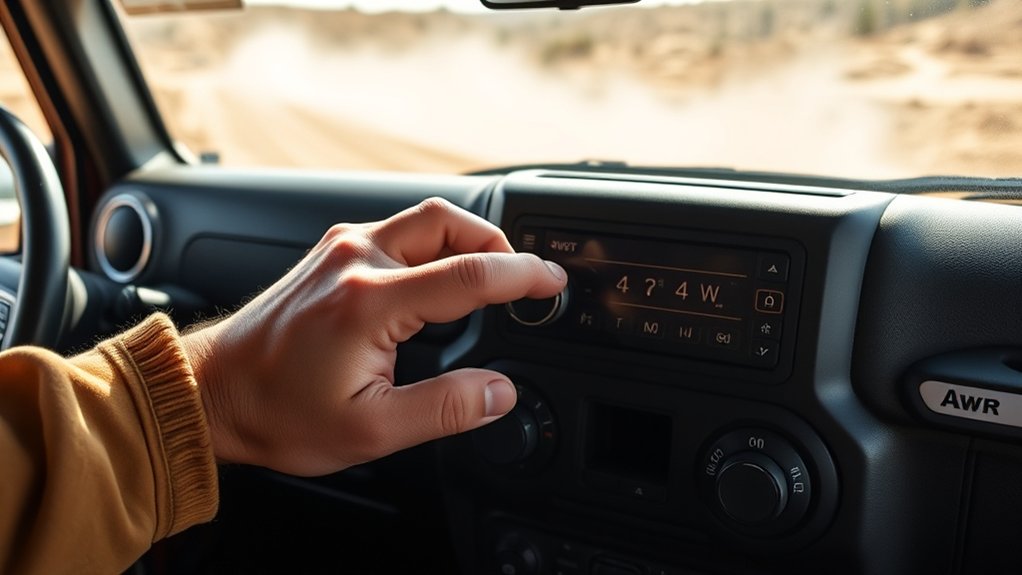
Although your Jeep Wrangler can handle many conditions in 2WD, you should engage 4WD when driving on slippery, uneven, or loose surfaces like mud, snow, sand, or gravel to maximize traction and control. Off road conditions often involve unpredictable terrain where 4WD distributes power to all wheels, preventing wheel slip and improving stability.
In winter driving, activating 4WD enhances your ability to navigate icy or snowy roads, reducing the risk of losing control. Avoid using 4WD on dry, paved roads, as it can cause drivetrain binding and unnecessary wear.
Always assess surface conditions carefully; if you encounter reduced traction or challenging terrain, switch to 4WD promptly to maintain vehicle performance and safety.
How to Engage 4WD on Your Jeep Wrangler
Engage your Jeep Wrangler’s 4WD system by first identifying the type of transfer case it uses, as this determines the specific steps required. For manual transfer cases, you’ll need to stop your vehicle or slow down considerably before shifting the lever from 2H (two-wheel drive high) to 4H (four-wheel drive high) or 4L (four-wheel drive low).
When engaging 4WD, make sure the transmission is in neutral or park for smooth engagement. For electronic transfer cases, simply press the 4WD control button or switch; the system will automatically engage. Always refer to your owner’s manual for exact procedures.
Engaging 4WD correctly maximizes traction and control, which are key 4WD benefits in off-road or slippery conditions, enhancing vehicle stability and performance.
Switching Between 2WD and 4WD on Your Jeep Wrangler
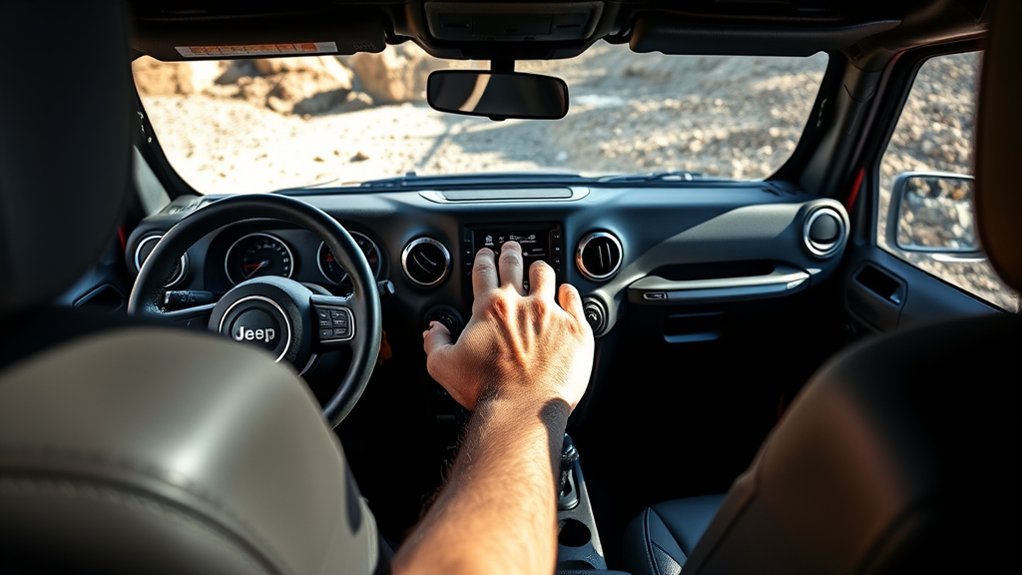
To switch between 2WD and 4WD on your Jeep Wrangler, start by locating the drive mode selector on the dashboard or shift lever. Engage 4WD when you encounter slippery or uneven terrain to improve traction and control.
Follow proper shifting procedures, such as stopping or driving at low speeds, to guarantee smooth changes and avoid drivetrain damage.
Identifying Drive Mode Selector
The drive mode selector on your Jeep Wrangler controls the shift between 2WD and 4WD, allowing you to adapt to varying road conditions. You’ll find two primary selector types: a lever-style and an electronic rotary knob. Lever selectors require manual shifting, while rotary knobs offer push-button convenience.
| Selector Type | Operation Method | Common Models |
|---|---|---|
| Lever-style | Manual 4WD engagement | Older and off-road trims |
| Rotary knob | Electronic switching | Newer Wranglers |
| Push-button | Simplified control | Premium trims |
Understand your Jeep’s selector type to engage 4WD correctly and guarantee smooth shifts between drive modes. Check the owner’s manual for specific instructions tailored to your model.
When To Engage 4WD
Although your Jeep Wrangler operates smoothly in 2WD under normal conditions, you’ll need to switch to 4WD when driving on slippery, uneven, or off-road terrain to maintain excellent traction and control. Engage 4WD in terrain conditions such as mud, snow, sand, or gravel where wheel slip is likely.
In driving scenarios involving steep inclines, loose surfaces, or deep ruts, 4WD distributes power evenly, preventing wheel spin and enhancing stability. Avoid using 4WD on dry, paved roads as it may cause drivetrain binding and increased tire wear.
Recognize that certain 4WD modes suit specific terrain conditions. Use 4WD High for moderate off-road and slippery surfaces, and 4WD Low for extreme off-road challenges requiring maximum torque. Proper engagement guarantees superior vehicle performance and safety.
Shifting Procedures And Tips
When you need to switch between 2WD and 4WD on your Jeep Wrangler, follow specific shifting procedures to guarantee smooth engagement and prevent drivetrain damage. Begin by evaluating your driving conditions. Engage 4WD when traction is compromised, such as on snow, mud, or uneven terrain.
For shifting techniques, if your Wrangler has a manual transfer case, come to a complete stop before shifting from 2WD to 4WD low. For 4WD high, you can shift on the fly at speeds under 55 mph by gently easing off the throttle. Always avoid abrupt throttle inputs during shifts.
To revert to 2WD, shift the transfer case lever back smoothly. Proper adherence to these shifting techniques guarantees ideal drivetrain function and prolongs the longevity of your Jeep’s 4WD system.
How to Identify Your Jeep Wrangler’s 4WD System
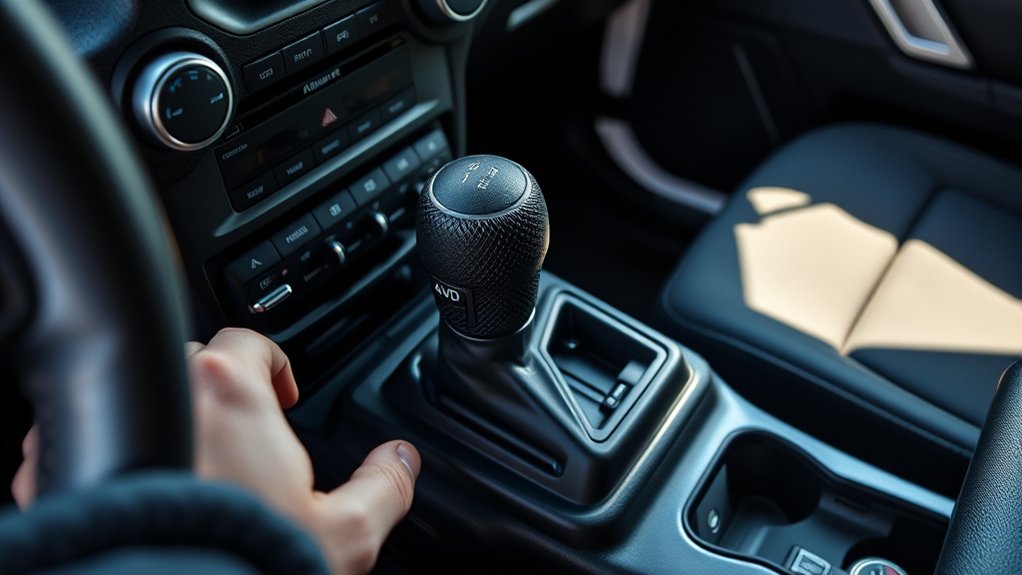
To properly engage your Jeep Wrangler’s 4WD, you need to identify which 4WD system it uses, such as Command-Trac, Rock-Trac, or Selec-Trac. Locate the 4WD controls, typically found on the dashboard or center console, to understand how to operate them.
Recognizing these components guarantees you shift correctly and maintain peak vehicle performance.
Types Of 4WD Systems
Because Jeep Wranglers have different 4WD systems depending on the model and year, you need to identify which one your vehicle uses before engaging 4WD. There are two main categories: manual vs automatic and full time vs part time.
Manual systems require you to physically shift the transfer case lever to engage 4WD, giving you direct control. Automatic systems use electronic controls to switch between 2WD and 4WD modes based on driving conditions.
Full-time 4WD systems deliver power to all wheels continuously, allowing you to drive in 4WD without manual input. Part-time 4WD systems operate primarily in 2WD and require you to engage 4WD when needed, typically for off-road or slippery conditions.
Knowing your Wrangler’s system type guarantees proper use and prevents drivetrain damage.
Locating 4WD Controls
Although Jeep Wrangler models vary, you can quickly identify your 4WD system by locating its specific controls inside the vehicle. Typically, the control location will be either a rotary dial, a lever, or push-button setup positioned on the center console or dashboard.
Look for labels such as “4H,” “4L,” or “N” near these controls, which correspond to different drive modes. Additionally, pay attention to your dashboard’s 4WD indicators; these lights confirm when the system is engaged or disengaged.
In some models, the indicators illuminate in green or amber to show active 4WD status. By familiarizing yourself with the control location and 4WD indicators, you ascertain precise operation and avoid misusing the system, which can affect vehicle performance and safety.
Fix Common Jeep Wrangler 4WD Problems
When your Jeep Wrangler’s 4WD system malfunctions, diagnosing the issue promptly guarantees safe and effective operation. Use 4WD troubleshooting tips to identify common transmission issues like stuck hubs, faulty shift motors, or low transfer case fluid.
Start by visually inspecting components, then test the 4WD engagement in different modes.
| Issue | Symptom | Fix |
|---|---|---|
| Stuck Hubs | Wheel won’t engage | Lubricate or replace hubs |
| Faulty Shift Motor | 4WD won’t shift | Replace shift motor assembly |
| Low Transfer Fluid | Noisy or rough shifting | Refill or replace fluid |
Following these steps, you’ll quickly restore your Jeep’s 4WD functionality and prevent further damage.
Maintain Your Jeep Wrangler’s 4WD System
Proper upkeep of your Jeep Wrangler’s 4WD system helps prevent common issues like stuck hubs or faulty shift motors from developing in the first place. To maintain peak performance, follow these 4WD maintenance tips and conduct regular inspections.
Start by checking the transfer case fluid level and quality, ensuring it’s at the recommended level and free of contamination. Next, inspect the front and rear differentials for leaks or damage. Finally, examine the drive shafts and universal joints for excessive play or corrosion.
Regularly cleaning and lubricating these components will extend their lifespan. Adhering to a scheduled maintenance routine helps you avoid costly repairs and keeps your 4WD system functioning smoothly under all driving conditions.
Frequently Asked Questions
Can I Use 4WD on Dry Pavement Without Damaging My Jeep?
You shouldn’t use 4WD on dry pavement because pavement conditions cause binding in the drivetrain, leading to excessive wear.
Reserve 4WD usage for low-traction surfaces like mud, snow, or loose gravel to protect your Jeep’s components.
What Is the Difference Between 4WD High and 4WD Low?
Think of 4WD High as your Jeep’s highway cruise control, engaging 4WD mechanics for moderate off-road advantages at higher speeds.
4WD Low, however, delivers maximum torque and control for tough, slow terrains by using lower gear ratios.
How Does 4WD Affect My Jeep Wrangler’s Fuel Efficiency?
Engaging 4WD increases your Jeep Wrangler’s fuel consumption due to drivetrain impact. Extra components work harder, adding mechanical drag and weight. Use 4WD only when necessary to optimize fuel efficiency and reduce unnecessary drivetrain strain.
Can I Install an Aftermarket 4WD System on My Jeep?
You can definitely install aftermarket systems on your Jeep, but the installation process demands precision and compatible components. Follow detailed guides and use proper tools.
Guarantee your drivetrain matches to avoid mechanical issues or voiding warranties.
Does Using 4WD Require Special Tires or Modifications?
You don’t necessarily need special tire types for 4WD, but tires with better traction differences, like all-terrain or mud-terrain, optimize performance.
Proper tires improve grip and prevent drivetrain stress during 4WD use.
Conclusion
Mastering your Jeep Wrangler’s 4WD system enhances control and confidence on varied terrain. By understanding when and how to engage it, you’ll navigate challenges with ease and precision. Should minor hiccups arise, addressing them promptly guarantees seamless operation.
Regular upkeep gently preserves your 4WD’s reliability, allowing you to confidently explore without hesitation. Embrace these practices, and your Jeep will remain a steadfast partner on every adventure. With proper knowledge and care, putting your Jeep Wrangler in 4 wheel drive becomes second nature.