You don’t need spark plugs in a diesel engine because it ignites fuel through compression ignition. When air is highly compressed, its temperature rises enough to spontaneously ignite the injected fuel without any external spark. This process enhances combustion efficiency and timing precision while reducing ignition system complexity.
Unlike gasoline engines that rely on spark plugs, diesel engines use fuel injection to control combustion.
Keep exploring to understand how this fundamentally improves performance and durability.
Key Takeaways
- Diesel engines do not have spark plugs because they use compression ignition to ignite fuel.
- High compression raises air temperature, causing spontaneous fuel combustion without an external spark.
- Fuel injectors control ignition timing precisely, eliminating the need for spark plugs.
- Unlike gasoline engines, diesel engines rely solely on heat generated by compressed air for ignition.
- The absence of spark plugs reduces ignition-related failures and enhances diesel engine durability.
Why Diesel Engines Don’t Have Spark Plugs
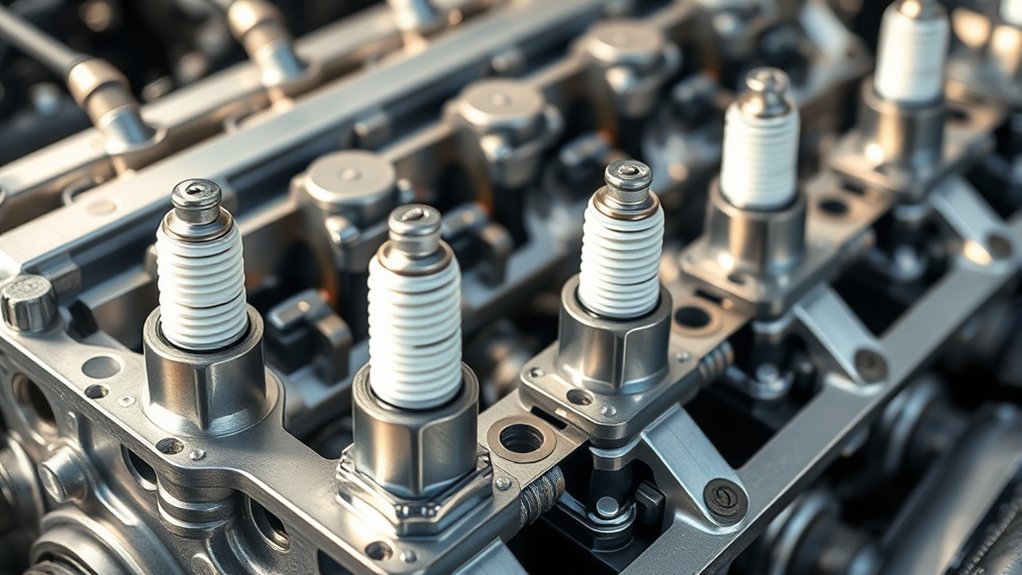
Although spark plugs are essential in gasoline engines to ignite the air-fuel mixture, diesel engines don’t use them because they rely on compression ignition. You should understand that diesel combustion operates under much higher compression ratios, which raises the air temperature inside the cylinder sufficiently to ignite the fuel spontaneously.
This process eliminates the need for an external ignition source like a spark plug. By depending on compression ignition, diesel engines achieve greater engine efficiency due to improved fuel atomization and combustion timing. You’ll notice that this method also reduces energy losses associated with spark plug timing and ignition variability.
Consequently, the design inherently supports more precise control over combustion, contributing directly to the diesel engine’s robustness and superior thermal efficiency compared to spark-ignited engines.
How Diesel Engines Ignite Fuel Without Spark Plugs
The absence of spark plugs in diesel engines stems from their unique ignition method, which depends entirely on compression. When you operate a diesel engine, the air inside the cylinder compresses to extremely high pressures and temperatures, typically around 500°C to 700°C.
This intense heat triggers fuel combustion immediately upon injection, eliminating the need for an external ignition source like a spark plug. You control ignition timing precisely by managing when the fuel injectors deliver diesel into the combustion chamber.
Since fuel combustion initiates due to the air’s elevated temperature, the engine relies on this compression-induced auto-ignition rather than an electric spark. This method guarantees efficient combustion, especially under varying load conditions, by synchronizing fuel injection timing with ideal ignition timing for power and emissions control.
Key Differences Between Diesel and Gasoline Ignition Systems
When you compare diesel and gasoline ignition systems, you’ll notice fundamental differences rooted in how each engine initiates combustion. Gasoline engines rely on spark plugs to ignite an air-fuel mixture, requiring an external electrical spark at a precise moment.
In contrast, diesel engines use compression ignition, where high compression raises air temperature to ignite injected fuel spontaneously. This absence of spark plugs in diesel systems contributes to improved fuel efficiency, as combustion timing is controlled by injection rather than spark timing.
Additionally, the robust design of diesel ignition components enhances engine longevity, with fewer ignition-related failures. Understanding these distinctions helps you appreciate why diesel engines perform differently under load and why their ignition systems impact maintenance and operational efficiency.
Benefits of Diesel Engine Compression Ignition
Since diesel engines rely on compression ignition, you benefit from higher thermal efficiency compared to spark-ignited engines. This process allows diesel engines to extract more energy from fuel, enhancing fuel efficiency and increasing torque output.
The combustion occurs at higher pressures and temperatures, which optimizes power delivery and reduces fuel consumption.
| Benefit | Explanation | Impact |
|---|---|---|
| Fuel Efficiency | Higher compression ratio improves energy extraction | Lower fuel consumption |
| Torque Output | Combustion at high pressure generates greater force | Superior low-end torque |
| Reliability | No spark plug reduces ignition system complexity | Enhanced durability |
Understanding these benefits helps you appreciate why diesel engines excel in heavy-duty applications requiring power and efficiency.
Frequently Asked Questions
What Maintenance Do Diesel Engine Glow Plugs Require?
You’ll want to regularly perform glow plug testing to spot failures before they leave you stranded. When testing reveals issues, prioritize glow plug replacement promptly to guarantee reliable cold starts and peak diesel engine performance.
Can Diesel Engines Run on Gasoline?
You can’t run diesel engines on gasoline without severely damaging engine performance, as diesel fuel’s higher ignition point and lubrication properties are essential.
Gasoline causes improper combustion, leading to reduced efficiency and potential mechanical failure.
How Does Cold Weather Affect Diesel Engine Starting?
Cold weather makes diesel engines harder to cold start due to fuel gelling and reduced battery efficiency.
You’ll improve starting by using fuel additives that lower fuel’s pour point and employing glow plugs to preheat combustion chambers efficiently.
Are Diesel Engines More Fuel-Efficient Than Gasoline Engines?
You’ll find diesel engines more fuel-efficient than gasoline ones, thanks to lower fuel consumption and higher compression ratios. This improves engine performance by extracting more energy per unit, enhancing overall efficiency and power output.
What Types of Vehicles Commonly Use Diesel Engines?
You’ll find diesel vehicles commonly in trucks, buses, and heavy machinery, where engine performance and fuel efficiency are essential. Their robust diesel engines handle high torque demands, optimizing power delivery and durability for demanding transportation tasks.
Conclusion
You don’t need spark plugs in a diesel engine because it relies on compression ignition, not spark ignition. Diesel engines compress air to extreme temperatures, then inject fuel that ignites on contact. This process eliminates the need for spark plugs.
This method contrasts sharply with gasoline engines, which use spark plugs to ignite a fuel-air mixture. Diesel’s compression ignition offers benefits like efficiency, durability, and power.
In conclusion, a diesel engine does not have spark plugs because it uses a fundamentally different ignition system designed for heavy-duty performance.