You rely on 4 stroke engine oil to lubricate your motorcycle’s internal parts separately from fuel, reducing friction and wear while maintaining consistent viscosity across temperatures.
This specialized oil creates a protective film between components, helping to dissipate heat and suspend contaminants to prevent deposits.
Its advanced additives provide strong anti-wear and corrosion protection, which enhances engine efficiency and longevity.
Selecting the right oil involves considering viscosity, synthetic options, and manufacturer specifications—details you’ll uncover next.
Key Takeaways
- 4 stroke engine oil lubricates moving parts in 4 stroke engines, reducing friction and wear.
- It circulates separately from fuel, unlike 2 stroke oil which mixes with fuel.
- The oil maintains proper viscosity to ensure consistent lubrication across temperature changes.
- It contains additives for anti-wear protection, heat dissipation, and contaminant suspension.
- Using the correct 4 stroke oil enhances engine efficiency, reliability, and longevity.
Understanding 4 Stroke Engine Oil
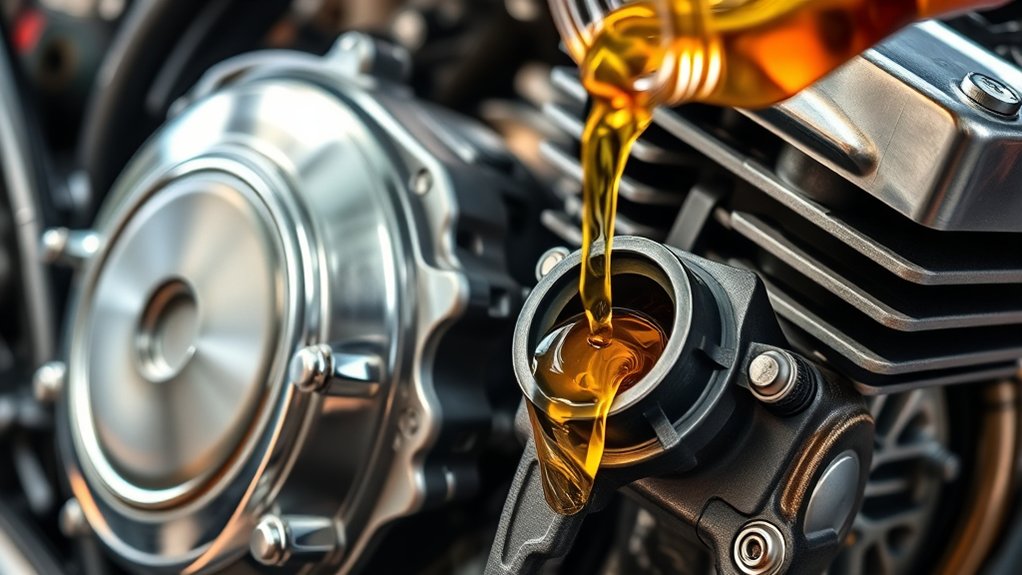
Understanding 4 stroke engine oil begins with recognizing its critical role in lubricating the engine’s moving parts. You rely on this oil to create a thin, protective film that reduces friction and wear between components like pistons, crankshafts, and camshafts.
You must select oil with the correct viscosity to guarantee ideal flow under varying temperatures and operating conditions; too thick, and it hinders movement, too thin, and it fails to protect adequately. The oil also aids in heat dissipation and prevents corrosion by neutralizing acids formed during combustion.
You’ll find that 4 stroke engine oil is formulated with additives enhancing its performance, maintaining stability under high stress. Proper engine lubrication with the right oil viscosity not only extends engine life but also improves efficiency and reliability.
How 4 Stroke Oil Differs From 2 Stroke and Other Types
While both 4 stroke and 2 stroke oils serve to lubricate engines, they differ fundamentally in formulation and application due to the distinct operating mechanisms of their respective engines. In 4 stroke engines, oil circulates separately from fuel, requiring a higher oil viscosity for effective engine lubrication under varied temperature and pressure conditions.
Conversely, 2 stroke oils mix directly with fuel, demanding lower viscosity and specific additives to guarantee combustion compatibility and minimize deposits. Additionally, 4 stroke oils contain advanced detergents and anti-wear agents to protect camshafts and valves, components absent in 2 stroke engines.
Other oil types, like those for diesel or automotive use, vary further in additive packages and viscosity grades tailored to their unique engine designs and operating environments. Understanding these differences guarantees you select the correct oil for peak performance and engine longevity.
Why 4 Stroke Oil Is Essential for Your Motorcycle
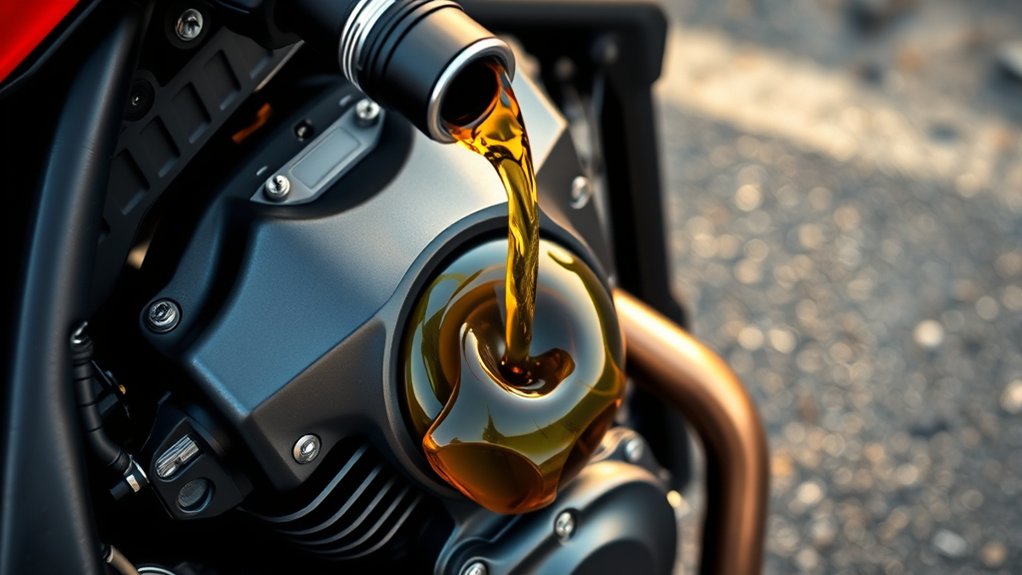
Three critical functions make 4 stroke oil indispensable for your motorcycle: lubrication, cooling, and contamination control. Proper lubrication reduces friction between moving parts, preventing wear and maintaining peak engine performance.
The oil’s viscosity is carefully formulated to guarantee it flows smoothly at varying temperatures, providing a consistent protective film. This prevents metal-to-metal contact, especially under high stress. Additionally, 4 stroke oil aids in cooling by transferring heat away from engine components, stabilizing operating temperatures and avoiding overheating.
It also suspends contaminants and combustion byproducts, keeping internal surfaces clean and minimizing deposits that could degrade performance. Using the correct 4 stroke oil guarantees your motorcycle runs efficiently, extends engine life, and sustains power output by maintaining the delicate balance of lubrication, temperature regulation, and cleanliness essential for peak engine function.
Key Qualities of Good 4 Stroke Engine Oil
Choosing the right 4 stroke engine oil hinges on its ability to maintain ideal viscosity, resist thermal breakdown, and provide robust anti-wear protection. You should look for oils with precise viscosity ratings that guarantee consistent lubrication properties across a wide temperature range.
Advanced additive packages enhance wear protection by reducing friction and preventing deposits, directly contributing to engine longevity. High temperature tolerance is essential, especially under demanding operating conditions, to prevent oil degradation and maintain performance stability.
Synthetic options often excel here, offering superior thermal stability and enhanced shear resistance compared to conventional oils. By prioritizing these qualities, you guarantee your engine operates efficiently, minimizes wear, and extends service intervals.
Ultimately, the right 4 stroke engine oil balances viscosity, additives, and thermal resilience to safeguard your engine’s reliability and performance.
How to Choose the Right 4 Stroke Engine Oil

Understanding the key qualities of effective 4 stroke engine oil sets the foundation for selecting the right product tailored to your engine’s specific needs. Focus on oil viscosity, which affects lubrication efficiency under varying temperatures.
Synthetic options often provide superior stability and protection compared to conventional oils. Always check your engine manufacturer’s specifications for recommended viscosity grades and oil types.
| Parameter | Conventional Oil | Synthetic Oil |
|---|---|---|
| Oil Viscosity | Narrow range, less stable | Wide range, highly stable |
| Temperature Range | Limited | Extensive |
| Additive Package | Basic | Advanced |
| Engine Protection | Standard | Enhanced |
| Cost | Lower | Higher |
Choosing synthetic oil with correct viscosity guarantees peak performance and longevity of your 4 stroke engine.
Frequently Asked Questions
Can I Use 4 Stroke Engine Oil in a Lawn Mower?
Yes, you can use 4 stroke engine oil in your lawn mower, ensuring lawn mower compatibility. This maintains ideal engine performance, reduces wear, and enhances lubrication, provided you follow the manufacturer’s recommended oil grade and specifications precisely.
How Often Should I Change 4 Stroke Engine Oil?
You should change oil every 25-50 hours or at least once per season to maintain peak engine performance. Following manufacturer-recommended oil change intervals guarantees proper lubrication, reduces wear, and prolongs your engine’s lifespan effectively.
What Happens if I Use the Wrong Oil Viscosity?
Using the wrong oil viscosity disrupts oil performance, causing increased friction and wear like a knight’s armor too heavy or too light. Viscosity effects reduce lubrication efficiency, risking engine damage, overheating, and lowered overall reliability.
Is Synthetic 4 Stroke Oil Better Than Conventional Oil?
Yes, synthetic 4 stroke oil offers superior synthetic benefits like enhanced oil performance, better thermal stability, and improved engine protection compared to conventional oil. This ensures longer intervals between oil changes and peak engine efficiency in demanding conditions.
Can 4 Stroke Engine Oil Expire or Go Bad?
Imagine old oil like forgotten syrup. Yes, 4 stroke engine oil can expire. Its oil shelf life varies, but exposure causes oil degradation, reducing lubrication efficiency.
Always check dates and storage to keep it effective.
Conclusion
Choosing the right 4 stroke engine oil is like giving your motorcycle a lifeline, ensuring every gear shift and mile hums smoothly. It protects, cools, and cleans with precision, acting as the invisible shield against wear and tear. Without it, your engine’s heart would falter.
So, trust in quality oil tailored for 4 stroke engines—it’s the essential fluid that keeps your ride performing with mechanical grace and unwavering reliability. Using the proper 4 stroke engine oil is key to maintaining your engine’s health and longevity.