A Jeep Wrangler’s length varies mainly by body style: two-door models measure about 166 inches, while four-door Unlimited versions extend to roughly 188 inches.
Width hovers near 73 inches, with height around 73 to 74 inches, balancing off-road capability and urban maneuverability.
Wheelbase ranges from 96 to 118 inches, influencing handling and interior space.
These dimensions prioritize rugged agility over passenger volume.
Exploring how length impacts parking, performance, and model differences provides deeper insight into its design.
Key Takeaways
- Jeep Wrangler two-door models typically measure around 166 inches in length.
- Four-door Wrangler Unlimited variants extend to approximately 188 inches long.
- Width is about 73 inches, with height ranging between 73 to 74 inches.
- Wheelbase ranges from 96 inches (two-door) up to 118 inches (four-door).
- Length varies slightly by generation and trim but remains consistent within body styles.
How Long Is a Jeep Wrangler? Quick Overview
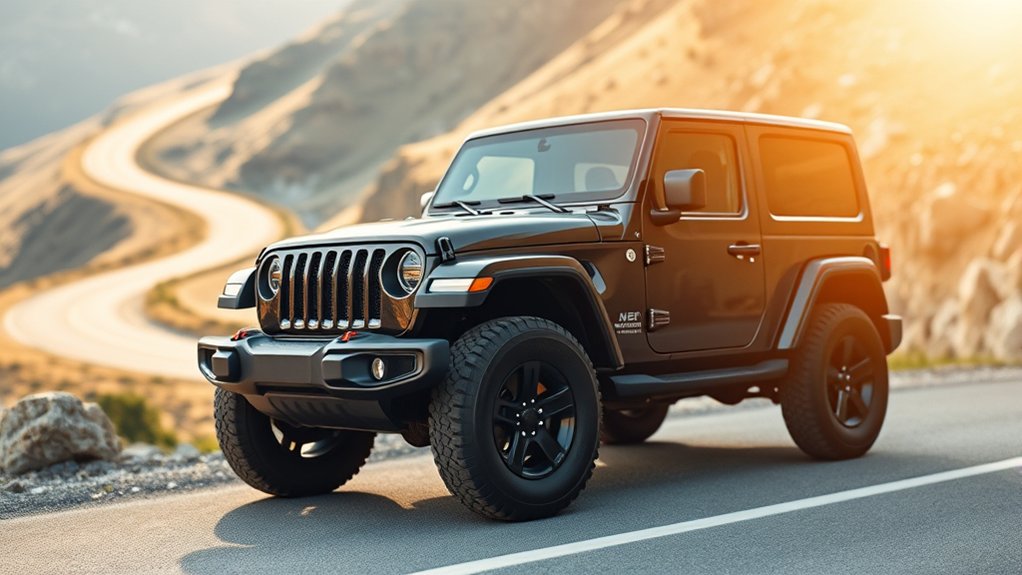
How long is a Jeep Wrangler exactly? You’ll find that Jeep dimensions vary slightly by model, but the standard length generally ranges from about 166 to 188 inches. This measurement depends on whether you have a two-door or four-door version, with the latter naturally extending the overall length.
When making vehicle comparisons, the Wrangler is shorter than many full-size SUVs but longer than most compact off-road vehicles. Its length contributes to its renowned off-road agility while still offering enough interior space for passengers and gear.
Understanding these Jeep dimensions helps you assess maneuverability, parking ease, and trail handling in relation to other vehicles you might consider for similar purposes.
Jeep Wrangler Lengths Across Generations
You’ll notice that Jeep Wrangler lengths vary considerably across different model generations, influenced by evolving design and engineering priorities. The choice between body styles, such as two-door and four-door variants, directly affects overall length measurements.
Understanding these variations helps clarify how the Wrangler’s dimensions have adapted over time to meet diverse functional needs.
Length Variations By Model
Although the Jeep Wrangler has maintained its iconic design, its length has varied considerably across different models and generations. For example, the JK model ranges from about 166.8 inches for the two-door to 188.4 inches for the four-door Unlimited variant. These length differences directly impact cargo capacity, with the longer Unlimited offering more rear storage space.
Engine specifications also influence model dimensions; newer engines and drivetrains may require slight frame adjustments, subtly affecting overall length. The JL generation, while similar in size to the JK, refines these dimensions with improved aerodynamics and structural tweaks.
Understanding these length variations helps you gauge how each model balances maneuverability, cargo capacity, and engine integration, allowing you to select the Wrangler variant best suited to your practical needs.
Impact Of Body Styles
Variations in Jeep Wrangler length are closely tied to its body styles, which have evolved notably across generations. You’ll notice that the two-door Wrangler models typically measure shorter, emphasizing maneuverability and off-road agility, while the four-door Unlimited variants extend the length notably to enhance passenger capacity and cargo space.
This body style influence impacts the vehicle’s wheelbase, overall length, and weight distribution, which in turn affect handling dynamics and trail performance. Design implications of these length differences are critical, as engineers balance structural integrity with off-road capability.
When comparing generations, you’ll see incremental length adjustments reflecting advancements in chassis design and consumer preferences, further illustrating how body style directly dictates the Wrangler’s dimensional specifications and functional versatility.
Comparing Two-Door and Four-Door Jeep Wrangler Lengths
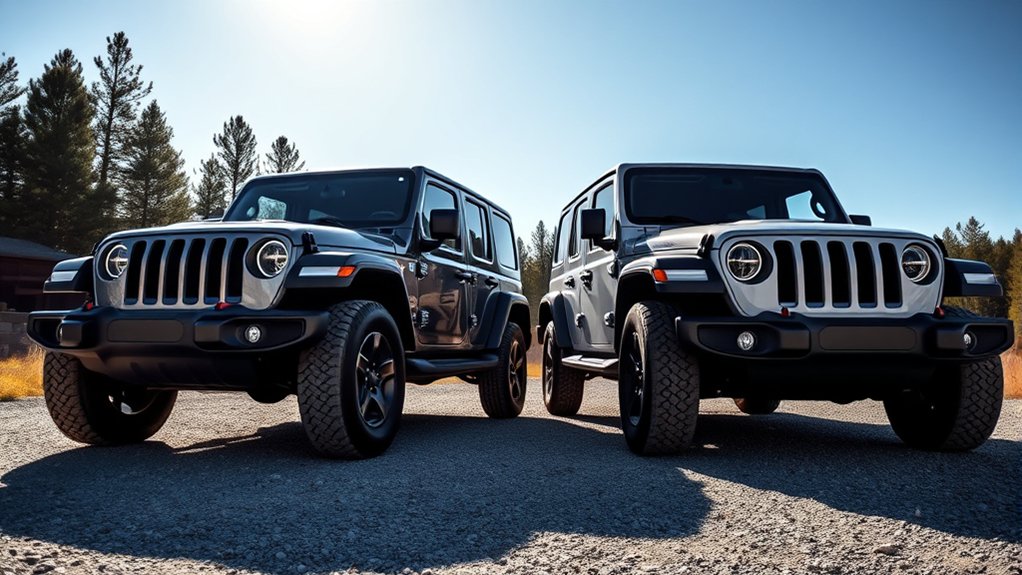
Several key differences distinguish the lengths of two-door and four-door Jeep Wranglers, impacting maneuverability, interior space, and off-road capability. The two-door comparison reveals a more compact length, typically around 166 inches, which enhances agility on tight trails and urban environments.
This shorter wheelbase reduces the turning radius, allowing you to navigate obstacles with greater ease. Conversely, the four-door Wrangler, measuring approximately 188 to 189 inches, offers distinct four door advantages, including increased passenger capacity and expanded cargo space.
While its extended length slightly compromises maneuverability, it provides greater versatility for daily use and longer trips. Understanding these dimensional differences helps you choose the right Wrangler variant suited to your specific driving and lifestyle needs without sacrificing core off-road performance.
Factors That Influence Jeep Wrangler Length by Model
When evaluating Jeep Wrangler length, you need to take into account model variants like the Sport, Sahara, and Rubicon, each with distinct dimensions. Trim levels also affect length due to added features such as bumpers, roof types, and wheelbase adjustments.
Understanding these factors helps you accurately assess the vehicle’s size for your specific needs.
Model Variants Overview
The dimensions of a Jeep Wrangler depend heavily on the specific model variant you choose, as each configuration offers distinct length measurements tailored to different uses. When making model comparisons, you’ll notice that the two-door Wrangler typically measures around 166 inches in length, favoring maneuverability and compactness.
In contrast, the four-door Wrangler Unlimited extends to approximately 188 inches, providing additional interior space and cargo capacity. Size specifications also vary slightly between the standard, Rubicon, and Sahara variants, mainly due to suspension setups and bumper designs, though these differences are minimal.
Understanding these model variants allows you to select the Wrangler length that best suits your driving environment, whether you prioritize off-road agility or passenger and cargo room.
Trim Level Differences
Beyond choosing between two-door and four-door models, trim levels introduce subtle variations that can affect the overall length of a Jeep Wrangler. Different trim level features, such as upgraded bumpers, integrated tow hooks, and protective skid plates, may slightly extend the vehicle’s dimensions.
For example, higher-end trims often include more robust front and rear fascia components, which can add marginal length compared to base models. Additionally, trim level options like roof racks or side steps may influence the effective length when measured from certain points.
While these changes are typically minor, ranging from a few millimeters to a couple of inches, they matter if you need precise measurements for parking or garage fit. Understanding how trim level features and options impact length helps you select the right Wrangler for your space requirements.
How Jeep Wrangler Length Affects Parking and Maneuvering
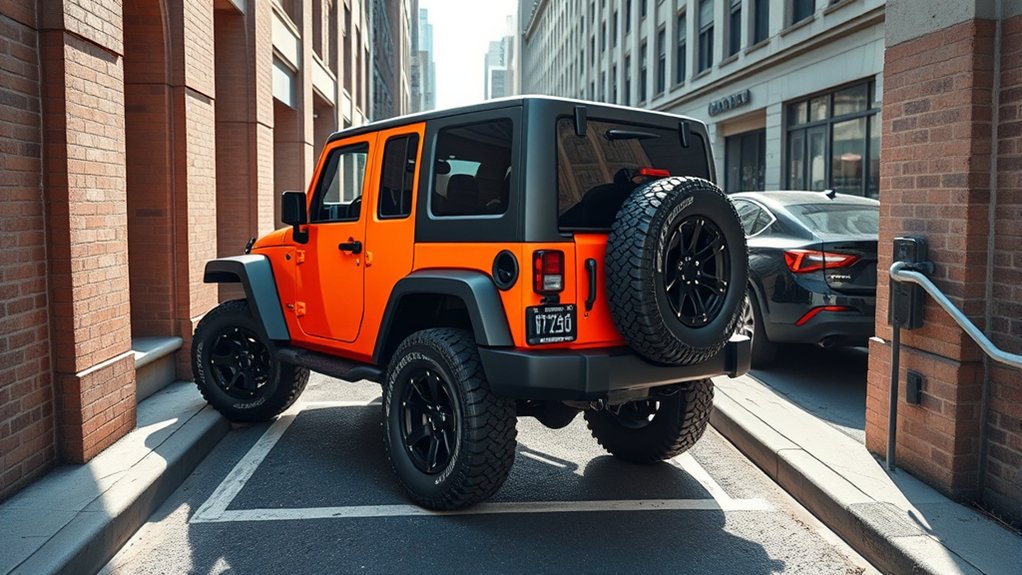
Anyone traversing tight urban spaces quickly notices how the Jeep Wrangler’s length directly impacts parking and maneuvering capabilities. With a length ranging from approximately 166 to 189 inches depending on the model, the Wrangler demands precise parking strategies.
You’ll need to account for its longer wheelbase and overall size when parallel parking or steering through narrow spots. Employing maneuvering techniques like tight turning radius optimization and angle adjustments becomes essential. Using a three-point turn or reversing into spaces can compensate for limited clearance.
Additionally, the Wrangler’s boxy design affects spatial judgment, so you must be vigilant about overhangs and curb proximity. Understanding these length-related factors helps you park efficiently and execute smooth maneuvers in confined environments, minimizing risks of scrapes or collisions.
Jeep Wrangler Length and Off-Road Performance
When tackling rugged terrain, Jeep Wrangler length plays an essential role in off-road performance by influencing approach, departure, and breakover angles. A shorter wheelbase improves breakover angle, allowing you to clear obstacles without the undercarriage scraping.
This directly enhances the Wrangler’s off-road capabilities by enabling it to navigate steep crests and uneven surfaces. Additionally, the vehicle’s length affects how the suspension systems absorb impacts; a shorter frame allows for more articulation, giving the tires better ground contact on irregular terrain.
Conversely, longer models provide increased stability but may struggle with sharper angles. Understanding the relationship between Wrangler length and suspension design helps you optimize your vehicle for specific off-road conditions, balancing maneuverability and comfort to maximize performance in challenging environments.
How Jeep Wrangler Size Stacks Up Against Other SUVs
The Jeep Wrangler’s dimensions not only influence its off-road prowess but also shape how it compares to other SUVs in everyday use. When evaluating Jeep dimensions against typical SUVs, you’ll notice key differences:
The Jeep Wrangler’s size impacts both its off-road ability and everyday SUV comparisons.
- Length: Wranglers generally measure between 166 and 188 inches, shorter than many midsize SUVs.
- Width: At roughly 73 inches, the Wrangler is narrower, aiding maneuverability in tight spaces.
- Height: Its height ranges from 73 to 74 inches, comparable to other SUVs but with a higher ground clearance.
- Wheelbase: Shorter wheelbase (96–118 inches) enhances off-road articulation but reduces interior space.
In SUV comparisons, these Jeep dimensions make the Wrangler more compact and agile, prioritizing rugged capability over passenger or cargo volume. Understanding these specifics helps you assess if the Wrangler fits your lifestyle and space needs.
How to Measure Your Jeep Wrangler’s Length Easily
Measuring your Jeep Wrangler’s length accurately involves a few straightforward steps and basic tools, such as a tape measure or measuring wheel. Start by parking your Jeep on a flat, level surface to guarantee precision. Use your length tools to measure from the front bumper’s tip to the rear bumper’s end.
Employ consistent measuring techniques, keeping the tape or wheel straight and close to the vehicle’s body.
| Step | Instruction |
|---|---|
| 1. Prepare | Park on flat ground |
| 2. Select Tools | Use tape measure or measuring wheel |
| 3. Measure | From front bumper to rear bumper |
| 4. Record | Note the length for accuracy |
This method guarantees you get an exact dimension of your Jeep Wrangler’s length without guesswork.
Choosing the Right Jeep Wrangler Length for Your Lifestyle
How do you determine which Jeep Wrangler length suits your daily needs and driving environment best? Start by analyzing your lifestyle needs and adventure preferences. Consider these four technical factors:
- Urban Maneuverability: Shorter wheelbases excel in tight city streets and parking, enhancing ease of use.
- Off-Road Capability: Longer wheelbases provide better stability on rugged terrain but reduce turning radius.
- Cargo and Passenger Space: Extended models offer increased interior volume, vital for gear and multiple passengers.
- Fuel Efficiency: Generally, shorter Wranglers weigh less, improving fuel economy for frequent commutes.
Frequently Asked Questions
What Is the Fuel Efficiency of a Jeep Wrangler?
You’ll get about 17-25 MPG in a Jeep Wrangler, depending on fuel types like gasoline or diesel and driving conditions such as city or highway. Efficiency varies due to engine options and terrain challenges you encounter.
How Much Does a Jeep Wrangler Weigh?
You’ll find a Jeep Wrangler weighs between 3,900 and 4,400 pounds, depending on the model. Its robust weight supports exceptional off-road capabilities while maintaining a spacious interior for comfort and utility on rugged terrains.
What Are the Engine Options for Jeep Wranglers?
You’ll find Jeep Wranglers equipped with a 2.0L turbocharged inline-4 or a 3.6L V6, both optimizing engine performance and off-road capabilities through advanced torque delivery and efficient fuel management systems.
How Much Can a Jeep Wrangler Tow?
You’re towing like a champ with a Jeep Wrangler, boasting a towing capacity up to 3,500 pounds. It handles various trailer types such as campers, boats, or utility trailers thanks to its robust frame and precise engineering.
Are Jeep Wranglers Good for Daily Commuting?
You’ll find Jeep comfort decent but firm, balancing Wrangler practicality with rugged design. For daily driving and urban adventures, it handles well but may feel less smooth than typical commuter cars, especially on rough roads.
Conclusion
Think of your Jeep Wrangler like a tailored suit—it’s all about fit. Whether you opt for the compact two-door or the spacious four-door, its length shapes your driving experience, from tight city parking to rugged trails. Understanding these dimensions helps you navigate practical needs and off-road adventures with precision.
By measuring and comparing carefully, you guarantee your Wrangler fits your lifestyle as perfectly as a well-crafted garment fits its wearer. Knowing how long a Jeep Wrangler is ensures you make the most of its capabilities and comfort.