4H Auto on your Jeep Wrangler automatically shifts power between the rear and front wheels to optimize traction on variable surfaces like wet pavement or gravel.
It operates mainly in rear-wheel drive but engages 4WD when it senses wheel slippage, enhancing stability without driver input.
Designed for speeds below 55 mph, it balances torque for smoother handling and better control.
Understanding how it works and when to use it can help you maximize your Wrangler’s performance across diverse conditions.
Key Takeaways
- 4H Auto on Jeep Wrangler automatically engages four-wheel drive when wheel slippage is detected for improved traction and stability.
- It primarily operates in rear-wheel drive, shifting power to all four wheels as needed without driver intervention.
- Ideal for variable surfaces like wet roads, gravel, or mud, enhancing control during mixed on- and off-road driving.
- 4H Auto continuously monitors wheel speed and adjusts torque distribution for smooth handling and safety.
- It should be used below 55 mph and avoids prolonged use on dry pavement to maintain drivetrain health.
What Is 4H Auto on a Jeep Wrangler?
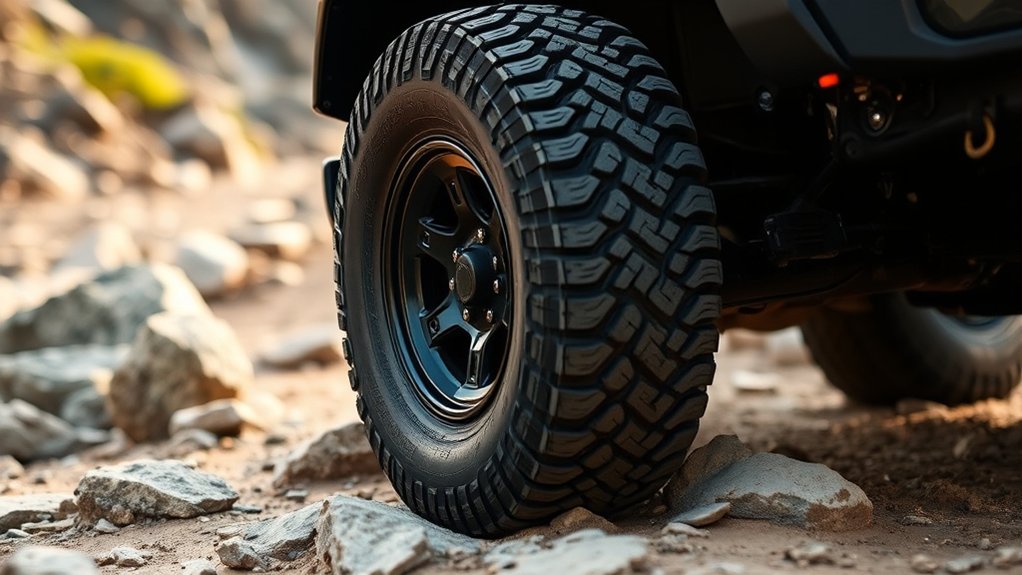
What exactly does 4H Auto mean on a Jeep Wrangler? It refers to a specific mode in the Jeep drivetrain that enables automatic engagement of four wheel drive. When you select 4H Auto, the system actively monitors traction conditions and seamlessly distributes power between the front and rear axles as needed.
This means the Jeep Wrangler operates primarily in rear-wheel drive but instantly shifts to four wheel drive if slippage is detected. The 4H Auto mode is designed for variable road surfaces where traction can change rapidly, such as wet pavement or light off-road trails.
How 4H Auto Works on a Jeep Wrangler
You’ll find that 4H Auto automatically adjusts traction between the front and rear axles based on driving conditions, optimizing grip without manual input. It’s best used on variable surfaces like wet pavement or loose gravel where traction changes frequently.
Automatic Traction Adjustment
Although 4H Auto on a Jeep Wrangler appears similar to traditional four-wheel drive modes, it actively monitors wheel slip and automatically adjusts torque distribution between the front and rear axles. Through automatic control algorithms, the system continuously evaluates traction conditions using sensors that detect wheel speed and slip.
When slippage is detected, the traction management system modulates torque delivery to maximize grip without driver input. This dynamic adjustment guarantees balanced power transfer, enhancing stability and control on varying surfaces.
Unlike fixed 4H modes, 4H Auto eliminates the need for manual intervention by adapting in real time to changing terrain. This precision in torque allocation improves off-road performance and on-road safety by maintaining peak traction across diverse driving conditions.
When To Use 4H Auto
The 4H Auto mode’s ability to automatically adjust torque between axles makes it ideal for conditions where traction varies frequently and unpredictably. Use 4H Auto when you encounter mixed terrain, such as shifting between paved roads and off-road conditions.
It provides seamless engagement without requiring manual intervention, ensuring peak traction and stability. On highway driving, 4H Auto maintains efficient power distribution, reducing drivetrain stress and improving handling when road surfaces become slippery.
Avoid using 4H Auto on dry, high-traction pavement for extended periods to prevent unnecessary drivetrain wear. Instead, engage it when you expect sudden changes in grip like wet pavement, gravel, or mud, allowing the system to respond dynamically.
This mode balances traction demands, making it a versatile choice for both on- and off-road driving scenarios.
Benefits Of 4H Auto
Because 4H Auto continuously monitors wheel slip and torque distribution, it optimizes traction by automatically sending power to the axle with the most grip. This enhances your Jeep Wrangler’s off-road performance by adapting to terrain changes in real time. You get improved driving stability without manual intervention, allowing you to focus on control and safety.
| Benefit | Description | Impact on Driving |
|---|---|---|
| Automatic Torque Shift | Transfers power dynamically between axles | Maintains traction on uneven surfaces |
| Enhanced Traction | Reacts instantly to wheel slip | Prevents loss of momentum |
| Improved Stability | Balances torque for smoother handling | Reduces skidding and fishtailing |
| Ease of Use | No driver input needed for engagement | Simplifies off-road navigation |
| Adaptability | Suitable for varied off-road conditions | Maximizes Wrangler’s capability |
Comparing 4H Auto to Other 4WD Modes on Your Jeep Wrangler
When you compare 4H Auto to standard 4H, you’ll notice 4H Auto automatically adjusts torque distribution based on traction conditions, enhancing stability without driver input. Unlike 4L mode, which provides maximum torque and slower speeds for extreme off-road situations, 4H Auto maintains normal driving dynamics while improving grip.
Understanding these differences helps you select the ideal mode for varying terrain and driving demands.
4H Auto Versus 4H
Although both 4H Auto and 4H modes engage four-wheel drive, they operate differently to optimize traction based on driving conditions. 4H Auto automatically adjusts torque distribution between the front and rear axles, allowing your Jeep Wrangler to maintain traction on variable surfaces without driver intervention.
This mode offers 4H Auto advantages such as improved fuel efficiency and seamless adaptation to changing road conditions. However, 4H Auto limitations include reduced effectiveness in extreme off-road scenarios where fixed torque distribution is preferable.
In contrast, 4H provides a constant, fixed 50/50 torque split between axles, delivering predictable power for consistent traction on slippery or rugged terrain. You’ll want to use 4H when you require maximum traction control, while 4H Auto suits mixed on- and off-road driving where conditions vary frequently.
Benefits Over 4L Mode
While 4L mode provides maximum torque and low-speed control for extreme off-road conditions, 4H Auto offers a more versatile balance between traction and drivability for everyday use. Unlike 4L, which limits speed and demands manual engagement, 4H Auto dynamically manages power distribution, enhancing off-road efficiency without sacrificing road manners.
When you choose 4H Auto, you benefit from:
- Automatic traction control adjustments adapting to varying terrain
- Higher speed capability without compromising drivetrain safety
- Reduced drivetrain binding on pavement compared to 4L
- Enhanced fuel efficiency due to optimized torque delivery
- Seamless shift between 2WD and 4WD modes improving overall handling
This mode gives you confidence on mixed surfaces, ensuring traction control systems work proactively while maintaining a smoother driving experience than 4L mode.
When to Use 4H Auto On- and Off-Road
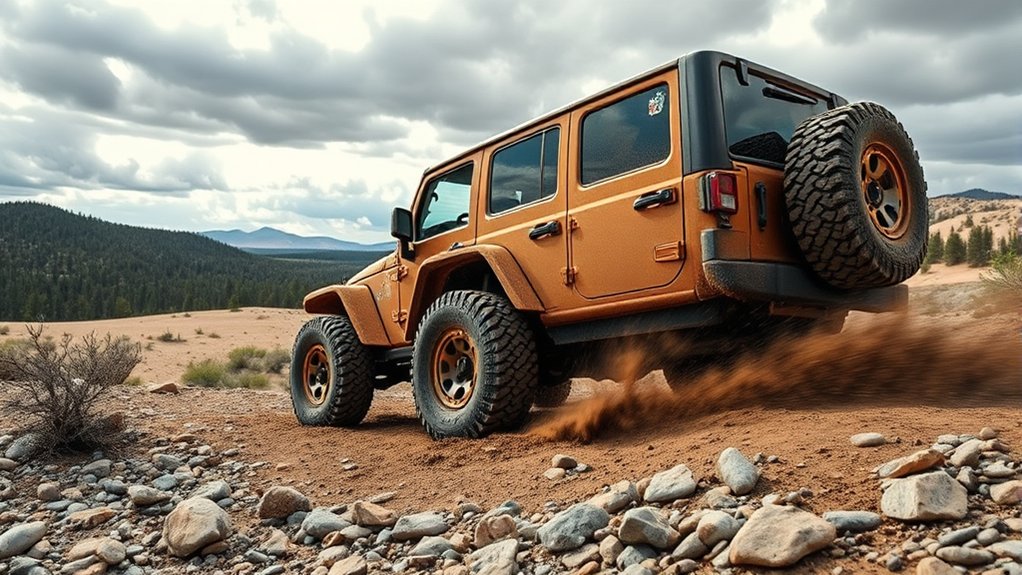
Since 4H Auto mode automatically adjusts torque distribution between the front and rear axles, you should engage it whenever you encounter variable traction conditions both on- and off-road. On paved surfaces with intermittent slippery patches, like wet pavement or light snow, 4H Auto optimizes on-road performance by seamlessly shifting power to wheels with the best grip, enhancing stability without driver intervention.
In off-road conditions, such as loose gravel, mud, or uneven terrain, it provides balanced torque delivery, preventing wheel slip while maintaining momentum. This dynamic torque modulation allows you to confidently navigate changing surfaces without manually switching modes.
However, 4H Auto is ideal for moderate speeds and mixed traction; for extreme off-road challenges, more specialized modes may be necessary to maximize control and durability.
How to Engage and Disengage 4H Auto Safely
Engage 4H Auto by bringing your Jeep Wrangler to a complete stop or slowing to a low speed, typically under 45 mph, to guarantee smooth activation of the system. When using proper engaging techniques, follow these steps:
- Shift the transfer case lever or dial to 4H Auto without pressing the clutch or brake aggressively.
- Confirm the 4H Auto indicator light illuminates on the dashboard.
- Avoid sharp steering inputs immediately after engagement.
- Drive steadily to allow the system to distribute torque evenly.
- Monitor traction conditions and adjust as necessary.
To disengage safely, use these disengaging tips:
- Slow down below 45 mph before shifting back to 2H.
- Shift transfer case lever or dial smoothly without abrupt movements.
- Wait for the 2H indicator to confirm disengagement.
- Avoid sudden acceleration during change.
- Verify road conditions are suitable for 2WD operation.
Common 4H Auto Problems and Fixes
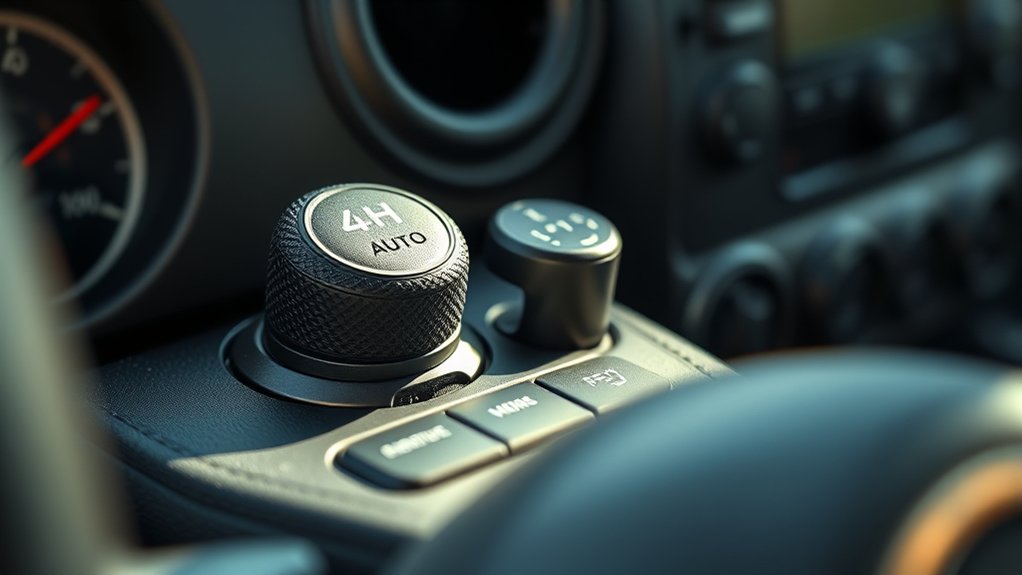
If your Jeep Wrangler’s 4H Auto system isn’t performing as expected, understanding common issues can help you diagnose and address problems efficiently. You might encounter tire slippage due to uneven tire wear or improper pressure.
Drivetrain issues often stem from worn components or inadequate fluid maintenance. Sensor malfunction can disrupt the system’s ability to engage 4H Auto properly, requiring diagnostic scans.
| Problem | Cause | Fix |
|---|---|---|
| Tire Slippage | Uneven wear or low pressure | Rotate tires, adjust pressure |
| Drivetrain Issues | Worn parts, poor fluid state | Inspect drivetrain, change fluid |
| Sensor Malfunction | Faulty sensor or wiring | Run diagnostics, repair wiring |
Regular fluid maintenance and sensor checks prevent most failures.
Frequently Asked Questions
Does 4H Auto Affect Fuel Efficiency on a Jeep Wrangler?
Yes, 4H Auto can slightly increase fuel consumption due to active torque distribution, which alters driving dynamics.
You’ll notice improved traction, but it may reduce efficiency compared to 2WD, especially during steady highway driving.
Can 4H Auto Be Used in Snowy or Icy Conditions?
Yes, you can use 4H Auto in snowy or icy conditions. It automatically adjusts power between axles, enhancing snow traction and stability on icy roads, providing balanced control without manually switching to full 4WD modes.
What Maintenance Is Required for the 4H Auto System?
You should service the transfer case fluid every 30,000 miles to maintain ideal 4H Auto function. Regularly check driving modes for smooth engagement and inspect seals to prevent leaks, ensuring precise drivetrain performance and longevity.
Is 4H Auto Available on All Jeep Wrangler Models?
You won’t find 4H Auto on all Jeep Wrangler models; its availability depends on specific Jeep Wrangler specifications and trims. This feature offers 4H Auto benefits like seamless traction adjustment, enhancing off-road control and on-road efficiency.
How Does 4H Auto Impact Tire Wear Over Time?
You won’t see excessive tire wear using 4H Auto if your tire alignment’s correct and driving habits stay smooth. This mode balances power distribution, reducing strain and uneven wear, preserving tire life during varied traction conditions.
Conclusion
Now that you know how 4H Auto on your Jeep Wrangler works, you’re equipped to tackle varying terrains with confidence. It seamlessly balances power between axles, offering traction that feels like it could conquer the moon itself. Just remember to engage it properly and monitor your driving conditions closely.
Mastering 4H Auto not only enhances your off-road adventures but also protects your drivetrain. This ensures your Jeep performs at its peak every time. Understanding and using 4H Auto on your Jeep Wrangler is key to getting the most out of your vehicle.